Event 1
Isaiah’s fatal fall from the warehouse roof
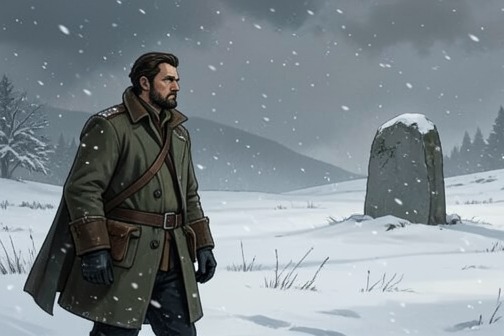
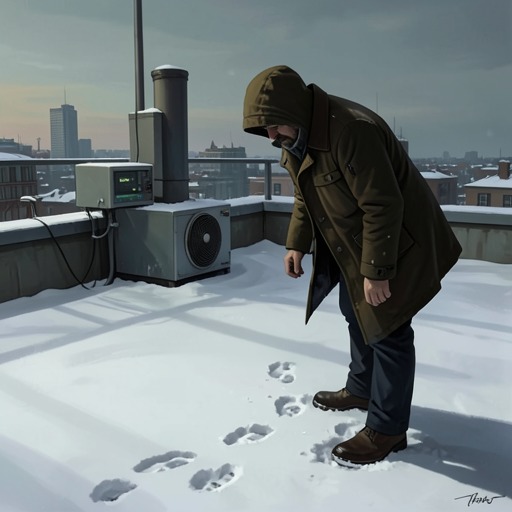
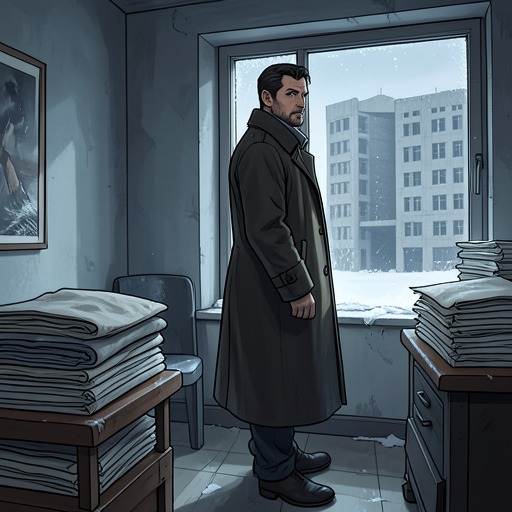
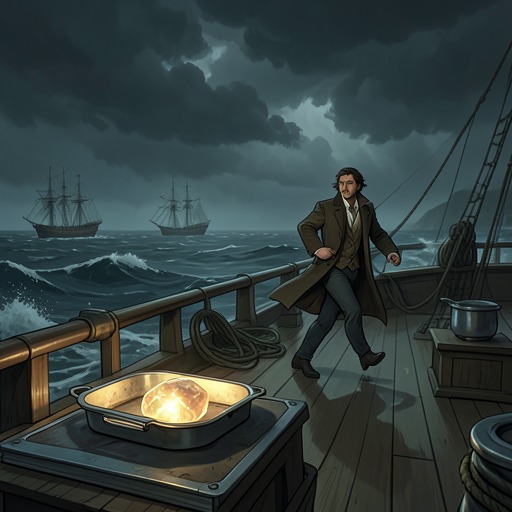
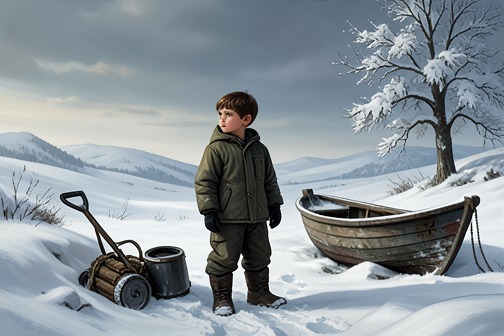
[Isaiah](entity:character-recall-character-isaiah-c3d5f123fd4f)’s fatal fall from a warehouse roof is the apparent accident that sets [Smilla](entity:character-recall-character-smilla-312dea36b0f5)’s investigation in motion. The scene initially offers the familiar outline of a fall, but the evidence in the snow and Isaiah’s profound fear of heights make the circumstances increasingly difficult to accept as self-explanatory; a later discovery of a postmortem muscle biopsy turns the death into a question of what happened before and after it was officially understood.
## Discovery and the Scene
On a December evening, Smilla notices a yellow light at the base of a warehouse near [Knippels Bridge](entity:location-recall-location-knippels-bridge-068e9e2402bb). Snow reflects it sharply. A police car’s blue light revolves by the building, where tape marks off a small dark shape in the snow. Smilla reaches the scene several minutes before the ambulance. Isaiah lies with his legs drawn up, his face in the snow and his hands around his head. The image does not establish what he experienced in his final moments, but it becomes the first, unresolved picture through which Smilla confronts his death.
The roof preserves a route across the snow. Isaiah’s worn basketball shoes leave identifiable prints: he steps out onto the roof, walks diagonally, follows its edge, turns inward, and then runs toward the point from which he fell. The tracks stop at the edge; there are no other footprints on the snowy surface. On the adjoining warehouse, steep glazed tiles offer no foothold. Smilla’s reconstruction therefore establishes that Isaiah approached the edge alone, but it does not explain why he did so.
## The Question of the Fall
The apparent physical cause is given as the fall. When Smilla asks the examiner what Isaiah died of, he answers in those terms; pressed to explain physiologically, he treats the answer as obvious. The gap between a cause stated in the simplest possible form and an account of the circumstances becomes central to the investigation. The fall identifies how the death occurred, not what brought Isaiah to the roof or whether anything happened to him before it.
Smilla points out the contradiction she cannot set aside: Isaiah was terrified of heights. He could manage the stairs to the second floor, but above that he crawled with his eyes closed, gripping the banister. His mother had tried to secure a ground-floor apartment, but, as Smilla notes, her family’s circumstances as Greenlanders dependent on welfare constrained what housing they could obtain. Against that history, Isaiah’s presence on a warehouse roof—and especially his movement toward its edge—demands an explanation. The footprints offer a precise account of his route while leaving its motive unknown.
## Evidence After Death
The most consequential challenge to a routine account emerges during the postmortem examination. The examiner recalls that the police were not present because the death was initially treated as routine. While inspecting Isaiah’s rain pants, he noticed a perforation near the thigh and found a corresponding hole in the tissue. The absence of bleeding and tissue contraction indicated that the puncture had been made after Isaiah’s heart had stopped beating.
A circular indentation around the hole suggested the use of a biopsy instrument. The examiner compared its shape with the mark such an instrument could leave and concluded that someone had probably taken a muscle sample after Isaiah’s death, apparently in haste. This finding changes the meaning of the death scene: the fall remains the stated cause of death, but it cannot account for an intervention made afterward. Isaiah’s body had been examined and sampled in circumstances that the ordinary procedure did not explain.
## Investigation and Significance
The fall is not narrated as a fully solved event. Smilla’s evidence narrows some possibilities—the footprints show no other person crossed the roof’s snow, while the biopsy establishes a separate postmortem act—but neither clue reveals why Isaiah went up or who took the sample. The investigation moves from a visible death to the concealed actions around it, and the apparent simplicity of the fall becomes precisely what requires scrutiny.
That inquiry also unfolds against a disparity in how Isaiah’s life is understood. His fear of heights is not a vague characterization but a practical limit that shaped how he moved through an ordinary apartment building. The difficulty his mother faced in seeking a ground-floor home connects that intimate knowledge to the family’s constrained position in [Denmark](entity:location-recall-location-79f6f9d89c0e). The death thus gathers together a physical puzzle and a social context: official description can name the fall, while the details that make it troubling emerge through Smilla’s knowledge of Isaiah and her attention to evidence others might leave unexplained.
Event 2
1991 Gela Alta expedition disaster
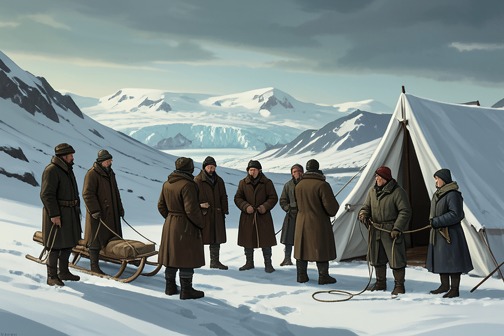
The [1991 Gela Alta expedition disaster](entity:event-recall-event-1991-3b58821cff69) was a fatal accident during a [Cryolite Corporation of Denmark](entity:organization-recall-organization-cryolite-corpora-2b6497c214bc) geological expedition to the Barren Glacier. Its official record lists five dead—one Finn and four Inuit, including [Norsaq Christiansen](entity:character-recall-character-f121880c3ca4)—and documents the effort to recover and transport their bodies. For [Smilla](entity:character-recall-character-smilla-312dea36b0f5), the report is both an apparently ordinary account of a tragic accident and a trace of a deeper connection between the corporation, [Greenland](entity:location-recall-location-greenland-ccdcf7f87d1f) expeditions, and the deaths she is investigating.
## Expedition and official account
The expedition took place from July through August [1991](entity:time-recall-time-1991-aeda6eb6bd7d), with the stated objective of investigating deposits of granular ruby crystals on the Barren Glacier on Gela Alta. The report names five European participants, including Arctic ethnology professor [Andreas Fine Licht](entity:character-recall-character-andreas-fine-licht-5c6a572c5f19), and notes support from the Institute for Arctic Ethnology. The mission’s institutional framing is geological exploration, although the presence of an ethnology institute and a professor of Arctic ethnology places it within a broader research apparatus than the mineral survey alone suggests.
The surviving report is substantial and orderly: twenty closely typed pages describe the expedition, followed by a twenty-page appendix containing mineralogical sample summaries, logs, and black-and-white aerial photographs. The photographs show a glacier splitting and floating around a bright, fractured conical cliff. Smilla finds the document in a black ring binder in the corporation’s archive; the pages and appendices make the disaster legible as an administratively recorded operation, complete with samples, observations, and records of the dead.
## Accident and rescue
The report’s rescue section describes an attempted evacuation from [Holsteinsborg](entity:location-recall-location-9d818dbb2b86) to the Barren Glacier. A helicopter could not land close to the site because its engine noise risked triggering an avalanche. A Cherokee 6-3000 was sent instead and landed on the water with a pilot, navigator, doctor, and nurse aboard. A rescue-team report and a hospital doctor’s certificate accompany the account, which records five fatalities: one Finn and four Inuit, among them Norsaq Christiansen.
The report does not give Smilla a detailed account of how the accident occurred. Elsewhere, she learns that Norsaq died while on an expedition on Greenland’s west coast, in an accident after eating something that made him sick. The two accounts establish the expedition context and his death, but the available explanation remains limited; the narrative does not equate the food-related account with a complete explanation of every death in the five-person toll.
## Records, family, and corporate history
The consequences of Norsaq’s death reach beyond the expedition file. [Juliane Christiansen](entity:character-recall-character-f1496a425fa2)’s papers include a letter from the Cryolite Corporation’s directors granting her a widow’s pension of 9,000 kroner a month, adjusted to the cost-of-living index. Though the letter follows corporate formality, a handwritten note in its margin says, “I am so sorry. Elsa Lübing.” The private apology, written beside an official decision, gives the disaster a human and institutional afterlife: the corporation’s documents preserve not only a benefit awarded to the widow but also a sign of an employee’s personal response.
The expedition records also sit within a company history marked by overlapping public and private authority. Elsa Lübing recalls that the Danish government owned 33.33 percent of Cryolite Corporation shares and was represented on its board. In 1957, the day she became chief accountant, she challenged the company’s six separate cafeterias before Social Welfare Minister Steincke; after several years, only one remained. Yet Lübing also describes limits on access to the books, especially in work involving private-sector partners. The disaster report is therefore part of an archive that can disclose official actions while leaving important parts of corporate activity beyond the view of even its chief accountant.
## Smilla’s investigation and the report’s limits
Smilla finds the 1991 report while searching the corporation’s archives. At first it appears clean and aboveboard: a tragic expedition accident, a rescue operation, five deaths, and a file of letters about transporting the bodies. She cannot see how that record could explain why a boy later fell from a [Copenhagen](entity:location-recall-location-copenhagen-aea5870325a0) rooftop, and briefly wonders whether she has misread the evidence. The report’s significance changes when she returns to the medical section and notices a detail that confirms her instinct to keep investigating. The detail itself is not disclosed in this passage, so the report’s evidentiary force is clear while its decisive medical finding remains outside the account presented here.
Smilla’s reading also takes place against a wider pattern of expedition access and secrecy. She is told that she served as navigator on nine expeditions in twelve years and signed declarations of confidentiality each time, with copies retained by the authorities. That fact does not establish that she took part in the 1991 expedition, but it locates the report within a system in which military-supplied maps, satellite and radar photographs, and meteorological observations accompanied travel in [North Greenland](entity:location-recall-location-516912907573). The archive’s neat paperwork and the expedition’s restricted information coexist: what is recorded can be extensive, while access to the knowledge behind it remains controlled.
## Significance
The disaster links a specific expedition death to the longer institutional history Smilla is trying to read. Norsaq’s name appears in the rescue records and in the widow’s pension letter; the corporation’s official paperwork preserves both the count of the dead and the aftermath borne by a family. At the same time, the report’s apparent completeness proves insufficient. Its technical appendices, rescue documentation, and transport correspondence describe a real tragedy, but they do not settle the questions Smilla brings to the archive.
That tension gives the episode its narrative importance. An accident can be recorded in exhaustive administrative form and still leave crucial matters unexplained. As Smilla moves between the official report, the medical material, and the company’s wider records, Gela Alta becomes not merely the site of a fatal expedition but a point where scientific work, corporate authority, state-supported systems, and personal loss converge.
Event 3
Annie Quavigak's disappearance
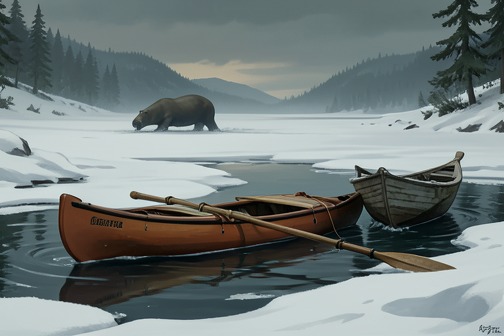
[Annie Quavigak's disappearance](entity:event-recall-event-c2324e1f90a4), recorded as June 12, 1963, is the loss that divides [Smilla](entity:character-recall-character-smilla-312dea36b0f5)’s childhood between a mother who remained present in memory and an absence that was never explained. The evidence says Annie went missing while hunting and was presumed dead; the remains of her kayak prompted the conclusion that a walrus had caused her disappearance, but no direct account of what happened survives.
## The disappearance and its record
In a later summary of Smilla’s personal history, Annie is listed as having been reported missing on June 12, 1963, while hunting, and presumed dead. The record places the loss amid other changes in the family: Smilla’s parents had married in 1956 and divorced in 1958, and after Annie’s death custody was transferred to Smilla’s father, [Moritz](entity:character-recall-character-moritz-a6d7a66c39ab) Jaspersen. Annie’s brother contested that decision, but the [Ministry of Justice](entity:organization-recall-organization-ministry-of-just-1bf803d2860f) denied his challenge in May 1964. The document gives the disappearance an administrative aftermath, yet its concise entries cannot settle the circumstances of the loss.
## The kayak and the suspected cause
The surviving physical clue was the remains of Annie’s kayak. These led people to conclude that a walrus must have been responsible. Smilla’s account explains why that possibility could be taken seriously: walruses are unpredictable, and under particular conditions can become efficient predators. She recalls seeing hunters feed a live-captured walrus a cod, which it stripped from the fish’s bones. This observation supplies context for the hypothesis, not proof of the animal’s involvement; the disappearance remains a presumption rather than a witnessed event.
## Annie’s life and the knowledge she passed on
Smilla remembers Annie as moving across roles that other accounts might keep separate. She cared for the household and children, but also hunted, paddled a kayak, and brought home meat. The novel sets this lived capacity against older records of Greenlandic women hunting as men did, while emphasizing that Annie’s life did not require her to renounce family life or become legible through a single social category. Her particular inheritance is conveyed through practice: when her father began losing his sight, Annie understood that her family’s survival could not depend on inadequate welfare support or relatives already short of resources. When a seal surfaced, she shot it. That remembered episode shows how practical judgment and responsibility shaped the knowledge Smilla associates with her mother.
## Loss in memory and narrative
The account of Annie’s disappearance is interwoven with scenes of hunting and subsistence rather than presented as a complete explanation of her fate. Smilla recalls hunting with others, going without food, catching birds, and then releasing them when she imagines the young waiting in their nests. The episode does not establish a direct connection to Annie’s final hunt; instead, it makes visible how animals, food, and human dependence on the landscape belong to Smilla’s remembered world. The disappearance itself remains unresolved, while the practices through which Annie lived on in memory give that absence a concrete family and cultural context.
## Consequences for the family
The loss altered Smilla’s childhood in material as well as emotional terms. Following Annie’s presumed death, custody passed to Moritz, and Smilla was taken to [Denmark](entity:location-recall-location-79f6f9d89c0e) in September 1963. Smilla remembers her mother as the parent who stayed, set out nets, and braided her hair, while describing Moritz as repeatedly moving between closeness to Annie and distance from her. The contrast does not reveal what caused Annie to disappear, but it shows what her absence left behind: a childhood organized around separation, and a memory of Annie grounded in care, work, and competence. Later, when Moritz invites Smilla to spend Christmas with him, she tells him that Christmas means nothing to her; the exchange underscores the distance that persists in the family after the loss.
Event 4
Operation Niflheim
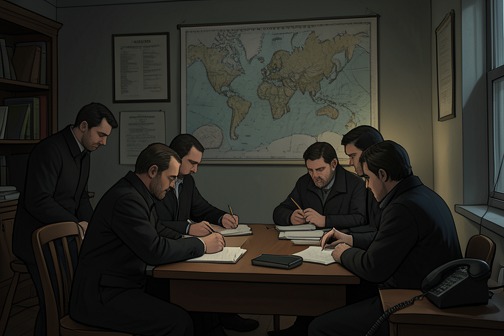
[Operation Niflheim](entity:event-recall-event-operation-niflheim-9e023069a626) was a postwar Allied intelligence operation to decipher a clandestine correspondence network whose letters concerned finding a ship and sailing it to [Greenland](entity:location-recall-location-greenland-ccdcf7f87d1f). Reconstructed by [Benedicte Clahn](entity:character-recall-character-benedicte-clahn-3fd8bfafae46) decades later, it resolves the mechanics of the code while leaving the expedition’s purpose unknown: the route can be read, but the reason for the voyage remains sealed within the past.
## The decoding group in postwar Germany
In [1946](entity:time-recall-time-1946-2eb191e2d998), Clahn was working in [Blankenese](entity:location-recall-location-blankenese-eb112c132a7e), on the [Elbe River](entity:location-recall-location-bb14554166bf), in a mansion taken over by the British. Forty people worked in the house, mostly British and Americans, divided among groups whose tasks were kept separate. Clahn’s small group initially comprised herself, an English mathematician, and a Belgian teacher of choreographic notation systems. They worked on coded letters and telephone conversations, mainly letters. Unlike at an earlier posting in [Rahlstedt](entity:location-recall-location-rahlstedt-d73798fc3e65), where the workers had shared information informally, the Blankenese operation was deliberately compartmentalized.
At first, the assignments appeared unimportant. The group often broke two letters a day, usually love letters. In August, the correspondence changed character: many letters came from the same people, and a German censor named Holtzer joined the group. He had worked for von Gehlen and possessed particular knowledge of the case, though Clahn says she never understood why the British and Americans had taken over parts of the German intelligence apparatus. Holtzer’s presence, and the other workers’ repeated questions about specific phrases, gradually revealed that the letters belonged to a coordinated case rather than an assortment of routine messages.
## Niflheim and the code
One word recurred in the material: Niflheim. Clahn looked it up and found that it meant the world of mists, the outermost region of Hell and the realm of the dead. By late August, investigators had narrowed their attention to letters exchanged by the same four people. The team never saw the envelopes and knew names but not addresses. Eight letters were in hand at first, with roughly two more arriving each week.
The code was at once crude and difficult. It seemed hastily learned, yet did not rest on ordinary language; instead, it used a series of agreed metaphors. On the surface, the correspondence concerned the transport and sale of goods. Johannes [Loyen](entity:character-recall-character-3ce426361dd8) joined the group as a forensic-medicine consultant, having come to Germany to take part in the closure of concentration camps. The letters did not require a medical adviser, but Loyen knew German well and worked on an equal footing with the others. Clahn suspected that he might have been to Greenland, though he never told the group.
The breakthrough came at the end of September. A letter gave a supposed forecast of bean prices for the current week: the figures rose slightly each day and reached a peak on Friday. Clahn consulted an almanac her mother had sent her and noticed that Friday was a full-moon night. Having sailed the English Channel in her father’s Colin Archer boat, she thought the numbers resembled tide tables. The group checked the British fleet’s large almanacs and identified the figures as the ebb and flow of the Elbe. Once that key was found, the team spent three weeks working backward through the letters.
## What the letters disclosed—and withheld
The decoded correspondence was about finding a ship and sailing it to Greenland. The operational details included negotiations to obtain a vessel during a state of emergency, the possibility of sailing to [Kiel](entity:location-recall-location-7b7735cfe1f3) and then north through Danish waters, which passages had been swept for mines, and the British blockade of the Elbe and the [Kiel Canal](entity:location-recall-location-695f4ac4abed). These particulars make the letters a practical record of passage through a restricted and dangerous postwar maritime landscape, not merely a coded statement of destination.
But the correspondence did not disclose why the voyage was being organized. When asked what the operation was for, Clahn could offer no answer; she did not think the others knew either. The writers themselves understood the purpose, which was precisely why they never named it. The decoded text therefore supplies a concrete itinerary and a continuing absence at its center: the ship and route can be inferred, while the intended object of the expedition stays unspoken.
## The later return to the letters
In [1966](entity:time-recall-time-1966-6e0ec857e681), Loyen worked for a company organizing a Greenland trip and asked Clahn to meet with him to reconstruct information from the 1946 letters. Their effort focused mainly on route descriptions and included a great deal about anchoring conditions, but they were unsuccessful despite spending substantial time on it. Clahn remembered that she may even have received a fee. The later attempt shows that the decoded correspondence retained practical value, but that its recovered details were not enough to restore a usable route with certainty.
Clahn is asked whether the letters were revisited again in 1990 or [1991](entity:time-recall-time-1991-aeda6eb6bd7d), but the conversation does not establish that they were. Her recollection instead leaves Operation Niflheim suspended between a solved cipher and an unsolved history. The episode’s retrospective form preserves both kinds of knowledge: the reader learns how the code yielded to tides and almanacs, yet shares Clahn’s limits about the mission’s purpose. Its central mystery is not a failure to decode the words but the silence the decoded words still contain.
Event 5
1966 Gela Alta expedition
The [1966 Gela Alta expedition](entity:event-recall-event-1966-1c7b9e3e65ab) is the shadow behind the later voyage to the same remote stretch of [Greenland](entity:location-recall-location-greenland-ccdcf7f87d1f)’s west coast: an expedition entered in the Cryolite Corporation’s accounts, marked by an unexplained payment and an explosives accident that killed two of its eight participants. [Smilla](entity:character-recall-character-smilla-312dea36b0f5) connects it to the [1991](entity:time-recall-time-1991-aeda6eb6bd7d) expedition through the books, then follows the money toward the possibility that both voyages concealed the chartering of ships to move something very heavy back to [Denmark](entity:location-recall-location-79f6f9d89c0e). The earlier expedition matters not because its full purpose is disclosed, but because its financial trace and fatal precedent make the later operation look less like an isolated venture than part of a repeated, concealed undertaking.
## The accounting trail
The expedition enters the investigation through Elsa Lübing, who recalls balancing the corporation’s semiannual accounts on [January 7, 1967](entity:time-recall-time-january-7-1967-f0d0da0aa334). A 115,000-kroner entry had not been itemized, and the file card that should have documented it was missing. The amount was large, but the corporation’s sales volume was about 50 million kroner, making it unlikely to draw notice from the board. For Elsa, who handled the daily accounts and believed in precise bookkeeping, the missing detail was intolerable. Her director told her he had authorized the entry and that the auditor considered the listing acceptable; Elsa returned to her desk and entered the figures as instructed. She later understood that compliance had made her an accomplice to something she did not understand.
The institutional setting helps explain how an irregularity could remain hidden. The corporation’s shares were dispersed among heirs of the eight partners who had acquired the original mineral rights, making it impossible to assemble all shareholders for a general meeting. The director consequently wielded exceptional influence over decisions concerning Greenland’s most economically significant mineral rights. Auditors also had reason to avoid challenging the company: it was a major customer, and the corporation’s auditor from [the 1960s](entity:time-recall-time-the-1960s-eedf096fa548) later became the director’s colleague in legal practice. The 115,000-kroner entry thus appears not as an isolated bookkeeping puzzle, but as a payment inside a structure where fragmented ownership, commercial dependence, and overlapping professional roles weakened scrutiny.
Decades later, Elsa’s attempt to settle the old account brings the [1966](entity:time-recall-time-1966-6e0ec857e681) books into contact with the records of the 1991 expedition. In 1992, three weeks before her retirement, she insisted on balancing the books herself. On January 7—exactly twenty-five years after the earlier accounting—she compared the expedition accounts item by item. The later expedition had been financed through the Scientific Commission, so the ledgers were not identical, but comparison was still possible. Its largest entry was 450,000 kroner. Elsa called the commission to request an itemization; she was later reprimanded in a letter for going over her superiors’ heads. By then, however, the telephone conversation had already supplied the answer: the money had paid to charter a ship.
## Accident and recurrence
Elsa discloses that the earlier expedition also suffered an accident: explosives went off, killing two of its eight participants. The account supplies no names for the dead or further description of the blast, and the accident’s precise circumstances remain outside the available evidence. Its placement beside the ledger discrepancy nevertheless gives it weight. The earlier journey was not merely a precedent in the books; it had already cost lives.
Smilla recognizes the connection between the two voyages before Elsa spells out the full pattern. When Elsa offers to show where the amount appears, Smilla guesses that it is in the accounts for the corporation’s geological expedition to the Barren Glacier on Gela Alta, off Greenland’s west coast, in the summer of 1966. Her basis is documentary: the 1991 report refers to an earlier expedition. Elsa confirms the accident, turning Smilla’s inference into a link between the two expeditions. The discovery is incremental rather than complete: a reference in one report leads to an old ledger, and the ledger leads to a fatal episode that makes the repetition harder to dismiss.
Elsa ultimately advances a hypothesis, not a proven account of the 1966 voyage. She believes that the 115,000 kroner was used to charter a ship and that someone, under the Cryolite Corporation’s name, sent two expeditions to Greenland’s west coast. After forty-five years with the company, she can think of only one explanation for the charter: the passengers or organizers meant to bring something back to Denmark, and it was so heavy that transport required a ship. Her inference gives the old expenditure a possible physical purpose, but the object itself remains unidentified.
## From ledgers to ships
The practical difficulty of hiding a charter clarifies why a payment for shipping matters. A ship’s main contract specifies its destination and cargo; an undisclosed destination or unspecified freight can be handled through a confidential side contract, while a private bonus may secure the shipping company’s discretion. In [Birgo Lander](entity:character-recall-character-birgo-lander-83dfbe8955dc)’s explanation, such side contracts can conceal unlawful cargoes and are kept out of the public-facing paperwork. The arrangement offers a mechanism by which an expedition funded through corporate accounts could mask what a ship was really carrying, without establishing that any particular cargo was transported in 1966.
A ship bound for Greenland also leaves technical and administrative traces. It must be ice-classed, and Danish maritime authorities inspect hulls, safety equipment, and engines on regular schedules. When Smilla and Lander test the name [Kronos](entity:object-recall-object-kronos-1c2f054f5a54) against Lloyd’s Register, they find five ships: a chemical tanker, a sand dredger, a tugboat, and two general-cargo vessels, one in Piraeus and one in Panama. Smilla identifies the last two as the relevant possibilities. The process turns Elsa’s broad inference into a traceable shipping question: a vessel can be hidden behind discreet contracting, but its classification and registry narrow the field.
The later narrative gives the search a physical dimension. During a timed cargo-drop test aboard the Kronos, the crew lowers a container into the water, where it lies about fifteen feet from the stern, held by a blue hawser and kept clear of the hull. The procedure demonstrates a means of handling heavy cargo at sea; it does not by itself identify the 1966 cargo or prove that the earlier expedition used the same technique. Elsewhere, the Kronos’s chart shows a route north along [South Greenland](entity:location-recall-location-5eded7ae6316)’s coast, around [Cape Thorvaldsen](entity:location-recall-location-9c839e7a8924), and then northwest toward a point near [Vestland](entity:location-recall-location-vestland-d491400f3fa9) in the open ocean. These later operational details make Elsa’s concern with chartering and weight legible within the novel’s larger maritime investigation, while leaving the exact relation between this route and the 1966 expedition unconfirmed.
## Concealment, space, and significance
The expedition’s significance is amplified by the novel’s contrast between lived knowledge of Greenland and the systems that render it available to outside institutions. Smilla describes her ability to read landscapes through maps as a form of learning a new alphabet: topographical elevations, military ice charts, radar photographs, satellite scans, geological sediment maps, and thermal imagery all become ways of reading the text of ice. At the Cryolite Corporation grounds, a map, aerial photograph, and floor plan allow her to reconstruct a place now reduced to a dark demolition site with snowdrifts. The expedition is likewise reconstructed through documents and routes, but those records do not transparently disclose what the corporation’s money supported.
That gap between a mapped destination and an understood place reflects a broader conflict in the book. Smilla argues that another culture cannot be understood through rankings imposed by European science; understanding requires living within a culture, asking to be received as a guest, and learning its language. Her childhood knowledge of Greenland is made concrete through practices rather than abstractions: her mother hunted and paddled a kayak as well as performed work conventionally assigned to women; as a girl, Smilla joined a hunt and later caught birds with a large net after the hunters had gone twenty-four hours without eating. Such experience contrasts with the company’s view of Greenland as mineral rights, expedition expenses, and a destination to be entered on a contract.
The expedition’s geography also belongs to a story about movement and confinement. Smilla recalls the Greenlandic hell not as a European infernal landscape but as a locked room, and associates childhood with being outdoors and her mother’s refusal to remain long in one place. Against that spatial freedom, concealed charters and corporate expeditions represent a different kind of movement: organized, financed, and directed toward transporting an unknown weight out of Greenland, with decisions made through channels ordinary auditors cannot see. The 1966 voyage remains incomplete as a historical reconstruction, but its unitemized payment, missing file card, two deaths, and suspected ship charter form a compact pattern of secrecy and consequence. By making that pattern recur in the 1991 accounts, the novel turns an old expedition from background history into evidence that the present investigation may be following a long-running operation.
Event 6
1991 Gela Alta expedition
The [1991 Gela Alta expedition](entity:event-recall-event-1991-47e6aa2b3964) is a failed, clandestine mission to [Greenland](entity:location-recall-location-greenland-ccdcf7f87d1f) whose official financial trail conceals the scale and purpose of its transport arrangements. Its reconstruction drives [Smilla](entity:character-recall-character-smilla-312dea36b0f5)’s investigation: a retired accountant’s comparison of old and new ledgers points to a chartered ship, while evidence from the earlier expedition, the [1991](entity:time-recall-time-1991-aeda6eb6bd7d) deaths, and a laboratory aboard the [Kronos](entity:object-recall-object-kronos-1c2f054f5a54) gradually links the two attempts. The expedition matters not only as an episode of covert resource-seeking, but as a chain in which accounting, forensic examination, and scientific instruments each disclose part of a story that its participants have tried to control.
## Financing and the charter
In 1992, three weeks before her retirement, Elsa Lübing insisted on balancing the books herself rather than leaving the task to the office manager. She had kept manual accounts even after the corporation computerized its records in 1977. On January 7, exactly twenty-five years after an earlier event she had mentioned, she compared the 1991 expedition’s accounts with those from the earlier Gela Alta expedition. The comparison was difficult because the newer expedition had been financed through the Scientific Commission, but the entries could still be examined side by side. The largest 1991 item was 450,000 kroner, and Elsa called the commission to request its itemization.
The answer she received by telephone was that the 450,000 kroner had paid to charter a ship. A later letter reprimanded her for going over her immediate superiors’ heads with the inquiry, but the warning came after the payment’s purpose had been disclosed. Elsa found the expense striking: the charter had transported eight men to Greenland’s west coast to collect a few kilograms of sample gemstones, whereas the [Greenland Trading Company](entity:organization-recall-organization-greenland-tradin-6a5cf6e8c9ca)’s Disko was regularly chartered to carry cryolite. In her view, a separate ship for so small an expedition was unthinkable. The accounts thus supplied a concrete clue, but not an explanation of what the expedition intended to find or whether the chartered vessel returned with it.
When Smilla asks whether the coaster sailed back with what it had gone to retrieve, Elsa cannot establish that it did. After the accident, the survivors and their equipment were flown to [Godthåb](entity:location-recall-location-godth-b-7bc7ea4302c5) and then home; she knows this because the accounting department paid for freight and plane tickets. The ledgers can account for expenditure and evacuation, but they cannot confirm the fate of the expedition’s intended samples. Their evidentiary value is therefore both powerful and limited: a cost entry exposes the ship charter, while the same administrative record leaves the central question unresolved.
## Two expeditions and a second failure
Smilla later reconstructs the expedition as a renewed attempt to pursue something believed to be in Greenland. In her account, [Loyen](entity:character-recall-character-3ce426361dd8) knew of something worth finding, while [Ving](entity:character-recall-character-1b97ae0b08ef) could provide an organizational cover through the Cryolite Corporation, of which he was director and, as Smilla understands it, real leader. [Andreas Licht](entity:character-recall-character-andreas-licht-a781165f866c) is associated with the plan because he knew conditions in Greenland. Smilla places the first attempt in [1966](entity:time-recall-time-1966-6e0ec857e681), under the corporation’s guise, and thinks that an accident involving explosives may have caused it to fail. The group then waited twenty-five years before trying again.
The second venture was different in its financing: outside money paid for transportation, suggesting that the operation had acquired help or formed an alliance. Yet it, too, went wrong. Four men died, including [Isaiah](entity:character-recall-character-isaiah-c3d5f123fd4f)’s father. Smilla’s reconstruction is explicitly tentative about the earlier disaster’s precise cause, but it draws a clear connection between the 1966 failure and the 1991 return to Gela Alta. The expedition’s history is not a straightforward sequence of discoveries; it is an attempted recovery repeated after a quarter-century, under altered financial arrangements, and ending in another catastrophe.
The evidence from the earlier expedition also complicates the notion that the 1991 disaster was an isolated accident. Looking at old X-ray negatives with [Lagermann](entity:character-recall-character-lagermann-2f240901a01f), Smilla sees that one preserves almost the entire spine, while another is reduced to fragments and shadows. Lagermann notes that the body positions seem to place the men directly above the explosive charge, rather than above a bored channel or a shaped charge of the sort professionals would ordinarily use on rock or ice. His observation does not establish who caused the explosion or why, but it raises technical questions about how the earlier deaths occurred. The X-rays turn a record once used to identify severely damaged bodies into a basis for reconsidering the circumstances of the expedition.
## The traces left by the mission
The 1991 deaths likewise leave evidence that changes the meaning of routine procedure. In the postmortem examination of Isaiah, the forensic examiner describes a small perforation in the boy’s rain pants and a corresponding hole in the tissue near his thigh. There is no bleeding or tissue contraction at the site, indicating that the injury occurred after his heart had stopped. The examiner then tests the mark against a biopsy needle and finds that its circumference could have been produced by someone thrusting the instrument into the tissue. The finding makes the timing of the sampling crucial: the wound was not simply an injury sustained during the fatal fall, but evidence of an intervention after death. It connects the investigation of the 1991 expedition’s casualties to the taking of a biological sample, without by itself identifying the person responsible or the sample’s destination.
Aboard the Kronos, Smilla finds another kind of trace: a concealed laboratory whose apparatus and live specimens make the ship’s scientific activity materially visible. Behind an interior door, rows of small, sealed aquariums are lit by individual lamps; nearby are sinks, burners, an autoclave, a scale, a pH meter, a camera, and a microscope. Drawers contain pipettes, slides, chemicals, and other laboratory supplies. The room is not an ordinary passenger space, and its scale and equipment make it difficult to reconcile with the captain’s earlier description of Smilla’s presence as merely employment as a cabin attendant. The ship’s hidden research setting extends the expedition’s story beyond its ledger and its dead: the voyage has brought scientific infrastructure into the Arctic, while the reasons for its secrecy remain part of Smilla’s inquiry.
At Gela Alta, the remains of an older laboratory further connect the two expeditions. In a room where a barrel of burning wooden crates provides the fire, Smilla sees instruments under a layer of gray ice: chromatographs, microscopes, crystallization jars, an incubator, and an unfamiliar glass-fronted plastic apparatus. [Tørk](entity:character-recall-character-t-rk-f2bda9f6e150) identifies that apparatus as electrophoresis, used to separate and analyze proteins, and says Loyen brought it in 1966, when the team still believed it was dealing with a form of organic life. The equipment’s apparent age and the possibility that it was left behind in either 1966 or 1991 make the room a material record of repeated research. In particular, the electrophoresis apparatus points to an earlier scientific question about the nature of the suspected life, before the later expedition renewed the effort to reach Gela Alta.
## Records, authority, and the meaning of the find
The expedition’s evidence reaches Smilla through institutions that each preserve a different fragment: Elsa’s handwritten accounts disclose a large transport expense; the postmortem examination establishes that sampling followed Isaiah’s death; X-rays invite a technical reappraisal of the earlier explosion; and the laboratories preserve the instruments used to investigate possible organic life. None of these records alone gives a complete account. Their force comes from comparison, and their gaps matter as much as their disclosures: Elsa can prove how the survivors and equipment returned but cannot say whether the coaster brought back its intended cargo, while forensic and laboratory evidence establishes practices and questions without settling every actor’s intent.
The expedition’s scientific object is finally entangled with belief and public interpretation. Tørk argues that the stone’s actual nature is less consequential than what people will believe about it. He invokes the expectation that it may represent a link between inorganic matter, life, and higher organisms, and anticipates that journalists will attach the [Arctic worm](entity:creature-recall-creature-arctic-worm-d76874fc5a70) to speculative accounts of the stone. In his formulation, fear and hope unleashed by the find will matter more than the stone’s underlying reality. This claim does not resolve the expedition’s history; it shows how the search can produce competing versions of significance, in which financial secrecy and scientific instruments establish a physical trail while anticipation supplies the find with meanings that exceed what the evidence alone can prove.
Event 7
Isaiah's death
[Isaiah](entity:character-recall-character-isaiah-c3d5f123fd4f)’s death is both the unsolved crime that propels [Smilla](entity:character-recall-character-smilla-312dea36b0f5)’s investigation and the break that sets her temporarily in motion. As she follows evidence of a postmortem biopsy and a covert expedition, the death expands from a personal loss into a point of entry into institutional secrecy. Yet the narrative repeatedly returns to the boy himself: his attentiveness, his restraint, and the practical conditions of his childhood resist being reduced to a clue in someone else’s scheme.
## Background and the boy’s world
The novel places Isaiah’s life within a history and culture that Smilla approaches through lived experience rather than abstract explanation. She recalls an Inuit account, told by Aisivak to Knud Rasmussen, of a world first inhabited by two sorcerers who wanted children; one transformed his body so he could give birth, and together they created many children. The account sits alongside records of Greenlandic women who hunted as men did, and a social understanding in which a person could contain the potential to become the opposite sex. These are not details about the circumstances of Isaiah’s death, but they establish the cultural frame through which Smilla understands family, identity, and forms of life that outsiders may misread.
Smilla’s memories of her mother make that frame concrete. Her mother lived in ways conventionally associated with both women and men: she gave birth and cleaned skins, but also shot, paddled a kayak, and brought home meat. When her grandfather’s failing eyesight made him unable to hunt, the family’s future narrowed to inadequate welfare, dependence on relatives, or hunger. Her mother stayed behind on the ice and shot the seal herself. Smilla’s account of survival thus begins not with an institution’s description of [Greenland](entity:location-recall-location-greenland-ccdcf7f87d1f) but with the work required to keep a family alive.
That inheritance informs the contrast between childhood in Greenland and life in [Denmark](entity:location-recall-location-79f6f9d89c0e). Smilla remembers her childhood as a life rarely spent indoors, and regards spatial freedom as something she protects with extraordinary intensity. She describes the locked room, rather than a European landscape of punishment, as the Greenlandic hell. In her understanding, Isaiah’s death is not separate from the larger pressures surrounding his life: the investigation unfolds in a society where freedom of movement, cultural knowledge, and control over Greenlandic affairs are all at stake.
## Isaiah in Smilla’s memories
Smilla remembers Isaiah as a child who did not readily announce his needs. When he came home to find no food, he did not complain or quarrel with his mother. He withdrew quietly and looked for another solution. Sometimes he went to [the mechanic](entity:character-recall-character-95fd5bb0bce6); sometimes he went to Smilla. He could sit in her living room for a long time without saying that he was hungry, maintaining what she sees as an extreme Greenlandic politeness even when he needed help.
When Smilla did cook for him, he preferred to eat on the floor. She would place a whole mackerel, weighing three pounds, on newspaper, and he would eat it methodically, using both hands. The particularity of this remembered meal matters: Isaiah is not rendered as a symbol alone, but as a child with a preference, a manner of eating, and a way of accepting care without asking for it. Smilla’s effort to understand the difference between growing up in Greenland and growing up in Denmark is bound to these ordinary encounters, as well as to her recognition that the urge to explain another person can itself obscure the experience she wants to grasp.
His relationship with [the Baron](entity:character-recall-character-20eec8c1d6d2) offers another measure of his need for continuity. The Baron remembered him and, after time apart, would stop playing, come over, walk with him for a while, and accompany him to the door. These small gestures reassured Isaiah that he had not been forgotten. Smilla recognizes that words do little to relieve grief; the remembered routine gives their loss a shape that abstract statements about death cannot.
## The death and the investigation
The evidence eventually directs Smilla toward a postmortem act that changes her understanding of the case. [Lagermann](entity:character-recall-character-lagermann-2f240901a01f) reports that Johannes [Loyen](entity:character-recall-character-3ce426361dd8) went into the relevant place early that morning, had no other reason to be there, and took a biopsy from Isaiah’s body. The security guard had seen him, and the timing of the cleaning staff’s presence may explain why Loyen was careless. The biopsy makes the boy’s body part of the investigation: what happened after his death becomes evidence of a further, concealed interest in him.
Asked how Loyen knew Isaiah was dead, Lagermann does not provide a settled answer. The mechanic supplies a possible chain: [Juliane](entity:character-recall-character-juliane-1fd6dabd02f1) called [David Ving](entity:character-recall-character-david-ving-34953bff0d9b), and [Ving](entity:character-recall-character-1b97ae0b08ef) must have called Loyen. The exchange offers a route by which news could have reached Loyen, but it remains an inference rather than a fully established account. The distinction matters because Smilla’s pursuit depends on separating what the evidence shows from what it merely suggests.
Smilla tells the mechanic the story in detail, including Isaiah’s death, the police, the [Cryolite Corporation of Denmark](entity:organization-recall-organization-cryolite-corpora-2b6497c214bc), the [Arctic Museum](entity:organization-recall-organization-arctic-museum-cb74f6cc2877), [Andreas Licht](entity:character-recall-character-andreas-licht-a781165f866c), and the mechanic’s own place in the events. Her disclosure turns private investigation into shared knowledge. The case no longer belongs only to her, although telling it does not resolve every uncertainty or restore Isaiah.
## From private loss to conspiracy
As Smilla assembles the history behind the death, she traces a pattern of failed expeditions and renewed attempts. In her reconstruction, Johannes Loyen knew of something worth finding in Greenland; David Ving could use the Cryolite Corporation as a cover, since he directed it and was its real leader; and Andreas Licht was familiar with conditions in Greenland. Under the corporation’s guise, an expedition was organized in [1966](entity:time-recall-time-1966-6e0ec857e681) and failed, perhaps after an accident involving explosives. Twenty-five years later, the effort resumed, this time with outside money paying for transportation and with some form of assistance or alliance. That second attempt also went wrong, and four men died, including Isaiah’s father.
This reconstruction gives the death a larger setting without proving that every element of the expedition history directly explains it. Isaiah’s death leads Smilla toward a network in which corporate authority, scientific knowledge, and access to Greenland could be used for concealed ends. The postmortem biopsy is especially consequential because it links the immediate case to an interest that persisted after the boy was dead. What began as a question about one child’s fall becomes part of a history of expeditions, failed plans, and deaths whose circumstances have not been openly accounted for.
Smilla also recognizes the limits of the explanation she can give. She believes another culture can be understood only by living within it, asking to be tolerated as a guest, and learning its language; even then, understanding may remain wordless. When she speaks about [Qaanaaq](entity:location-recall-location-qaanaaq-e0a8341f5929), she risks losing the very experience she is trying to describe. This tension runs through her investigation: she needs explanation to uncover what was done to Isaiah, but she distrusts explanations that turn a lived world into an object judged by outside standards.
## Consequence and narrative significance
At two in the morning, crossing [Copenhagen Harbor](entity:location-recall-location-copenhagen-harbor-6b16e84453dc) on the ice, Smilla reflects on what has happened since Isaiah’s death. Denmark appears to her as a drifting spit of ice, holding people in a fixed relation to one another. The death is the irregularity that opens a fissure in that arrangement. For a brief time, she feels herself set in motion, a foreign body skating over the ice. The image makes the consequence of the loss both political and personal: the investigation loosens her from the position in which she had been held, even as it cannot undo the death that began it.
The narrative does not treat that release as a simple resolution. Smilla’s movement across the harbor is temporary, and the evidence catalogued around Isaiah’s death leaves open questions about how Loyen learned of it and how the larger expedition schemes connect to the boy. Instead, the death functions as a rupture through which the novel brings intimate memory and institutional power into contact. The boy remembered for waiting, watching, and seeking food without complaint becomes the center of a pursuit that exposes how little the official account can contain—and how costly it is to mistake a person’s life for a case to be explained.
Event 8
Andreas Fine Licht's murder
[Andreas Fine Licht](entity:character-recall-character-andreas-fine-licht-5c6a572c5f19)’s murder transforms a visit to a museum office into evidence of a calculated killing. [Smilla](entity:character-recall-character-smilla-312dea36b0f5) finds the professor and curator dead, his hands bound with copper wire and cotton in both ears; a later forensic account explains that his killers exploited his blindness by targeting his hearing, then used an electrical cord to kill him. The gap between discovery and reconstruction makes the scene a turning point: what first appears as a silent, sealed room becomes proof of deliberate torture and an unresolved search for what the perpetrators wanted.
## Discovery in the Museum Office
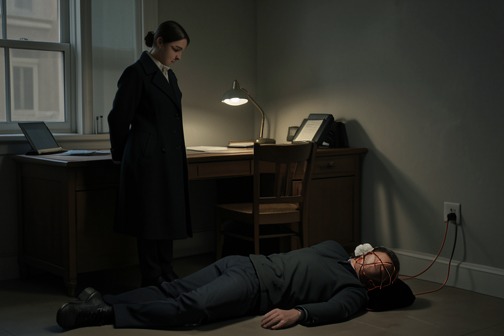
A little reading lamp is on the desk when Smilla enters the office. Andreas Fine Licht sits behind it, smiling broadly, his head cocked. He grips the chair as though he needs it to remain upright. Up close, Smilla sees that his hands are not holding the seat: thin copper wire binds them. He is warm, but she can feel no pulse or heartbeat.
Cotton plugs both ears. Smilla initially has no explanation for them. She has ceased to be curious and wants to leave, but the hatch over the stairs closes without warning and is locked from outside. Then the light goes out. Only in darkness does she realize why the room had seemed so dim: Fine Licht was blind and had no need for light. The discovery arrives amid her own confinement, and the silent closing of the hatch leaves the murder scene inseparable from the threat to her.
## Reconstruction of the Killing
A doctor later reconstructs the attack from Fine Licht’s condition. The killers first restrained him with pieces of copper wire; he fought, and the doctor infers that more than one person was involved. They knew he was blind, although the doctor says this was not information he himself had at the time. They therefore focused on his hearing, his remaining vulnerable sense.
The account links the cotton in Fine Licht’s ears to the method of killing. The doctor says he inferred its use from small burns found during the examination: the perpetrators may have moistened cotton with caustic lye, split an electrical cord, placed one pole in each ear, and switched on the current. Fine Licht was already dead when Smilla boarded the ship, and the cotton was gone by the time his body was recovered. The doctor’s explanation turns the plugs from an unexplained detail into forensic evidence of a killing designed around the victim’s blindness.
## Motive and Narrative Significance
The reconstruction identifies the method but not the purpose. The doctor wonders what the killers were trying to obtain, while Smilla recalls that Fine Licht had already sounded broken when she spoke with him by telephone. His murder is therefore more than a discovery that prompts a forensic explanation: it exposes a purposeful, organized act of violence whose immediate objective remains unknown. The doctor’s account emphasizes that torture is legally distinguished by its connection to an organization, but he does not identify the people responsible or establish what they wanted. That gap keeps the killing tied to the investigation’s unanswered questions rather than closing it with a complete solution.
The scene also turns on a stark contrast between blindness and the room’s light. Smilla notices the dimness only after the hatch is locked and the office goes dark; then she understands that Fine Licht, who could not see, had no use for the lamp. The detail that first seemed incidental becomes part of the murder’s meaning: the perpetrators knew his disability and used it to choose the sense they attacked. His blindness is not a clue to a hidden motive, but it makes the calculated adaptation of the killing legible.
## What the Scene Leaves Unresolved
The evidence establishes a planned killing but does not disclose its purpose or identify its perpetrators. The doctor infers that several people restrained Fine Licht, and concludes that his captors knew of his blindness, though he had learned this only later from the medical records. He describes the attack as torture and notes that the legal definition requires an organization to carry it out; neither that observation nor the forensic reconstruction proves who was responsible. His central question remains what the killers wanted from Fine Licht.
That unanswered question gives the murder its continuing force in the investigation. The plugs in Fine Licht’s ears, first encountered as an inexplicable detail in a dim office, become evidence of how the killing was adapted to his particular vulnerability. Yet the explanation clarifies the method without resolving the motive. Smilla’s memory of Fine Licht sounding broken during their telephone conversation suggests that the violence had already begun before she found him, while leaving what had been demanded of him unknown.
## Significance and Limits of the Evidence
Fine Licht’s murder is presented through two stages of recognition: Smilla first discovers a body whose bound hands and cotton-filled ears make the room’s apparent stillness deceptive; the doctor later reconstructs the attack from those details and the small burns found during examination. The scene’s darkness also acquires meaning only after the hatch has been shut and locked: Smilla realizes that the professor’s blindness explains why the office had been so dimly lit. The shift from unexplained particulars to a forensic account makes the murder legible as an attack tailored to its victim, while leaving its larger purpose obscure.
The doctor’s reconstruction supports the conclusion that Fine Licht was tortured by more than one assailant, but it does not identify them or establish what they sought. His explanation of the legal definition of torture—that it must be carried out by an organization—frames the violence without proving who organized it. The question of what the perpetrators wanted therefore remains open. Fine Licht’s murder changes the investigation by exposing the deliberate character of the violence, not by supplying a complete account of its motive or responsibility.
Event 9
Arson and sinking of the Northern Light
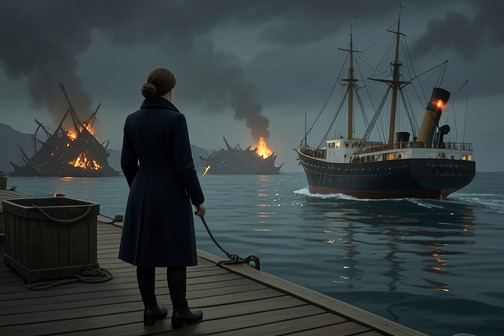
The arson and sinking of the [Northern Light](entity:object-recall-object-northern-light-5506acec51b5) is the violent turning point that converts [Smilla](entity:character-recall-character-smilla-312dea36b0f5)’s confinement aboard the ship into a desperate escape across the harbor. As the vessel is already moving away from the wharf, a firecracker signals an attack: gasoline catches fire, the diesel tank explodes, and the ship begins to break apart and sink. Smilla jumps into the water and, nearly overcome by cold and exhaustion, reaches the dock beside the burning wreck. The scene makes survival depend on a narrow interval between two lethal spaces: the ship engulfed in fire and the harbor’s freezing water.
## The Ship Begins to Move
The attack unfolds while Smilla is trapped aboard. The engine starts and idles, then the ship slowly swings away from its berth; from a bedroom with portholes facing the dock, she sees the wharf receding into darkness. The movement leaves her alone on a vessel whose engine is running and whose course is no longer under her control. The ship’s motion, at first a sound and a shifting outline, becomes the condition that makes escape harder.
A small spark appears on the dock. It rises and arcs toward Smilla, trailing embers; she recognizes it as a firecracker just before it bursts above her head. The flash blinds her. At the same instant, the fire draws the oxygen from the air, and she throws herself to the floor. Gasoline has been poured over the ship. The assault is not a single blast but an attack that surrounds her: the flash, the depleted air, and the fire close in while the vessel continues to move.
## Fire Takes the Vessel
The fire illuminates the room through the skylights after their covering burns away. Muffled explosions sound on deck, and the light flickers blue, then yellow, before the air fills with the smell of burning epoxy paint. In the bedroom, smoke begins to seep inside. Through the portholes, the fire’s reflections make the soybean-factory silo appear lit by sunset and the windows along [Iceland Wharf](entity:location-recall-location-iceland-wharf-9b7defe6ebb4) glow like molten glass. The heat and spectacle do not offer a way out; they show how fully the blaze has taken hold around her.
The diesel tank then blows up. The narrator describes not a conventional explosion but a whistle swelling into a roar. The blast tears away the bed and the wall adjoining the engine room, exposing the engine amid its network of pipes. It breaks free and sinks into the sea, where it causes explosive boiling; burning diesel spreads across the water in tongues of flame. What should be a route of escape is also part of the fire.
The stern turns into an open gateway facing Iceland Wharf, and the whole ship slowly rotates away from the burning oil. Yet the wreck is already listing. Water enters the hull and pulls it backward until Smilla is standing knee-deep in it. The ship’s changing position and flooding turn its interior into a shrinking, unstable refuge. The professor comes through the door after his office chair rolls across the careening room; he slams into a bulkhead, rides through what had been his bedroom, and plunges into the water. His appearance marks the wreck’s collapse as an immediate physical danger, not merely a view outside the portholes.
## The Jump into the Harbor
Smilla strips off her clothes before making the crossing. The flare from the diesel engine has burned away the fur on her hat and singed the top of her head; she feels blood on her hands. The dock at [Svajer Wharf](entity:location-recall-location-svajer-wharf-472a02e5b1a6) is perhaps two hundred yards away, but the fire blocks the other side. She has no choice but to jump into the water.
The cold forces her eyes open underwater. Firelight makes everything gleam green and red, but she does not look back. She knows that a person in water below 42°F can survive only a few minutes, with the time depending on physical condition; she considers herself in poor shape. Her body’s response becomes a clock. She describes the shaking that begins as body temperature falls from 98.6° to 95°F, then stops as it drops toward the critical 86°F, when apathy sets in. The knowledge does not make the swim safer; it gives precise terms to the process that may kill her.
After a hundred yards, she can no longer straighten her arms. Thinking of the past does not help, and thinking of [Isaiah](entity:character-recall-character-isaiah-c3d5f123fd4f) does not help either. She feels as if she is standing on a slope, leaning into a stiff wind, and might as well give up. The scene narrows survival to an effort that cannot be sustained by memory or reflection. What carries her forward is the thought that the attackers may believe they have killed her, and that they consider her a fake Greenlander. She decides to take ten more strokes. On the eighth, she strikes her head against a tractor tire hanging as a bumper beside the berth of the Northern Light.
## Survival and the Burning Wreck
With only seconds of consciousness left, Smilla pulls herself onto a platform above the water. In [Greenland](entity:location-recall-location-greenland-ccdcf7f87d1f), a person who has fallen into the sea runs on getting out to avoid freezing; here the air seems wonderfully mild. She realizes the warmth comes from the fire. On the platform she sees the Northern Light in the harbor entrance, a black skeleton of wood inside a white ball of flame. The warmth that lets her remain on the dock comes from the same blaze that has destroyed her refuge.
She crawls up the stairs on her hands and knees. The dock is deserted, and she is close to collapse. Her naked skin glows in the firelight; the small hairs on it are singed black and curling. She begins to walk while hallucinations fragment into memories from childhood: a flower she found, worry about whether Eberlein has more brocade for her hat, and the feeling of being sick and wetting the bed. The escape ends not in safety or composure but in a near-collapse, with the fire’s warmth sustaining a survivor whose body and perception have been pushed to their limits.
The sinking changes the stakes of Smilla’s confinement by destroying the ship around her and forcing her to choose between fire and cold water. Its sequence of material failures—the engine starting, the firecracker, burning fuel, the exploding diesel tank, and water entering the hull—makes the vessel itself an active part of the danger. Smilla survives not by mastering either element, but by crossing the harbor in the brief interval before cold can finish what the fire began.
Event 10
1966 Barren Glacier explosion and deaths
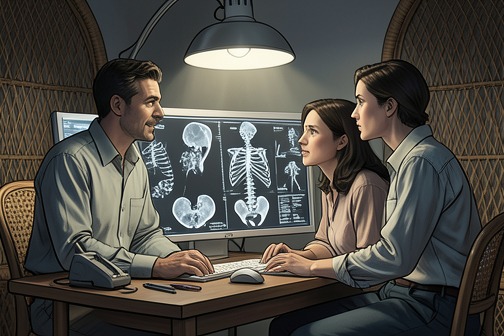
The [1966 Barren Glacier explosion and deaths](entity:event-recall-event-1966-644114b0a1c7) are re-examined years later through the survivors’ and investigators’ medical evidence, revealing a possibility more disturbing than the original blast: some of the men may have been dead before the explosion. The event’s significance lies in that reversal. The X-rays that were first taken to identify mangled bodies become evidence that the apparent cause of death may have concealed another, still unexplained cause.
## The bodies beneath the ice
In [Moritz](entity:character-recall-character-moritz-a6d7a66c39ab) Jaspersen’s consultation room, three X-rays are clipped to a light box as Moritz, [Smilla Qaavigaaq Jaspersen](entity:character-recall-character-smilla-qaavigaaq-ja-6018cea6ee70), and [Dr. Lagermann](entity:character-recall-character-dr-lagermann-7bb9a3212f54) study the remains. One identifies Marius Høeg, who died on the Barren Glacier at Gela Alta in July [1966](entity:time-recall-time-1966-6e0ec857e681). The images place the disaster at a distance of decades, but not at a safe distance: the bodies had been buried in the permafrost at [Holsteinsborg](entity:location-recall-location-9d818dbb2b86), covered with stones, and sealed under cement to keep Arctic foxes away.
The room’s domestic comforts—the wicker furniture, yellow marble floor, fabric-covered walls, and avocado-green examination table—contrast with what the light box makes visible. [Smilla](entity:character-recall-character-smilla-312dea36b0f5) first describes the X-rays as a universe rendered in human anatomy: ribs become planetary ellipses, lungs resemble the Milky Way, and the heart and intestines suggest burnt stars and scattered cosmic matter. That imaginative comparison does not soften the facts. The person inside the image is dead, and the film turns a body into both a cosmic pattern and forensic evidence.
## Why the X-rays were taken
The X-rays originated in the immediate aftermath of the 1966 explosion, when the victims were so badly maimed that identification was uncertain. Investigators looked for old fractures and other distinguishing features, and the negatives were reportedly circulated among doctors in [Greenland](entity:location-recall-location-greenland-ccdcf7f87d1f) alongside full dental images of what remained of the men’s teeth. The pictures were therefore produced as practical records for identifying the dead, not as an investigation into an infection.
The examination also raises questions about how the explosion happened. Dr. Lagermann observes that the bodies appear to have been sitting directly over the charge. In ordinary professional blasting, plastic explosives would be placed in a drilled channel or shaped to concentrate the force in a particular direction. Here, the blast seems to have gone off almost directly beneath the men. [Lagermann](entity:character-recall-character-lagermann-2f240901a01f) stresses that this is speculation based on limited evidence, but the apparent placement is troubling: it is not what he would expect when professionals are involved.
## The unexplained channels
A closer look at enlarged X-ray negatives changes the meaning of the blast. The images show no thighbones beneath the pelvis in one body; other films present an almost intact spine and, in contrast, a scatter of bone fragments and dark shadows. In those enlarged areas, Dr. Lagermann identifies channels bored through the bodies: each runs sixteen inches and measures at least two millimeters across, passing through the diaphragm and soft organs before stopping in regions damaged by infection.
The tracks do not resemble injuries caused by the explosion alone. Lagermann reasons that whatever made them may have been a worm or something else, and that it had reached vital organs before the men died. In his account, the blast did not kill these two victims: one had something lodged in his heart, the other in his liver. The X-rays thus reverse the apparent order of cause and consequence, making the bodies evidence not simply of a fatal detonation but of a prior, unidentified affliction.
The possibility is especially disquieting because the victims had been so violently mutilated that the original investigators relied on radiographs to establish their identities. Images made to distinguish the dead now expose a different uncertainty: the men may have been dead before the explosion, though the precise nature and timing of the infection remain unresolved. The old forensic record can reveal the hidden channels, but it cannot by itself name what passed through them.
## Reading the evidence in retrospect
The old films acquire a second purpose when viewed beside later knowledge. Moritz notes that an article by [Loyen](entity:character-recall-character-3ce426361dd8) in Nature concerns diagnosing this kind of parasite through X-rays, a difficult task when the organism has not calcified in tissue. After death, the heart no longer circulates contrast fluid through the body, making the diagnostic image harder to obtain. Moritz recognizes why the article matters: he had underlined it in his letter, and Loyen is one of the specialists most likely to investigate the finding. The evidence points toward a question the 1966 identification effort could not have asked, but it does not settle the answer. Dr. Lagermann is a forensic specialist, not an expert in tropical disease, and cannot identify the organism or explain how it reached the men.
## Retrospective significance
The re-examination changes the status of the 1966 records without turning suspicion into certainty. The X-rays make it possible to question whether the explosion was the men’s true cause of death, while the apparent positioning of the charge raises a separate question about how the blast was set. Yet Dr. Lagermann explicitly treats the placement as speculation, and the films do not identify the thing that bored through the victims’ organs. The account preserves these as related but unresolved problems rather than forcing them into one explanation.
The scene’s central reversal is forensic: images created to identify bodies mangled by an explosion reveal traces suggesting that the victims may already have been dead. The records therefore carry two histories at once—the visible destruction of the blast and a less legible process that preceded it. Their return to the light box decades later makes the old disaster newly uncertain, while leaving its most consequential question unanswered.
Event 11
1991 botulism deaths in Greenland
The [1991 botulism deaths in Greenland](entity:event-recall-event-1991-dba181a154f7) are presented as a cluster of five young deaths whose cause could not be read from outward appearance. Their diagnosis depended on laboratory testing and the elimination of other explanations, making the case an example of how evidence can be difficult to see—and how institutions beyond [Greenland](entity:location-recall-location-greenland-ccdcf7f87d1f) were needed to establish it.
## The reported deaths
A report held in [Godthåb](entity:location-recall-location-godth-b-7bc7ea4302c5), with a copy in [Copenhagen](entity:location-recall-location-copenhagen-aea5870325a0), recorded that five people were found on the same day, August 7, [1991](entity:time-recall-time-1991-aeda6eb6bd7d). They were described as healthy young people. The account identifies botulism, caused by *Clostridium botulinum*, as the explanation for the deaths, but does not provide the victims’ names or the circumstances in which they were found.
## Diagnosis and evidence
The account stresses that botulism leaves no distinctive external sign. The toxin attacks the peripheral nervous system where nerves connect to muscle fibers, and can paralyze the lungs; after death, there may be no visible indication that distinguishes it from other causes. Diagnosis therefore proceeds by elimination: when no other cause is found, investigators test a blood sample and suspected food.
Queen Ingrid’s Hospital in Godthåb had a medical laboratory, but lacked facilities to identify less common toxins. Blood samples were consequently sent to Copenhagen, where testing found botulinum toxin. The confirmed diagnosis thus depended on both the local investigation and laboratory capacity located elsewhere. The passage does not specify what food, if any, was implicated, or describe the individual testing results for each of the five people.
## Place in the wider inquiry
The case enters the novel through a discussion of deaths in Greenland and the limits of ordinary forensic observation. It establishes a specific historical precedent for a fatal illness whose cause could remain hidden without specialist analysis. The scene also places the investigation within a broader contrast between Greenland and [Denmark](entity:location-recall-location-79f6f9d89c0e): the report was held in Godthåb, but the samples had to travel to Copenhagen for the relevant tests. The evidence does not establish a connection between the 1991 botulism deaths and the separate parasite investigation that unfolds in the novel.
Event 12
Nathalie Ravn's suicide in Singapore
[Nathalie Ravn's suicide in Singapore](entity:event-recall-event-1846f9190a4a) is recalled as a death with consequences beyond the immediate tragedy: it prompted public discussion of the legal rights of Danes abroad, while the name [Nathalie Ravn](entity:character-recall-character-50d285c4026c) connects the episode to the novel’s wider web of investigation and political power.
## The remembered case
The event reaches the reader through a conversation prompted by a newspaper clipping. Asked whether he remembers it, a man recalls that a consular secretary died after jumping from a roof and that another man was arrested. He says the arrested man had tried to talk her out of it. The account is therefore not presented as an uncomplicated report of the circumstances: it includes both the death and the intervention attributed to the person arrested.
The man identifies the case as one that raised a fundamental question about the legal rights of Danes abroad. The detail gives the event a public and legal dimension, setting an individual death against uncertainty about what protections apply beyond [Denmark](entity:location-recall-location-79f6f9d89c0e). The evidence does not resolve that question or provide a legal judgment; it records the issue the case brought into view.
## Nathalie Ravn remembered
The speaker identifies the woman as Nathalie Ravn and says that he and [Ravn](entity:character-recall-character-ravn-31684f0264e1) studied international law at university together. His tears and description of her as a wonderful girl make the recollection explicitly personal: the clipping does not summon only a public controversy but the loss of someone he knew and admired.
He also recalls that Ravn applied for a position with the [Ministry of Justice](entity:organization-recall-organization-ministry-of-just-1bf803d2860f). In local circles, he says, she was thought capable of becoming the first female police commissioner. That unrealized possibility sharpens the contrast between her prospective public career and the abruptness of her death, without establishing what position she ultimately would have attained.
## Place in the wider story
The memory surfaces during a discussion of events linking [Greenland](entity:location-recall-location-greenland-ccdcf7f87d1f) and [Singapore](entity:location-recall-location-22b100143ee9). [Smilla](entity:character-recall-character-smilla-312dea36b0f5) responds that nothing is isolated anymore: if something happens in Greenland, it is connected to something else in Singapore. Her remark reframes the remembered death as one strand in a wider chain of connections, while the man’s grief and confusion show the difference between his personal recollection and Smilla’s investigative purpose.
The scene does not supply further details about the arrest, the circumstances leading to the death, or the outcome of the legal debate. Its significance rests on the facts it does establish: a consular secretary died in Singapore, the arrested man was said to have tried to dissuade her, and the case raised questions about the rights of Danes abroad. Through the name Nathalie Ravn, the account also gives that public controversy a remembered face and a lost future.
Event 13
Freia Film's Greenland expeditions
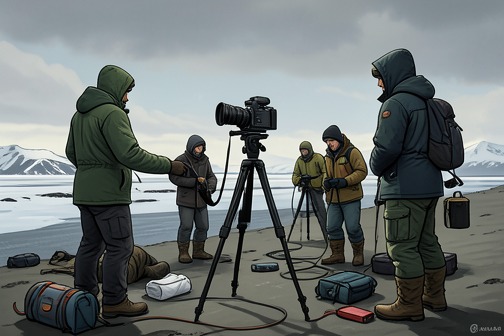
[Freia Film's Greenland expeditions](entity:event-recall-event-freia-film-1f45647f07f3) were covert intelligence operations disguised as film projects. Their concealed purpose—to assess the occupation of [Greenland](entity:location-recall-location-greenland-ccdcf7f87d1f), secure its cryolite quarries for German aircraft production, and survey possible air-base supply routes for an invasion of the United States—places them within the book’s history of external powers converting Greenland into a strategic resource and military corridor.
## Film as Cover
[Freia Film](entity:organization-recall-organization-freia-film-44971533d80d) was a film company used to conceal German intelligence activity both before and during the occupation of [Denmark](entity:location-recall-location-79f6f9d89c0e). Under the stated pretext of making footage in support of Horbinger's Thule theory, the company organized two expeditions to Greenland. The film rationale provided a public-facing explanation for travel and fieldwork; the disclosed intelligence purpose was political and military rather than cinematic.
## Strategic Objectives
The expeditions assessed whether Greenland could be occupied, with particular attention to its two cryolite quarries. The resource mattered because cryolite was essential to producing aluminum, itself crucial to the aircraft industry. The expeditions also surveyed sites for air bases that could supply a possible invasion of the United States. Greenland thus appears not as a remote backdrop but as a place whose minerals and geography were being evaluated in relation to European war and transatlantic military planning.
## Secrecy and Greenland
The history of these expeditions resonates with the later restrictions surrounding access to [North Greenland](entity:location-recall-location-516912907573). [Smilla](entity:character-recall-character-smilla-312dea36b0f5) had served as navigator on nine expeditions in twelve years, using confidential maps, military satellite and radar photographs, and meteorological observations; each time, she signed a secrecy declaration. The contrast between a film company’s concealed wartime surveys and later military control underscores the persistence of strategic secrecy around Greenland, even as the institutions and political circumstances changed.
That secrecy sits alongside other forms of outside power. In the account of Greenland’s political incorporation, Danish-language schooling promised an avenue to education and a way out of Arctic hardship, while the official description of Greenland as Denmark’s northernmost county recast Inuit as Northern Danes. The narrative links such administrative and cultural pressures to a broader pattern in which ostensibly cooperative development can conceal unequal control. Its later description of the Greenland Star oil platform makes the governing logic explicit: development has been created with coercion in mind, now exercised less through direct military violence than through appeals to greed.
## Narrative Significance
The expeditions establish a historical precedent for treating Greenland as something to be surveyed, secured, and used by distant powers. Their cover story is significant in itself: the language of film and exploration masks work directed toward occupation, mineral extraction, and invasion logistics. Set beside military confidentiality, language loss, and later resource development, Freia Film’s operation becomes part of the book’s sustained contrast between the stories institutions tell about Greenland and the interests those stories may serve.
Event 14
Alvarez impact event
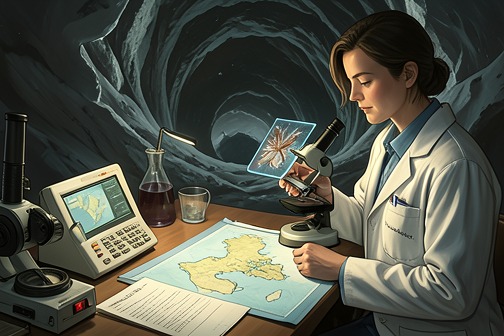
The [Alvarez impact event](entity:event-recall-event-alvarez-7f3587745cf2) is a prehistoric catastrophe whose proposed ecological aftereffects become central to [Tørk Hviid](entity:character-recall-character-t-rk-hviid-783e69d11acf)’s account of the [Arctic worm](entity:creature-recall-creature-arctic-worm-d76874fc5a70). In the paper [Smilla](entity:character-recall-character-smilla-312dea36b0f5) finds at the [Center for Developmental Research](entity:organization-recall-organization-center-for-devel-2d3d6d834185), the impact is linked to the collapse of marine food chains and possible mutations among parasites; [Tørk](entity:character-recall-character-t-rk-f2bda9f6e150)’s later demonstration of the parasite’s extraordinary adaptability makes that distant hypothesis feel newly consequential without turning it into established fact.
## The hypothesis in Tørk Hviid’s paper
Tørk’s hundred-page paper, titled “[A Hypothesis on the Eradication of Submarine Life in the Arctic Sea in Conjunction with the Alvarez Incident](entity:object-recall-object-t-rk-hviid-7a8b61d47a77),” draws on physicist and Nobel Prize-winner Luis Alvarez’s theory. Alvarez proposed that unusually high iridium content in a clay layer between chalk and Tertiary sediments, found at Gubbio in the northern Apennines and at Stevn’s Klint in [Denmark](entity:location-recall-location-79f6f9d89c0e), could only be explained by an immense meteor impact.
The paper’s account places the impact 65 million years ago and estimates the meteor at between four and nine miles in diameter. It would have exploded on impact with energy comparable to 100 million megatons of TNT. The resulting ash cloud, according to the theory, blocked the sun for at least several days.
## Ecological consequences and uncertainty
In the hypothesis, the loss of sunlight set off cascading damage: several food chains collapsed, marine and submarine microorganisms were annihilated in large numbers, and the disruption had further consequences for larger herbivores and carnivores. The event is therefore presented not simply as a moment of collision, but as the beginning of an extended ecological chain whose later effects could be difficult to isolate from the catastrophe itself.
Drawing on discoveries in the [Barents Sea](entity:location-recall-location-05dfbb2bab03) and [Davis Strait](entity:location-recall-location-davis-strait-fe8fcc0dcde6), Tørk’s paper considers whether radiation from the impact might explain mutations among marine parasites during the early [Paleocene](entity:time-recall-time-paleocene-e46abe877928). It also asks whether those mutations could have contributed to the mass extinction of larger sea animals. The wording remains conjectural: the impact is a proposed explanation for a sequence of biological changes, not a conclusion the narrative independently verifies.
## From ancient catastrophe to the Arctic worm
The novel later gives the hypothesis a more immediate context when Tørk shows Smilla a water flea, [Cyclops marinus](entity:creature-recall-creature-cyclops-marinus-45d94253df21), under a dissecting microscope. Inside it is a roundworm he identifies as Dracunculus borealis, the Arctic worm. He describes a life cycle moving between marine mammals and water fleas: larvae released into seawater are eaten by the fleas, develop there over several weeks, and can enter a larger mammal when the flea is swallowed. In the mammal, the worm matures and reproduces before the female moves toward the subcutis and releases more larvae.
Tørk contrasts the Arctic worm’s ordinary relationship with its hosts against the possibility of a transformed parasite. He explains that a good parasite does not kill its host, and uses the [Guinea worm](entity:creature-recall-creature-guinea-worm-9a622b3fd6e3) to illustrate how a parasite’s spread is constrained by environmental conditions and by the host population. In a later account of the research, he says that after twenty-five years [Loyen](entity:character-recall-character-3ce426361dd8) discovered that the larva had adapted to the human immune system: it could disguise itself with proteins from the infected person and develop far more rapidly in a human than in a seal or whale. Tørk further states that [Verlaine](entity:character-recall-character-verlaine-ba68c2cc490b) grafted larvae onto different saltwater and freshwater fish, at varying temperatures, and that the parasite adapted to each. These claims make the old impact theory part of a wider argument about mutation and adaptation, while leaving the precise connection between the prehistoric event and the present danger a matter of hypothesis.
## Narrative significance
The impact reaches the reader first as difficult, remote scientific material. Smilla encounters it through a computer catalogue, scrolls past illegible images and geological diagrams, and finds the paper’s clear style unable to make 65 million years feel near. Later, Tørk’s microscope lesson supplies a bodily scale for the questions raised in the text: a tiny organism can carry a long evolutionary history, and a small channel inside a water flea may matter more than the inaccessible diagrams that first introduced the theory.
That movement from deep time to a living parasite gives the event its narrative force. The Alvarez impact is not shown directly, nor is its proposed role in the parasite’s history confirmed. Instead, it offers a possible origin point for consequences that unfold across species and geological eras, linking mass extinction with the novel’s immediate concern about a parasite capable of crossing its usual biological limits.
Event 15
Kronos sea container drop test
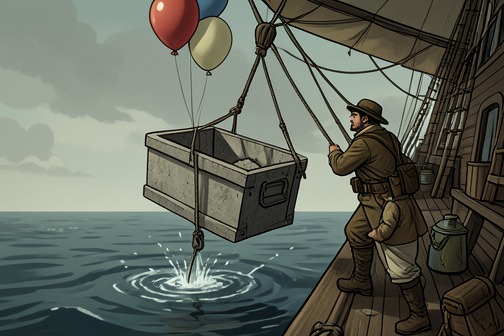
The [Kronos sea container drop test](entity:event-recall-event-kronos-823ad81f6f27) is a carefully staged rehearsal for secretly placing heavy cargo in the sea. A cement-filled container is lowered from the ship, released astern, and fitted with flotation balloons; the later discovery that it contains only cement changes the apparent meaning of the operation. What seems to be a delivery is instead a test of equipment, positioning, and crew coordination before a more valuable shipment.
## Background and purpose
The test takes place within a charter whose secrecy has already been built into its paperwork. [Birgo Lander](entity:character-recall-character-birgo-lander-83dfbe8955dc) explains that a ship’s formal contract records its destination and cargo, while a private side contract can conceal what the voyage is really for. When [Smilla](entity:character-recall-character-smilla-312dea36b0f5) says the destination is [Greenland](entity:location-recall-location-greenland-ccdcf7f87d1f)’s west coast, Lander points out that the route is traceable: a vessel bound for Greenland must meet ice-class and inspection requirements. Secrecy, in other words, depends not just on what the ship carries but on the legal and logistical trail that makes its movement legible.
The ship’s identity is also part of the investigation. Calling Lander from a phone booth, Smilla asks him to check the name [Kronos](entity:object-recall-object-kronos-1c2f054f5a54). Lloyd’s Register lists five vessels with that name; she and her companion settle on the last two, the general-cargo ships registered in Piraeus and Panama. This search establishes the ship through an ordinary record system even as the voyage itself relies on confidential arrangements.
## The overnight operation
The test interrupts the ship’s established nighttime rhythm. Smilla wakes to boots, slamming doors, loudspeaker announcements, and the distant sound of hydraulic winches. She goes toward the bridge and sees that the forward cargo hold has been opened and ringed with a railing. Two wires run down from the forward cranes, and a heavy blue hawser lies across the rail. The activity is organized around a specific piece of machinery and a designated opening in the deck, not an improvised disposal.
From the hold, Smilla glimpses [Verlaine](entity:character-recall-character-verlaine-ba68c2cc490b) sitting on the lid of a large metal container roughly thirty feet below deck level. White fiberglass holders sit at its corners. The operation is conducted under direction from above: orders transmitted over the intercom tell the crew when to hoist, lower, and release. The timed countdown marks the drop as a controlled sequence, with the crew acting in coordination rather than simply throwing cargo overboard.
Once the container reaches the sea, it floats about fifteen feet from the stern, apparently riding a bow wave. A blue hawser still connects it to the ship, while crew members use a long boathook to keep it clear of the hull. Two narrow inflatable strips run along its sides. When the container is released, it drifts farther astern and begins to sink. Then five fiberglass shells are cast off, and five self-inflating gray flotation balloons spread across the water above it. The test thus includes both the controlled release and the deployment of equipment intended to keep the submerged container identifiable or recoverable.
## Discovery of the dummy cargo
The meaning of the operation changes when a crewman explains that he has secretly opened the container. The ship’s cargo-area keys are kept on the bridge for use if cargo shifts, and he borrowed them while on watch. Inside, he found hundreds of 100-pound sacks of Portland cement. He searched further, even moving the sacks and probing them with a barbecue skewer, but found nothing concealed beneath them. His search turns the cement from an apparent cover story into evidence that the container was not carrying the valuable cargo he had suspected.
The crewman’s suspicion had been sharpened by the voyage’s secrecy and extra pay: the sailors had been told neither where they were going nor what they were carrying, yet the container appeared to be ordinary cement. The geography raised another doubt. The ship had come from a [Hamburg](entity:location-recall-location-hamburg-83eba4856d4b) shipyard and had been in Danish waters for two weeks, making a delivery far out in the Atlantic seem implausible. His inspection provides a concrete answer to one question—what was in this particular container—while leaving the larger purpose of the voyage unresolved.
## Rehearsal for a larger shipment
The crewman interprets the drop as a dry run rather than a smuggling delivery. Heavy cargo must be placed at precise coordinates, kept clear of the propeller, and lowered without swinging dangerously in wind and rough water. The ship cannot simply stop and ease it overboard: a change in speed would be recorded and could draw the attention of customs authorities over VHF radio. The rehearsal therefore tests whether cargo can be dropped discreetly while the ship continues moving.
The operation also tests the system surrounding the container: flotation balloons, transmitting equipment, the boom, the winch, and the forward guy wire. Just as important, it gives the deck crew a chance to practice their movements. The cement-filled container is a dummy, but the procedure is real. Its release at a point where the ship is believed to be beyond radar range serves as a preview of the later operation the crewman expects the vessel to undertake for more valuable goods. He suspects drugs, but the passage presents that as his conclusion, not as a confirmed identification of the future cargo.
## Route, infrastructure, and significance
The ship’s route reinforces the scale of the plan without resolving its destination. When asked where the vessel is headed, Captain [Lukas](entity:character-recall-character-a80153e423b8) points to a chart of [South Greenland](entity:location-recall-location-5eded7ae6316) overlaid with a clear plastic sheet marked with ice concentrations, visibility, and iceberg positions. The plotted course runs north along the coast, rounds [Cape Thorvaldsen](entity:location-recall-location-9c839e7a8924), then turns north-northwest and stops at a point near [Vestland](entity:location-recall-location-vestland-d491400f3fa9) in the open ocean. Lukas says that this is all he knows, underscoring that even the captain is kept on a short leash.
The test makes the ship’s infrastructure legible as a connected system: contracts and registries conceal or reveal the voyage; charts and ice reports guide the route; cranes, winches, wires, hawsers, flotation devices, and communications coordinate the drop. Elsewhere, Lukas contrasts the authority of older captains with the controlled conditions of an offshore oil complex, where access ashore is restricted and supplies are delivered through managed systems. Against that wider context, the test is more than a suspicious cargo maneuver. It shows how a carefully coordinated technical operation can move goods while limiting what the crew knows—and how close inspection of an apparently ordinary container can expose the difference between rehearsal and delivery.
Event 16
Smilla's escape aboard the Kronos
[Smilla](entity:character-recall-character-smilla-312dea36b0f5)’s escape aboard the [Kronos](entity:object-recall-object-kronos-1c2f054f5a54) is the decisive passage from a threatened life in [Copenhagen](entity:location-recall-location-copenhagen-aea5870325a0) to a dangerous pursuit at sea. As pressure closes around her investigation of [Isaiah](entity:character-recall-character-isaiah-c3d5f123fd4f)’s death, she abandons her apartment, accepts help from her estranged father, [Moritz](entity:character-recall-character-moritz-a6d7a66c39ab), and leaves shore in a small rubber boat. The crossing is both practical flight and a test of what freedom means to someone who has long experienced confinement as a form of punishment.
## The decision to leave Copenhagen
The escape begins amid a painful discovery about Isaiah. On the stairs, [Juliane](entity:character-recall-character-juliane-1fd6dabd02f1) emerges from her apartment and recognizes that Smilla is going away. Smilla confronts her over why she had concealed that [David Ving](entity:character-recall-character-david-ving-34953bff0d9b) came to collect Isaiah. Juliane explains that [Ving](entity:character-recall-character-1b97ae0b08ef) had provided the apartment and had threatened to take it away; her fear of losing their home had helped keep her silent. She asks whether Smilla will return, and Smilla assures her that she will. The exchange leaves the promise of return beside a newly exposed breach of trust: Juliane’s silence was tied not to indifference but to the power Ving held over her housing.
Smilla goes upstairs and finds her apartment undisturbed. She tries to pack essential clothes in the dark, using the city light reflected from the snow rather than switching on a lamp. Two suitcases prove too heavy to manage, so she pares her belongings down to one large duffel bag, making the departure an act of painful selection rather than a simple change of address. She takes Isaiah’s cigar box with her and says farewell to her home in her mind. The box is among the few things she carries out, linking the escape to the death and investigation that have made staying impossible.
A telephone rings just as she is preparing to leave. She knows she should let it ring: she has promised [the mechanic](entity:character-recall-character-95fd5bb0bce6) not to return upstairs, does not want to speak to the police, and sees no advantage in answering. Nevertheless, she loosens the tape and picks up the receiver. The caller says her name and lets her hear his deep, calm breathing. Smilla puts the receiver down on the table rather than back on the telephone, then takes her bag and runs. Her sudden flight shows how little control remains once fear overtakes deliberation: she races down the dark stairs and out into the streets without time to change her shoes.
## Moritz’s intervention
Lander is waiting with the engine running. Smilla throws herself into the passenger seat and clings to him; he calls it a good start. Yet the path out of the city does not lead directly to the boat. When Smilla reaches Moritz, she is exhausted by the recurring pattern in which attempts to escape her father’s house and country have been interrupted by life’s return to unresolved problems. She is preparing to give up when Moritz stands, tells [Benja](entity:character-recall-character-benja-e5e8bf867e20) to stay, and asks Smilla what he can do. The change matters because the father who has often been a source of distance now chooses to help her leave.
Smilla gives him a precise task: drive his car to the back door, close enough to load the box without being seen, and let her lie on the floor in the back. At the car, she does exactly that, with Isaiah’s box placed on the rear seat and a blanket pulled over her. Moritz takes the front seat. The Toenail thanks him for his help as they drive away, while Smilla remains concealed. The scene makes the escape a piece of covert logistics, dependent on Moritz’s willingness to risk assisting her under the eyes of those pursuing her.
## The crossing to the Kronos
At Skovshoved Water Ski Club, Lander is waiting beside a broad wooden ramp descending from the high dock toward the water. His black waterproof sailing suit is tucked into his boots; the vehicle is a high-bodied Land Rover, not the Jaguar, and a black tarp covers the rubber boat. The Zodiac, made of heavy rubberized canvas with a wooden bottom, is tied beneath it. Moritz tries to help but cannot move quickly enough. Lander tips the boat off the car, catches it on his head, and pushes it down the ramp in one fluid movement. He then brings out an outboard motor and fastens it to the stern.
The three of them lift the boat into the water. From her box, Smilla takes rubber boots, a balaclava, thermal gloves, and a sou’wester, dressing for the crossing rather than for the life she has just left. Moritz stays by the railing instead of joining them on the ramp and asks if there is anything more he can do. Lander answers that he can get out of there fast. He pushes off and starts the motor; the boat is drawn away from land as the snow falls heavily, and Moritz disappears from view before turning back toward his car.
Lander has a compass strapped to his left wrist. A temporary corridor of visibility in the snowfall reveals Sweden and the lights of Tarba;k, as well as two ships at anchor between the shore and the central navigation channel, northwest of Flakfort. Lander identifies the starboard vessel as the Kronos. The ship is not an abstract destination but a visible point beyond the shore, reached by a small boat through winter darkness and falling snow.
## Boarding and the meaning of departure
At the transfer, Smilla slings Isaiah’s box onto the platform herself. She steps up and turns back. Lander stands for a moment, a small figure rising and sinking with the movement of the rubber boat, then turns away and pushes off. Smilla’s action completes the separation: the man who has brought her across does not follow her aboard, and the box that connects her to Isaiah is carried into the next stage of the journey.
The escape draws force from Smilla’s understanding of spatial freedom. She recalls that there are no prisons in [Greenland](entity:location-recall-location-greenland-ccdcf7f87d1f) and contrasts Greenlandic punishment by fines with Copenhagen’s use of imprisonment. In her memory of childhood, she and her mother were almost never indoors, and remaining in one place for long was unthinkable to her mother. Smilla describes her own attachment to freedom of movement as something she cradles and worships. Against that background, the locked room is not merely an instrument of interrogation or punishment: it represents a form of confinement that threatens the self she has built around movement and open space.
The flight also carries a cultural and personal history that the novel does not reduce to a simple opposition between [Denmark](entity:location-recall-location-79f6f9d89c0e) and Greenland. Smilla describes understanding another culture as a matter of living within it, being tolerated as a guest, and learning its language; explanation, she reflects, can itself create distance. Her memories of Greenland include concrete practices and inherited knowledge, from hunting and paddling to living with the demands of landscape. Those memories inform her sense of what freedom costs, even as she recognizes the difficulty of claiming a culture as wholly her own.
Boarding the Kronos therefore shifts the story’s geography and its immediate stakes without resolving the investigation. Smilla leaves behind an apartment, a promise to Juliane, and a father who has helped her at the moment she is ready to surrender. She carries Isaiah’s cigar box into a journey at sea, while her need to escape confinement becomes inseparable from her need to find out what happened. The crossing is an exit from Copenhagen, but not an escape from the questions that drove her there.
Event 17
The 1991 Gela Alta Expedition and the Divers’ Deaths
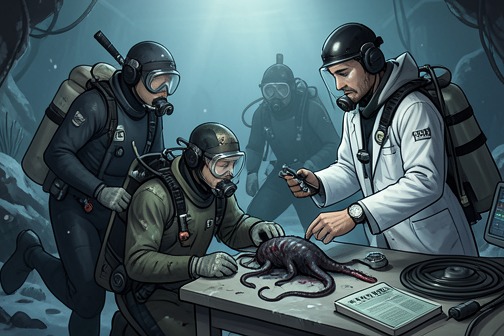
The [1991 Gela Alta expedition](entity:event-recall-event-1991-47e6aa2b3964) joined a search for a fifty-ton meteorite to a scientific investigation into a lethal parasite. Its divers died after encountering an [Arctic worm](entity:creature-recall-creature-arctic-worm-d76874fc5a70) whose life cycle had been altered to develop rapidly in human beings; [Isaiah](entity:character-recall-character-isaiah-c3d5f123fd4f), who accompanied his father on the expedition, became a later target of the same inquiry. The expedition’s significance lies in how a remote field operation links scientific ambition, lethal exposure, and the concealment of knowledge from those placed at risk.
## Background and Participants
The expedition took Isaiah to [Greenland](entity:location-recall-location-greenland-ccdcf7f87d1f) with his father. He had earlier fled the ship in [Nuuk](entity:location-recall-location-nuuk-ef44f1707578) and was left behind; [Loyen](entity:character-recall-character-3ce426361dd8) found him and sent him home. That history becomes significant when [Smilla](entity:character-recall-character-smilla-312dea36b0f5) learns that Loyen had regularly examined Isaiah, suggesting that the boy’s connection to the expedition was not merely incidental. Loyen was trying to establish whether he had been infected.
[Tørk](entity:character-recall-character-t-rk-f2bda9f6e150) described the expedition as a search for an extraordinary meteorite, said to weigh fifty tons and to contain diamonds and substances not found on Earth. The group brought oxygen and acetylene and cut fragments from it. The promise of treasure and scientific discovery thus forms the expedition’s visible purpose, while the divers’ deaths point to a danger that the expedition’s outward story does not explain.
## The Divers’ Deaths and the Evidence
Smilla’s interpretation changes after she examines X-rays from the [1966](entity:time-recall-time-1966-6e0ec857e681) expedition, which [Lagermann](entity:character-recall-character-lagermann-2f240901a01f) had obtained from Queen Ingrid’s Hospital in Nuuk. The images showed remains of the earlier expedition’s dead, but Smilla noted that the divers had not simply died in the explosion: she inferred that a parasite had attacked them. She connected Loyen’s examinations of Isaiah to the possibility that the same disease might have reached him.
Smilla proposes that Isaiah’s father and the others had been diving, and that the parasite could have passed through water. She warns that Tørk is likely to arrange further dives without telling the other participants why they are at risk. This is her reconstruction of the expedition’s danger, not a fully observed account of every diver’s exposure; its force comes from joining the X-ray evidence to the parasite’s known route through aquatic hosts.
## The Parasite and Its Changed Life Cycle
At Gela Alta, Tørk demonstrates the organism under a microscope. The small water flea [Cyclops marinus](entity:creature-recall-creature-cyclops-marinus-45d94253df21) carries a worm that Tørk identifies as Dracunculus borealis, the Arctic worm. In its established cycle, the parasite develops through water fleas and larger mammals, including whales, seals, and dolphins. It releases larvae into the sea, where the fleas ingest them; a larger mammal becomes infected when it takes in the flea, and the worm matures in the new host.
Tørk explains that the natural cycle is usually constrained by the parasite’s dependence on its hosts and on suitable conditions. In his account, a good parasite does not normally kill its host: the established relationship is one of compatibility. That balance is disrupted when the worm is made capable of infecting people and developing far faster than it does in sea mammals.
Tørk says that it took Loyen twenty-five years to determine that the larva had adapted to the human immune system. Once inside the mouth, it penetrates the mucous membranes and forms a protective layer from the person’s own proteins, allowing it to evade the body’s defenses. Instead of developing over months in a sea mammal, it grows rapidly, and stages that can take up to six months in marine hosts may take only days in a human being.
The parasite’s capacity to survive in different fish further weakens a natural limit on its spread. Smilla understands that it is not restricted to a narrow range of transmitting hosts. Tørk nevertheless describes a remaining constraint: in the absence of enough human hosts, the parasite’s development stays slow in sea mammals, and it depends on infected material reaching seals that can carry it onward. Human infection changes the pace of that process and makes the expedition’s divers particularly vulnerable.
## Consequences and Significance
The expedition’s deaths reveal a collision between an old ecological relationship and an experimentally altered one. The worm’s ordinary cycle can persist without killing its hosts, but its rapid development in humans turns that compatibility into a threat. The deaths are therefore not simply an unexplained consequence of working in a remote environment: they force Smilla to reconsider the expedition’s scientific history and the danger facing anyone asked to dive.
The event also exposes the unequal distribution of knowledge and risk. Smilla argues that Tørk would not tell the divers what he knew, even as he sought to involve them in further dives. The episode places the supposed promise of meteorite fragments and scientific distinction beside the concealed biological danger, making discovery inseparable from the question of who is allowed to understand its costs.
Event 18
Jakkelsen Is Murdered and Hidden in a Diving Equipment Case
[Jakkelsen Is Murdered and Hidden in a Diving Equipment Case](entity:event-recall-event-jakkelsen-5bb5ea8735e9) is a turning point aboard the ship: the narrator discovers [Jakkelsen](entity:character-recall-character-9d064e39fde6)’s body concealed in a case among the diving equipment, then identifies [Verlaine](entity:character-recall-character-verlaine-ba68c2cc490b) as the killer and explains the plan to dispose of the body at sea.
## Discovery Among the Equipment
The discovery comes in a space crowded with the equipment of an expedition. Nearby are pressure gauges, wrist compasses, goggles, flippers, inflatable collars, wetsuits and dry suits, safety lines, and battery-powered lamps. Against the bulkhead stands a case resembling an oversized instrument case. Jakkelsen has been placed inside it, folded into a position the case can barely accommodate. The narrator recognizes him beneath her jacket.
The case has been made to pass as cargo, but its awkward dimensions and concealed contents transform it into evidence. Jakkelsen’s presence among the diving gear is not accidental: the equipment provides cover for moving his body aboard without drawing attention.
## Evidence of Murder
The narrator checks the breast pocket where Jakkelsen had kept a syringe and finds it missing. Instead, a small metal triangle protrudes from his chest. Unable to turn him over in the case, she traces the metal behind his back and discovers a short, flat blade between his shoulder blades. Its placement reveals the method: it had been driven between two ribs and upward toward the heart, then its handle was removed while the blade remained. The concealed fragment accounts for the otherwise puzzling metal in his pocket and shows that the case hid not merely a body but the evidence of a carefully disguised killing.
The narrator estimates that Jakkelsen must have been killed only shortly before she reached him, perhaps while she was crossing the square. His body is still warm, and the murder’s recency changes the discovery from a search for what happened earlier into an immediate threat aboard the ship. She concludes that the killing took place on the [Greenland](entity:location-recall-location-greenland-ccdcf7f87d1f) Star, just as she arrived there.
## Identification and the Disposal Plan
After examining the body, the narrator turns off the light and leaves the room with [the mechanic](entity:character-recall-character-95fd5bb0bce6). On the deck, he asks who killed Jakkelsen. She names Verlaine, identified as the bosun, and places the murder on the Greenland Star, just as she and the mechanic arrived. The identification is presented not as a witnessed act but as the narrator’s conclusion, which she must persuade the silent mechanic to accept.
She reconstructs the next steps as a practical concealment plan. Jakkelsen followed Verlaine onto the docks and was caught; the solution, she says, was to make room in the equipment cases, put him into one, load it aboard, and wait until the ship was clear of the platform before letting the body slip overboard. The story she offers connects the case’s presence among the diving gear to a planned removal at sea, rather than treating it as a hiding place intended to last.
The narrator and the mechanic climb steps welded to the external bulkhead and settle on a dark half-deck between a motorboat resting on wooden trestles and a large rubber raft. From there they can see the quarterdeck while remaining shielded from its light. She tells the mechanic that the ship is now far out at sea and that Jakkelsen’s continued presence aboard is a risk for those responsible. She expects them to come for the body within minutes; with no other way to dispose of it, they will have to bring it up on deck and throw it over the side. Their concealed position makes them witnesses waiting for the proposed plan to unfold, while the narrator’s account of the murder becomes an attempt to turn the mechanic’s silence into shared vigilance.
## Narrative Consequences
The discovery changes the meaning of the equipment case from a place of concealment into a danger that may soon have to be confronted. The narrator tells the mechanic that the ship is far out at sea and that every moment Jakkelsen remains aboard increases the risk to those who arranged his concealment. She predicts that they will come for the body within minutes and, unable to remove it by another route, will carry it onto the deck and cast it overboard. The scene therefore turns on a precarious shift: the hidden killing has been uncovered, but the people responsible may still control what happens next.
To watch for that next move, the narrator and the mechanic climb steps welded to the outer bulkhead and settle on a dark half-deck between a motorboat resting on wooden trestles and a large rubber raft. The position gives them a view of the quarterdeck while keeping them shielded from its light. The mechanic has asked who killed Jakkelsen; the narrator’s answer and reconstruction of the disposal plan are not a witnessed confession or an independently confirmed account. She is trying to persuade him to believe her, turning his silence into a test of whether he will share the risk of watching. The body in its case thus becomes both evidence of a recent murder and the focus of an imminent attempt to erase it at sea.
Event 19
Smilla Escapes by Climbing the Kronos’s Outer Hull
[Smilla Escapes by Climbing the Kronos’s Outer Hull](entity:event-recall-event-smilla-kronos-67bba9297d6c) is a desperate escape from [Verlaine](entity:character-recall-character-verlaine-ba68c2cc490b) and [Hansen](entity:character-recall-character-546d729b7afb) that turns the exterior of the [Kronos](entity:object-recall-object-kronos-1c2f054f5a54) into a narrow, improvised route to safety. In near-freezing rain, with the ship rolling in heavy seas, [Smilla](entity:character-recall-character-smilla-312dea36b0f5) climbs its exposed iron rungs, is denied help by [Kützow](entity:character-recall-character-fd0c83e4a265), and faces pursuit across the upper decks. She reaches the bridge injured, having secured a way back inside but not an easy or unambiguous freedom.
## The Escape Takes Shape
Smilla is moving through the corridor with a bare survival plan and intends to speak with [Lukas](entity:character-recall-character-a80153e423b8) when Hansen comes down the stairs. She withdraws to the open deck below the upper level, where the weather’s severity becomes unmistakable: torrential rain close to freezing, gusts driving it sideways, and white streaks of spindrift pulled from the wave tops. Verlaine appears behind her. The exposed deck offers no shelter, but it is also the setting for the chance to get away.
The positions of her pursuers make clear that this is not a safe passage through the ship. Smilla realizes that this is the only place where they can act without being seen from the bridge, and that they have been waiting for such an opportunity. She weighs 110 pounds; a quick lift, she thinks, would put her in the water. Instead of surrendering to the threat of being forced overboard, she approaches the railing herself and studies the ship’s side. Below it, the freeboard interrupts the drop, and rectangular iron rungs welded into recesses run down the hull and disappear into the darkness.
## Down the Hull and Back Up
Smilla climbs onto the railing, making Hansen and Verlaine freeze as if she is about to jump. Then she grips the rungs and pulls herself outside the ship. Verlaine rushes to seize her ankles. A heavy swell strikes the Kronos, making the hull shudder and list to starboard; pressed against the railing and at risk of being flung into the sea, Verlaine has to release her. Smilla’s feet slip on rungs slick with rain and salt water. As the ship rolls back, she hangs by her hands above the white shine of the waterline, then closes her eyes and continues climbing.
The climb brings her to the promenade-deck windows, where blue curtains conceal the lights inside. Smilla pounds on the glass. Kützow cautiously parts the curtains and peers from the engineer’s office, his face only inches from hers on the other side of the window. She calls for help, but he looks at her and shuts the curtains. The encounter turns the window into a particularly stark barrier: the ship contains a possible refuge, and someone inside sees her, yet no help comes.
The rungs end at the boat deck. Smilla collapses beside the davits holding the aft lifeboat and finds the nearby door locked. Another exterior ladder rises along the funnel to the platform outside the bridge. [Maurice](entity:character-recall-character-4c6f64f90472), still wearing an arm sling, stands at its top to prevent witnesses from appearing on the upper decks. When Smilla turns toward the stairs, Verlaine is coming up from below, with Hansen close behind. The route upward is guarded, while the route back inside remains contested.
## Pursuit Across the Decks
With Verlaine and Hansen above her, Smilla grabs a tarp and steps over the side. The Kronos rolls, lifting her free as she wraps her thighs around the material and lowers herself. When the tarp is cut loose, she falls; her outstretched arms catch on the sea rail, her knees strike the ship’s side, and the impact knocks the breath from her. She then slides headfirst onto the upper deck. The escape is no longer a controlled climb but a sequence of falls and improvised catches, each one keeping her in the ship’s reach without guaranteeing that she can stay there.
Hansen emerges through the stairway door as Smilla crosses the quarterdeck toward the boat-deck stairs. Verlaine is coming down in blue shoes. Smilla thrusts her hands beneath the railing and shoves the shoes outward, using the momentum of his own movement rather than forcefully wrestling him. Verlaine’s feet arc into the air; his head strikes a step beside her shoulders, and he falls the remaining distance to the deck without breaking his fall. The moment reverses the pursuit: the men who have been closing in are no longer simply directing her movements, and Smilla gains enough space to run for the ladder.
## Reaching the Bridge
Smilla climbs toward the bridge. Maurice comes to the ladder, while the bridge door opens and Kützow appears barefoot and wearing a bathrobe. The two men stare at each other as Smilla passes between them into the bridge. The earlier refusal at the engineer’s-office window and this new encounter place Kützow at both sides of her attempt to reach safety; the sequence does not explain his motives, but his presence marks the precarious passage from the ship’s exterior into its interior.
Inside, Smilla finds [Sonne](entity:character-recall-character-sonne-c75c77f84d12) and [Maria](entity:character-recall-character-maria-de0c38967fe7) at the tiller and asks to be let into the sick bay, saying she has had an accident. Her arrival there ends the immediate chase, but it does not erase the physical cost of the escape. When she asks for help cleaning her wounds, the response is that the sight of blood is unbearable. Smilla cleans herself instead. Her hands shake as liquid runs over the wounds; she applies sterile compresses and wraps them in gauze. She then asks for Cliradon, only to be told that providing it would violate regulations.
## Significance
The escape is built from changes in the meaning of the ship’s spaces. The open deck first reveals the storm and the danger of the sea; the hull’s rungs become a precarious ladder; a lit window offers a view of possible help but ends in a closed curtain; and the bridge becomes reachable only after Smilla survives a fall and turns Verlaine’s momentum against him. Each apparent exit carries a new obstacle, so escape consists not of finding a clear passage but of making one under pressure.
The episode’s decisive reversal is practical rather than conclusive. Smilla gets inside and out of the immediate grasp of her pursuers, but she reaches the sick bay wounded, has to tend to herself, and still cannot obtain the medication she requests. The climb therefore establishes both her resourcefulness and the limits of what escape secures aboard the Kronos: for the moment she has regained access to the ship’s interior, not freedom from its dangers.
Event 20
Smilla Discovers Smuggled Mayam Aboard the Kronos
[Smilla](entity:character-recall-character-smilla-312dea36b0f5)’s discovery of [Mayam](entity:object-recall-object-mayam-5e4a67c19a31) aboard the [Kronos](entity:object-recall-object-kronos-1c2f054f5a54) turns an unexplained alteration in the ship’s interior into material proof of a smuggling operation. Behind a newly fitted plywood wall, she and [the mechanic](entity:character-recall-character-95fd5bb0bce6) find a refrigerator packed to look like ordinary provisions; inside its rice boxes is a dense yellowish substance. The concealment connects the cargo to [Tørk](entity:character-recall-character-t-rk-f2bda9f6e150) and [Verlaine](entity:character-recall-character-verlaine-ba68c2cc490b)’s arrangement and helps explain how [Jakkelsen](entity:character-recall-character-9d064e39fde6)’s discovery of the scheme led to his death.
## The Concealed Compartment
The search begins with a discrepancy in Smilla’s measurements. The wall stands more than five feet from the hydraulic rudder system, and she wants to know why there is a generator-like object behind it. Rather than fetch the mallet Smilla points out, the mechanic examines the molding and its nail holes. The wood is fresh. He pulls away the paneling, revealing a plywood sheet about half an inch thick and six yards square, fixed with roughly fifteen nails along each side.
Behind the false wall stands a stainless-steel refrigerator six feet tall and three feet wide. Metal fittings secure it against the ship’s rolling, while a cylinder lock closes its door. The pair remove the fittings and shift the refrigerator into the room. The mechanic unscrews its back panel, carefully pocketing the screws, and exposes the cords, cooling grid, compressors, and fluid tank. The reveal is deliberately prosaic: they are looking at the ordinary machinery of a refrigerator, but its presence in this concealed space makes the appliance evidence of a second use for the ship.
## Rice Boxes and Mayam
The refrigerator is filled with neatly stacked square boxes that appear to contain rice. The mechanic opens one and lifts out a boiler bag. Its contents are not rice but a vacuum-packed, dense yellowish substance. When he slices the bag open, air enters with a small sigh and dark, lumpy powder spills into his hand. Its texture is compared to melted butter mixed with hourglass sand. He checks several other boxes at random, then returns them carefully to their places.
Smilla identifies the substance as Mayam, an intermediate stage between raw opium and heroin. Its high oil content explains why the product must be refrigerated. The refrigerator is therefore not merely a hidden store: its cooling system is part of the cargo’s practical concealment and preservation. After the inspection, the mechanic replaces the back covering, pushes the refrigerator back into position, restores the plywood, and hammers the panel into place. Their attempt to leave the secret undisturbed cannot undo what they have learned.
## The Smuggling Arrangement
Smilla connects the concealed Mayam to information [Ravn](entity:character-recall-character-ravn-31684f0264e1) had given her: Tørk developed the product, and it is Verlaine’s share of an agreement between the two men. She reasons that the Kronos is expected to call at a [Greenland](entity:location-recall-location-greenland-ccdcf7f87d1f) port on its return journey, perhaps [Holsteinsborg](entity:location-recall-location-9d818dbb2b86) or [Nuuk](entity:location-recall-location-nuuk-ef44f1707578), and considers whether Verlaine has connections through the Greenland Star. The specific port remains uncertain; what is clear to her is that the ship’s concealed cargo belongs to a commercial arrangement extending beyond the vessel.
Smilla sets that arrangement against the changing scale of trade in Greenland. Liquor and cigarettes were smuggled north only ten years earlier, she observes, but that belongs to a vanished period. Nuuk now has a large cocaine market and a Greenlandic upper class living in a European manner. In her account, the Mayam shipment is not an isolated cache but part of a larger market whose growth has made the old forms of smuggling obsolete.
## Jakkelsen’s Discovery and the Cost of Knowing
The refrigerator also helps Smilla reconstruct Jakkelsen’s part in the violence surrounding the cargo. She concludes that he must have discovered the Mayam and then exposed himself: high and overconfident, he applied pressure, forcing the others to act. She says Tørk handled the telegram for them because he had to, while also emphasizing that Tørk and Verlaine hate one another. Their cooperation is tactical, sustained by mutual use rather than trust; they come from different worlds but can profit from the same scheme.
The find therefore changes the meaning of the hidden space and sharpens the stakes of Smilla’s investigation. A wall displaced from the rudder system, fresh molding, and an apparently ordinary refrigerator resolve into a system for hiding a valuable drug product. The rice boxes disguise the cargo; refrigeration accommodates its physical properties; and the Kronos provides a means of moving it toward a market. At the same time, Jakkelsen’s fate warns what can follow when someone discovers the arrangement and tries to exploit that knowledge.
Event 21
The Kronos Heads to Gela Alta in Search of a Meteorite
The [Kronos](entity:object-recall-object-kronos-1c2f054f5a54)’s planned expedition to Gela Alta is framed as a meteorite-recovery mission, but the account steadily unsettles that description. In a cabin conversation, [Smilla](entity:character-recall-character-smilla-312dea36b0f5) learns that the stone lies beneath a cold glacier in a lake of meltwater, weighs an estimated fifty tons, and is supposedly rich in diamonds and unfamiliar substances. Her knowledge of glacier temperatures makes the water itself an anomaly; the ship’s rebuilt forward tank makes the expedition’s purpose more disturbing still, suggesting that [Tørk](entity:character-recall-character-t-rk-f2bda9f6e150) may expect to retrieve something living.
## The recovery plan and its prize
Huddled on the bunk in his cabin, [Føjl](entity:character-recall-character-f-jl-1d981b4af323) explains that the object is a meteorite wedged into a kind of saddle in the cliff beneath the ice. Tørk has called it ancient, and the plan is to pick it up. The meteorite is not a casual discovery: photographs among Tørk’s papers had shown Smilla what looked like X-rays, including the Widmannstätten structure, the pattern formed by the relationship between nickel and iron in meteorites. In retrospect, those images had pointed toward the expedition’s real objective.
The reported scale of the find gives the recovery its extraordinary stakes. Tørk says the meteorite weighs fifty tons and is the biggest ever found. On the [1991](entity:time-recall-time-1991-aeda6eb6bd7d) expedition, the team took oxygen and acetylene and cut off several fragments. He also claims that the stone contains diamonds and substances not found on Earth. To Føjl, those possibilities carry the bright appeal of a child’s treasure; Smilla recognizes the enthusiasm, but the circumstances around it make the promise of hidden riches feel less innocent.
## Secrecy and the question of ownership
Føjl says that a discovery of interest in [Greenland](entity:location-recall-location-greenland-ccdcf7f87d1f) must be reported to the National Museum in [Nuuk](entity:location-recall-location-nuuk-ef44f1707578). The museum would then contact the Mineralogical Museum and the Institute for Metallurgy in [Copenhagen](entity:location-recall-location-copenhagen-aea5870325a0), after which the find would be registered as a matter of national interest and confiscated. His explanation makes the expedition’s secrecy legible: the group is not simply collecting a valuable specimen, but acting to keep it outside the official chain of reporting and control.
That proposed confiscation also places the recovery within a tension between the expedition’s private ambitions and the public institutions responsible for a find in Greenland. The stone’s exceptional size and alleged contents sharpen that conflict. The more important the meteorite might be, the less plausible it becomes that its removal is an ordinary scientific undertaking.
## A glacier that should not contain a lake
Føjl describes the meteorite as almost covered by meltwater and close to the ice surface. [Seidenfaden](entity:character-recall-character-seidenfaden-7fa54ead879e) believes it should be reachable either through a meltwater tunnel or through cracks in a crevasse beside the saddle. Getting it out is harder: the proposal is to enlarge the tunnel that drains the lake, using explosives, and carry out the recovery as underwater work.
Smilla tests the explanation against the physics of ice. She acknowledges the account that pressure can lower the melting point: at depth, the weight of the ice raises the temperature, and temperate glaciers in the Alps and Rocky Mountains can hold meltwater far below the surface. Føjl says Tørk explained the phenomenon to him. But Gela Alta is not a temperate mountain glacier. Smilla identifies it as a small cold glacier: its surface is about 14°F, its base about the same, and the melting point under the pressure there is around 32°F. On those conditions, not a drop of liquid water should form inside it.
The contradiction is not an abstract technical dispute. The lake is the route by which the team intends to extract the fifty-ton stone; if the water cannot naturally exist in that glacier, both the stated recovery plan and the account of the meteorite’s surroundings become suspect. Føjl does not seem persuaded by Smilla’s objection. She considers whether he does not understand it, whether Tørk’s influence has made him trust the explanation, or whether the ice remains difficult to comprehend for someone not born to it.
## From meteorite to possible living thing
Smilla offers a tentative explanation for the heat she suspects must be present: it may come from the stone, which could be emitting energy, perhaps radioactivity. She does not present this as certainty. Instead, she sets it against another clue aboard the Kronos. The ship’s forward tank has been rebuilt so that it can be sterilized, and it is supplied with oxygen and compressed air. Its construction is suited to transporting a large animal.
Together, the anomalous water and the adapted tank alter the meaning of the expedition. Smilla suspects that Tørk may believe the object they are going to retrieve is alive. The meteorite remains a stone in Føjl’s account and an unproven source of heat in hers, but the ship has been equipped for a different kind of cargo. The planned journey to Gela Alta thus holds two incompatible explanations in view: the recovery of an unprecedented extraterrestrial specimen, and the containment of something capable of living. The evidence does not resolve that uncertainty; it makes the expedition’s scientific language increasingly difficult to take at face value.
Event 22
The Joint Venture Warrior Prototype Platform Is Destroyed by an Iceberg
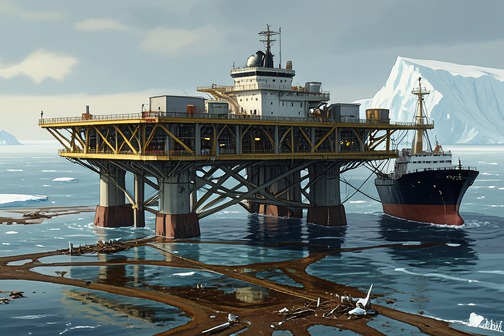
The destruction of the Joint Venture Warrior prototype is the catastrophe that gives practical force to [Smilla](entity:character-recall-character-smilla-312dea36b0f5)’s warning that the Arctic cannot be conquered. Built as a vast offshore drilling platform for [North Greenland](entity:location-recall-location-516912907573)’s oil development, the prototype is rolled over by an iceberg despite the presence of two icebreakers; in its wake, the platform is reduced to oil patches and debris. Smilla recounts the disaster to explain why Arctic equipment is designed to be dismantled quickly, and why the grand infrastructure of a modern harbor remains vulnerable to ice.
## The platform and the problem of Arctic oil
Smilla describes the platform while explaining to [Jakkelsen](entity:character-recall-character-9d064e39fde6) why the structures around them are made to come apart. Oil was discovered off North Greenland, but it took ten years before it could be extracted because of the ice. The Joint Venture Warrior was conceived as the answer: a cooperative project involving the United States, the Soviet Union, and [Denmark](entity:location-recall-location-79f6f9d89c0e)’s largest shipping company, [A. P. Møller](entity:organization-recall-organization-a-p-m-ller-0fec8cdab4dd). Its prototype was meant to precede a platform four times larger than ordinary offshore installations, which already rose above storm waves on supports and contained bars, restaurants, offices, workshops, cinemas, and fire stations.
The prototype itself stood sixty feet above the water and was intended to provide work for 1,400 people. It was constructed in [Baffin Bay](entity:location-recall-location-d081f92325dd), where its scale embodied the confidence that engineering could make the Arctic a site of sustained industrial production. But the disaster that followed became an argument against treating that confidence as mastery.
## The iceberg overwhelms the defenses
The iceberg was not entirely unexpected. It had calved at the edge of the [Arctic Ocean](entity:location-recall-location-a61c54094755), and two large icebreakers were on hand to tow it onto another course. Yet the berg was larger than usual: 325 feet high, flat-topped, with 1,300 feet of ice below the surface and a mass of about 20 million tons. The account stresses the mismatch between human effort and the moving ice. Even with little current and no wind, the icebreakers’ engines could not alter its course; the iceberg continued ahead as though it did not notice the tow.
It then rolled over the Joint Venture Warrior prototype. The proud model left no trace on the water beyond patches of oil and pieces of debris. The disaster is presented not as a contest narrowly lost through a technical mistake, but as a collision between industrial plans and a physical scale that those plans could not command.
## From catastrophe to dismantlable infrastructure
After the platform’s destruction, Arctic equipment was designed to be taken apart within twelve hours—the amount of warning the [Greenland Ice Center](entity:organization-recall-organization-greenland-ice-ce-bbd1caf6dd3c) could provide. Drilling shifted to floating platforms that could be cut loose. Smilla uses that history to reinterpret the imposing harbor before her: despite its appearance of permanence, it is only a tin tray, and a passing iceberg could carry its platform away as if it had never been there. The infrastructure is erected only under seasonal conditions, when field ice and pack ice do not reach it at the same time.
The Joint Venture Warrior disaster therefore explains both the design logic and the limits of Arctic development. Industrial systems respond to the catastrophe by making themselves more mobile and temporary, but that adaptation is not victory over the ice. Smilla’s conclusion to Jakkelsen is that the battle has not even begun. The remembered destruction gives that claim its weight: the iceberg is not scenery around the human enterprise, but a force that can erase the enterprise’s largest construction in a single passage.
Event 23
Loyen Discovers the Meteorite at Gela Alta
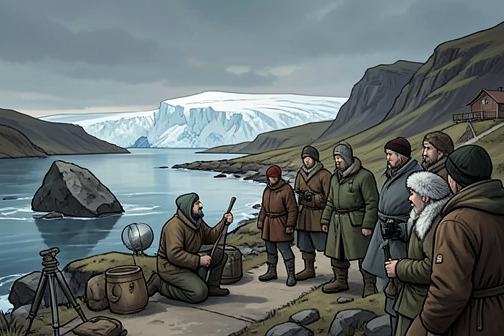
[Loyen](entity:character-recall-character-3ce426361dd8)’s discovery of the meteorite at Gela Alta begins not with a triumphant scientific claim but with attention to Inuit stories. In [Smilla](entity:character-recall-character-smilla-312dea36b0f5)’s account, the find launches a sequence of expeditions whose technical ambitions repeatedly outrun what their participants can understand, making the stone both a material object and the center of an unresolved history.
## A discovery grounded in local knowledge
Loyen first came to Gela Alta in the thirties with a German expedition. Its members planned preliminary construction for an airport on a narrow strip of flat coast on the north side of the island and brought Thule Inuit with them; West Greenlanders would not join because the island had a bad reputation. Loyen began searching as Knud Rasmussen had when he found his meteorites: by taking Inuit stories seriously. The account identifies this approach, rather than a technical method, as the path that led him to the meteorite.
The discovery therefore sits uneasily beside the expedition’s infrastructural purpose. The visitors came to prepare an airport, while the decisive clue emerged from a willingness to attend to stories that outside institutions might have dismissed. Smilla’s later reflections on understanding another culture sharpen this contrast: understanding comes through living among people, learning their language, and accepting the limits of explanation, not by placing them on an external scale.
## Expeditions and the unfinished passage
Loyen returned in [1966](entity:time-recall-time-1966-6e0ec857e681) with [Ving](entity:character-recall-character-1b97ae0b08ef) and [Andreas Fine Licht](entity:character-recall-character-andreas-fine-licht-5c6a572c5f19). By then the group knew of the stone, but, as Smilla recounts, they lacked the knowledge needed to solve the technical problems involved in reaching it. They constructed a permanent passageway to the meteorite, yet the expedition was cut short before that work could yield a complete resolution.
In [1991](entity:time-recall-time-1991-aeda6eb6bd7d) the expedition returned, and Smilla’s group came along as well. They were forced to go home. The sequence—discovery, an engineered passage, interruption, and return—makes the meteorite’s history less a completed triumph than a chain of attempts whose practical and historical consequences remain unsettled. The passageway is a concrete mark of access pursued, but not of understanding achieved.
## The story around the stone
The discovery is related during a tense conversation in darkness, when the speaker describes the expeditions while Smilla tries to understand why he is still lying even though he has control of the situation. Her next question concerns the pieces cut off the meteorite. That immediate concern turns the discovery story toward what was removed and what remains unexplained, rather than allowing the find to settle into a closed account of scientific achievement.
The narrative also places the meteorite’s history beside Smilla’s embodied knowledge of [Greenland](entity:location-recall-location-greenland-ccdcf7f87d1f). Her memories include hunting, food, kinship, and the freedom of moving through a landscape where her family could not imagine remaining indoors or in one place for long. These details do not supply a technical explanation of the stone; they show the difference between knowledge formed through lived practice and the institutional narratives that classify people and places from a distance. Loyen’s respect for Inuit stories briefly crosses that divide, while the interrupted expeditions and missing pieces preserve its unresolved edge.
Event 24
Smilla Escapes the Kronos Infirmary
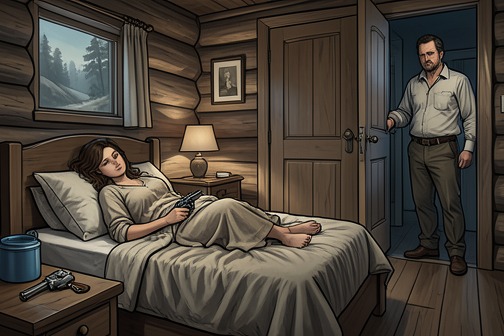
[Smilla Escapes the Kronos Infirmary](entity:event-recall-event-smilla-kronos-7db8bd4835ef) is the shipboard escape sequence in which [Smilla](entity:character-recall-character-smilla-312dea36b0f5), injured and still under threat, arms herself with a concealed revolver, fights her way out, and forces Captain [Lukas](entity:character-recall-character-a80153e423b8) to lead her onto the deck. Its decisive turn is from confinement under other people’s control to an unstable freedom she must secure by keeping a weapon trained on them.
## The Hidden Means of Escape
The escape begins not with a planned route but with objects concealed close at hand. Inside the cushion Smilla has been using as a pillow, she finds [Jakkelsen](entity:character-recall-character-9d064e39fde6)’s key, a blue plastic container, and a piece of metal wrapped in cloth. The metal is a [Ballester Molina Inunangitsoq revolver](entity:object-recall-object-ballester-molina-inuna-781165f5869f), manufactured in [Nuuk](entity:location-recall-location-nuuk-ef44f1707578) under an Argentine license. Smilla distinguishes it from hunting rifles, which can serve as protection against musk oxen and polar bears; this short-barreled weapon, with its flat-tipped lead-jacketed bullets, has no such plausible hunting use. Its box is full, and its cylinder holds six rounds. The weapon offers a means of resistance, but possessing it does not make escape simple or safe.
## The Fight with [Maurice](entity:character-recall-character-4c6f64f90472)
To get the cabin door open, Smilla makes a rattling cough, then kicks the remaining shards of glass in the cupboard door until they crash to the floor and the door swings open. When Maurice comes in, she braces herself against the table and aims the revolver with both hands. She orders him to his knees, but he advances. Smilla points the barrel at his legs and pulls the trigger; nothing happens, because she has forgotten to release the safety catch. Maurice strikes her in the chest with his good left arm, hurling her against the cupboard. Glass from the broken window cuts into her back, and his kick breaks her nose and briefly knocks her unconscious.
When she comes to, Maurice is standing over her. Smilla reaches into the tool pouch in her work pants for scalpels wrapped in Band-Aids and cuts his ankle, severing his Achilles’ tendon. He falls as he tries to pursue her. Still holding the revolver, she strikes him in the mouth with its barrel when he reaches inside his windbreaker, then leaves and locks the door behind her with his key. The improvised escape depends on successive close-range acts rather than on the firearm alone: the weapon initially fails, and Smilla gets past Maurice by turning the tools she has at hand into weapons and securing the door after she leaves.
## From the Infirmary to the Deck
The infirmary door is only the first barrier. At sea, doors are left unlocked when people are inside so they can be opened quickly in a fire, and Captain Lukas is asleep behind an unlocked door. Smilla closes it behind her and sits at the foot of his bunk. When Lukas wakes, she says she has temporarily discharged herself. He tries to grab her, but she shows him the revolver; when he keeps coming, she raises it to his face and takes off the safety. Her threat changes the balance: Lukas tells her to return, insisting that arrest is her security, but Smilla counters that Maurice outside is hardly reassuring and orders him to put on his coat and go out on deck with her.
## The Deck as a Provisional Escape
Lukas complies, and the two go out across the deck. As they pass the stairs to the upper decks, [Sonne](entity:character-recall-character-sonne-c75c77f84d12) comes down. Smilla moves close to Lukas; when Sonne stops, Lukas waves him on. Sonne hesitates, then yields to his naval training and discipline and steps aside. [Smilla and Lukas](entity:relation-recall-relation-smilla-lukas-3b0739532229) continue to the railing, where she stands several yards away so that he cannot easily grab her. The distance forces them to raise their voices to be heard, turning open space into a tactical safeguard rather than a place of ease.
From the railing, Smilla sees the island rising above the frozen sea. After so many days on the open water, its narrow, high outline has a dark and painful beauty: ice covers most of the rock, spilling from the bowl-shaped summit down the steep sides, while the Barren Glacier projects toward the [Kronos](entity:object-recall-object-kronos-1c2f054f5a54). The landscape does not settle the danger or make her escape secure. It marks instead the precarious change the episode has achieved: Smilla has left the infirmary and forced her way onto the open deck, but she remains injured, armed, and in control only so long as the men around her keep their distance.
Event 25
The Final Confrontation in the Gela Alta Ice Cave
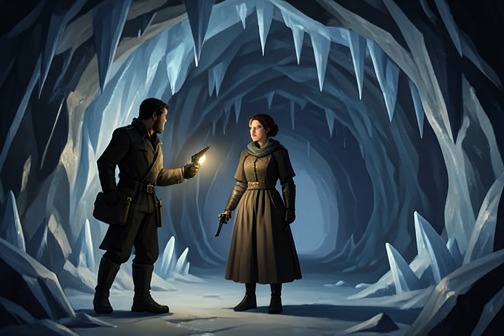
[The Final Confrontation in the Gela Alta Ice Cave](entity:event-recall-event-gela-alta-5bcf18c0448a) is the novel’s climactic confrontation between [Smilla](entity:character-recall-character-smilla-312dea36b0f5) and the men connected to the expedition’s concealed violence. Its decisive turn is not a final explanation of the mystery but a reversal of immediate power: [Sigmund Lukas](entity:character-recall-character-sigmund-lukas-c183f7ea2d7e) intervenes against [Verlaine](entity:character-recall-character-verlaine-ba68c2cc490b), [the mechanic](entity:character-recall-character-95fd5bb0bce6) confronts [Tørk](entity:character-recall-character-t-rk-f2bda9f6e150), and Tørk escapes onto the ice with Smilla in pursuit. The scene ends without confirming whether Tørk dies, and without resolving the questions that the stone and the expedition have raised.
## The Dead End and Verlaine’s Arrival
Smilla follows the cave wall through darkness until it ends at a wall of ice. There is no draft to suggest another exit, and she waits at the dead end. A light approaches without audible footsteps. Its bearer has fixed a lamp to his forehead; when he takes it off, Smilla recognizes Verlaine. The constrained setting leaves her with no obvious way out as he closes the distance.
Smilla tells Verlaine that she has shown [Lukas](entity:character-recall-character-a80153e423b8) the refrigerator and that, together with what Verlaine did to [Jakkelsen](entity:character-recall-character-9d064e39fde6), this could bring him a life sentence without parole. Verlaine stops between her and the light and answers that she would find a way to fight back even if her limbs were taken from her. He bows his head, mutters what sounds to Smilla like a prayer, and steps toward her. The exchange makes clear that she is confronting him with evidence and consequences, but it does not prevent his advance.
## Lukas Intervenes
A rose-shaped pattern of red dots appears on the ice wall, initially mistaken by Smilla for Verlaine’s shadow. Verlaine rises from the ground and is pinned to the wall at its center. Only then does a brief whistle sound and a gray cloud drift through the lamp light. Lukas emerges from it holding a compressed-air harpoon gun. His arrival converts Verlaine’s approach into an interruption: Smilla is no longer alone with the man she has accused.
Verlaine tries to reach behind himself, where a thin black line protrudes below his shoulder blade. The harpoon has entered near the place where Jakkelsen was stabbed; its metal is strong enough to hold Verlaine off the ground. The specific resemblance links the two attacks, while Lukas’s weapon and intervention reveal that he has entered the confrontation as an armed participant rather than a bystander. Smilla steps out of the light and passes Lukas, moving on from the encounter toward the rest of the cave complex.
## The Mechanic and Tørk
Smilla walks toward a rising light and emerges from the tunnel to find a lamp burning high on a stanchion, apparently powered by a generator. Tørk stands beside it. The mechanic is in the water up to his knees, wearing a large yellow suit with boots and an attached helmet. Smilla recognizes him only after a moment. She is halfway toward the men when Tørk notices her and takes from his gear a pipe-like object about the size of a furled umbrella.
The mechanic is looking down at the water, and his helmet would keep him from hearing Smilla. She throws her compass into the water to attract his attention. When he looks up, he begins sliding back the glass on the front of his helmet. Tørk is still struggling with the umbrella-shaped weapon, unfolding its stock. The mechanic calls Smilla by name as she continues forward. Behind her, footsteps sound in the tunnel’s resonant shaft, keeping the threat of pursuit present even as the confrontation shifts toward Tørk.
## Lukas, Jakkelsen, and the Reversal of Force
## The Cost of Tørk’s Weapon
As Smilla crosses the ice toward Tørk, Lukas comes around the stone from the other side. Tørk has been dividing his attention between Smilla and the mechanic; now Lukas announces that Bernard is dead and says Tørk must be held responsible. He holds the harpoon gun before him, its length compared to a lance. His trousers have frozen stiff after he apparently fell into the water on his way ashore. The warning turns the confrontation into a direct reckoning over Jakkelsen’s death, but Tørk responds before Lukas can make his accusation matter.
Tørk’s umbrella-shaped weapon shudders, and an unseen force spins Lukas around. The blast leaves him seated on the ice, bleeding and missing his left arm. The scene makes the weapon’s threat immediate: Lukas has arrived armed, yet Tørk can disable him from a distance. The mechanic then surges out of the water and reaches Tørk. He grips Tørk’s shoulder and jaw, but Tørk kicks the side of the mechanic’s helmet; the yellow-suited figure lists sideways and sinks to his knees. The exchange leaves both allies unable to stop Tørk by force, while the weapon lies on the ice between them and Smilla is too frightened to kick it away.
The mechanic begins removing his oxygen tanks, moving slowly after the struggle. Tørk takes off, and Smilla runs after him. She understands that he might compel the others to sail away, despite their resistance, particularly [Sonne](entity:character-recall-character-sonne-c75c77f84d12); the chase is therefore also an attempt to prevent him from regaining control of the ship and its people. Tørk runs along the crevasse with his lamp flickering, while Smilla follows across the ice without a flashlight. Her kamiks grip the snow differently from his boots, and the landscape she knew from childhood gives her confidence as his strength and bearings fail.
## The Pursuit Across the Ice
The chase moves away from the cave and into a landscape Smilla can read more confidently than Tørk can. She recognizes the new ice as hikuliaq: it has formed where older ice drifted away, too thick for a motorboat to break through but too thin to walk on safely. Frost hangs above it in a white fog. Tørk heads out onto the ice, and Smilla takes a parallel route, keeping him in sight while avoiding a direct path behind him. He realizes he lacks the strength to reach her.
The [Kronos](entity:object-recall-object-kronos-1c2f054f5a54) is hidden in the fog. Tørk veers too far to the right; when he tries to correct his course, the ship is two hundred yards behind them. He has lost his bearings and is being led toward open water, where the current has hollowed the ice until it is thin as a membrane. Smilla’s description of the danger slips into an image of [Isaiah](entity:character-recall-character-isaiah-c3d5f123fd4f) beneath the ice, an unborn face pressing upward and calling Tørk. She cannot settle whether Isaiah seems to be drawing Tørk onward or whether she herself is steering him toward the fragile ground. The pursuit thus carries the memory of Isaiah’s earlier flight into the present, making Smilla’s attempt to alter the course of events inseparable from the possibility of repeating them.
The ending refuses to report Tørk’s fate. He may fall through the thin ice, or change direction and remain on its surface; in the latter case, the worsening cold and approaching snowstorm would leave him only a few hours to survive. Smilla’s thoughts return to the certainty that the ice cannot be defeated, while the scene withholds the outcome of her chase. Behind her remain the stone, its unresolved mystery, and the mechanic; ahead, Tørk’s running figure grows darker. The confrontation closes not with a capture or an explanation but with pursuit continuing into obscurity, and with Smilla rejecting the promise that the remaining questions can be neatly resolved.
## Consequences and Unresolved Ending
Tørk continues down the crevasse while Smilla pursues him across the ice. Although the mechanic and the stone remain behind, the scene gives no account of what becomes of either after the struggle. The Kronos is lost in the fog, and Tørk’s attempt to correct his direction leaves him farther from the ship and nearer the open water. The current has thinned the ice there; Smilla considers both the possibility that it will give way beneath him and the possibility that he will turn back and die from exposure in the worsening cold. Neither outcome is confirmed.
The pursuit does not end in a captured Tørk or a settled explanation of the stone. Smilla’s final view is of his figure growing darker ahead of her, while behind her the stone retains its mystery and the mechanic remains somewhere out of sight. The novel closes this confrontation by withholding the resolution that others will demand: the chase continues, and the questions raised by the expedition remain open.