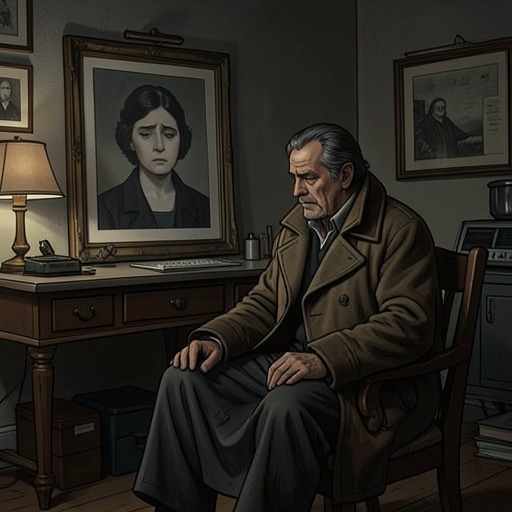
Ane Qaavigaaq—Moritz Jaspersen
Smilla's Sense of SnowAne Qaavigaaq and Moritz Jaspersen’s relationship is presented as a powerful attachment that neither settled into ordinary family life nor ended cleanly. Moritz followed Ane into the life she chose in North Greenland, left in anger, and was drawn back by longing; after her disappearance, his attachment persisted through memory and through Smilla, the daughter who recalled Ane to him. The relationship is inseparable from the contrast between Ane’s independence and Moritz’s estrangement from the world in which she lived.
Unequal Worlds
Moritz was in his early thirties when he came to Greenland and met Ane. The narrator frames their difference through the lives they inhabited rather than through a simple contrast of temperament. Ane could move between forms of work conventionally divided by gender: she bore children and did domestic work, but also shot, paddled a kayak, and brought meat home. Her competence belonged to a life of practical necessity and mobility in North Greenland, not to an abstract idea of cultural difference.
That mobility was central to the limits of Moritz’s place in the family. He tried to persuade Ane to move onto the American base, but she refused; for her, as for those born in North Greenland, being cooped up was intolerable. Moritz instead followed her to a barracks built of plywood and corrugated tin after the Americans displaced Inuit residents from the base area. His decision to remain for four years, despite expecting only a month in what he regarded as a remote, inhospitable posting, signals the force of his attachment. The narrator imagines him willing to leave behind his golf clubs at any moment to follow Ane.
Attachment and Withdrawal
The relationship is described as a repeated movement between closeness and separation. Moritz was present but, in the narrator’s account, could not take a real part in family life; he seemed dangerous and captive in a land he hated, held there by a love he did not understand and over which he had little influence. When Smilla was three, he left—not simply through circumstance, but because his own character drove him away. The narrator recalls his departure as furious and profane, while describing the longing that brought him back as still more powerful.
The narrator interprets this cycle as a painful consequence of absolute dependence: love can carry hatred toward the beloved when that person seems to hold the only key to happiness. Moritz’s attachment therefore appears not as calm devotion but as an oscillation between total closeness and putting the North Atlantic between himself and Ane. The image of an invisible elastic force captures a bond that remained active even when he withdrew.
Family Life and Its Limits
Ane is remembered as the steady presence who stayed, set out nets, and braided Smilla’s hair. Moritz, by contrast, came and went, and his relationship with the children was slight. From her first six years, Smilla recalls only traces of him: his Latakia tobacco, the autoclave he used to sterilize instruments, and the occasions when he practiced golf by hitting balls across the new ice. Most strongly, she remembers the volatile mood he brought with him, which she understood as the sum of his feelings for Ane.
The narrator is careful about the limits of this childhood account. She cannot know what role Ane played in the couple’s failure, and recognizes that memory may have altered how she understands her mother. What she can say is that Ane remained in place while Moritz swung between merging with his beloved and fleeing from her. This uncertainty prevents the relationship from becoming a one-sided diagnosis: the emotional pattern is vivid, but its full causes remain inaccessible.
Disappearance, Grief, and Memory
Ane’s disappearance transformed Moritz’s attachment into grief. Smilla recalls that, after Ane vanished, part of Moritz seemed to have vanished with her; the world he inhabited lost its color and narrowed to black and white. His grief helps explain why he brought Smilla to Denmark: she was the one person who could remind him of what he had lost. He continued to face her hostility and rejection because the resemblance between daughter and mother offered brief relief.
The relationship thus survives in the novel less as a resolved shared history than as an inheritance carried by Smilla. Moritz’s love remains fixed on an absent person, while Smilla is made to bear the weight of that memory without becoming Ane. The narrator’s reflections on living within cultural difference rather than explaining it also clarify the limits of what can be known about the couple: Ane’s life cannot be reduced to Moritz’s longing or to an outsider’s account of Greenland. Their bond is enduring precisely in its incompleteness—an attachment shaped by incompatible needs, separation, and a loss that leaves no true closure.