Cryolite Corporation of Denmark
Smilla's Sense of SnowThe Cryolite Corporation of Denmark is a mining and research company whose history makes it more than the remnant of a depleted Greenland industry: its expedition records, divided archives, and concentrated decision-making connect the novel’s investigation to the control of mineral rights and information. The company’s visible legacy is a demolished Copenhagen plant; its less visible legacy is a system of records and relationships that reaches from Greenland fieldwork into government, military, and criminal networks.
Industrial history and decline
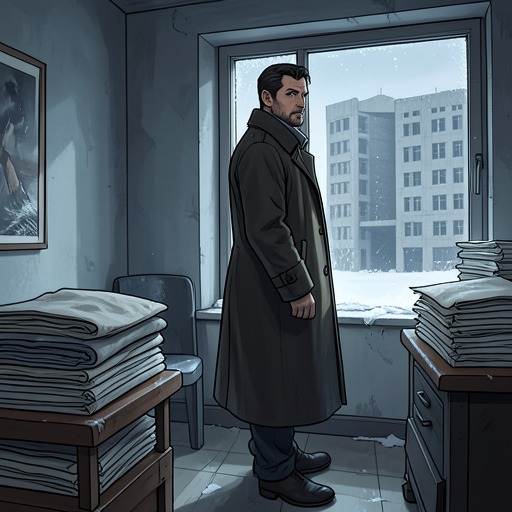
The corporation once occupied a substantial site at number 72B on Strand Boulevard, beside its competitor, the Øresund Cryolite Corporation. It had 500 employees, two laboratory buildings, a raw cryolite hall, a sorting hall, a canteen, and workshops. By the time Smilla visits, the industrial complex has largely disappeared: railway tracks, sheds and shacks, and a single red-brick building remain. The contrast between the former scale of the operation and its reduced physical trace gives the company’s past a material presence even as its business is being wound down.
The company’s principal resource came from the two large cryolite deposits at Saqqaq in Greenland, which were depleted in the 1960s. During the 1970s, the corporation shifted to other activities. It had also supported recurring geological work: every second or third year, it outfitted an expedition to Greenland. The transition from extraction to other corporate activity therefore did not end the company’s involvement in Greenland; it changed the means and institutional forms through which that involvement continued.
At the time of Smilla’s inquiry, the company is in the process of closing down and its foundation is being reorganized. Its director tells her that government representatives had sat on the board and that company papers are being transferred to the National Archives of Denmark. Access is not immediate: some records are classified as general resolutions and protected for fifty years, while personal files receive eighty years of protection. The director cannot identify which particular papers fall into either category. The archive transfer thus preserves the corporation’s documentary legacy while putting much of it beyond the reach of a present-day investigation.
Governance and concentrated authority
The company’s formal structure divides accountability among management, the board, and shareholders, but its practical balance of power is highly unequal. The finance director is also the executive chairman of the board. Although the company’s shares are distributed among the finance director, the government, and numerous heirs of the eight original mineral-rights partners, the heirs have never all been assembled for a general shareholders’ meeting. In practice, this gives the director unusually extensive influence over decisions, including those concerning Greenland’s economically important mineral rights.
The finance director’s authority is reinforced by credentials and public standing. He is described as both a lawyer and an accountant, a former city council member representing the Social Democratic Party, and a director on other boards, including housing associations and savings banks. The narrator’s account makes clear that the corporation’s authority is not simply a matter of private ownership: government participation, the dispersed shareholding, and the director’s multiple public and corporate roles all shape who can make decisions and on what apparent basis.
The company’s internal organization changes as its research activity expands. A permanent research group grows to twenty laboratory staff, following earlier periods when geologists, often from Finland, were hired temporarily. In 1967, the corporation forms the Advisory Scientific Commission, bringing together representatives of partner companies and institutions, including the Swedish Diamond Drilling Company, Denmark’s Underground, Inc., the Geologic Institute, and Greenland’s Geologic Survey. The commission is intended to help find new deposits, but its creation also makes daily work more secretive. New fees and expedition expenses complicate the bookkeeping, leaving unresolved questions about earlier sums, including 115,000 kroner recorded in 1966.
Records, expeditions, and concealed work
The corporation maintains a double archive in the basement of its Strand Boulevard building. The front archive contains accounts and correspondence, accessible to supervisors, bookkeepers, the chief accountant, and sometimes department heads. Behind it is a more restricted archive holding expedition reports, mineral samples, a wall of topographical maps, and a case of geological drilling cores. Access to this second archive formally requires permission from the board or director. The arrangement embodies a distinction between routine corporate documentation and the records, samples, and maps that could disclose what the company’s field operations had found or done.
The archive is important to Smilla’s inquiry because the corporation’s accounts and expedition records can be read together. A former chief accountant tells her that she believes 115,000 kroner in 1966 may have paid to charter a ship, and that someone acting under the corporation’s name sent two expeditions to Greenland’s west coast. The evidence is presented as her interpretation, not as a confirmed accounting conclusion. Still, it places the company’s ordinary financial records beside the possibility of expeditions whose purpose or sponsorship was not openly recorded.
The corporation’s geological activity is documented by its report on the July–August 1991 expedition to Gela Alta, whose stated purpose is to investigate granular ruby deposits on the Barren Glacier. The report lists five European expedition members, including the Arctic ethnologist Andreas Fine Licht, and identifies support from the Institute for Arctic Ethnology. Smilla later encounters a copy of the report whose final six pages are original, technically flawed aerial photographs of the glacier. The report and photographs show how corporate expeditions turn remote fieldwork into institutional records—and how those records become clues when the company’s official account is no longer sufficient.
The corporation’s relationship with Greenland also belongs to a wider structure of authority. Smilla recalls that teachers in Qaanaaq did not know Greenlandic and offered successful pupils advancement through Danish-language education, in a period when Greenland was officially designated Denmark’s northernmost county and Inuit were described as Northern Danes. She also rejects the outsider’s image of Thule as a preserved museum of innocence: her mother used a kayak made according to an older local design but hunted with a sealed plastic container as a float. These details do not make the corporation the sole agent of colonial policy, but they place its mineral and research operations within a setting where Danish institutions, military access, and local life do not share equal control.
From corporate network to criminal infrastructure
The corporation’s expedition work relies on forms of access and information that extend beyond ordinary geology. A navigator involved in its repeated expeditions has signed nine declarations of secrecy over twelve years, covering confidential map material, satellite and radar photographs, and meteorological observations supplied by the military. This evidence links corporate fieldwork to restricted military information, while also showing that secrecy is institutionalized through signed declarations rather than left to informal discretion.
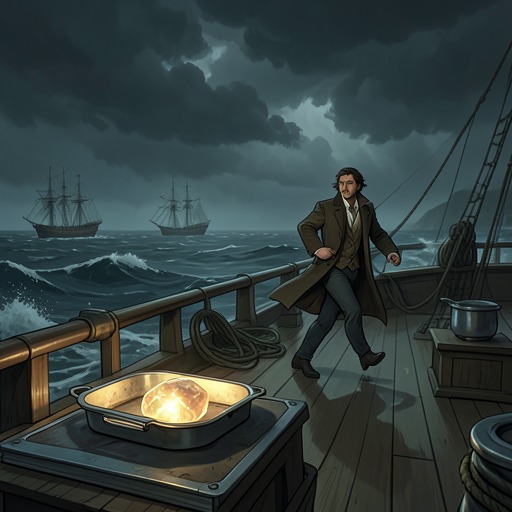
The company’s use as an organizational cover is made explicit when Smilla recognizes the broader network aboard the Kronos. She sees the ship’s crew as a group of people compromised and constrained by the system Tørk and Claussen created, and compares that network to the way Loyen and Ving made use of the Cryolite Corporation. The corporation is thus not merely a former employer or a source of archived papers: it is one of the existing organizations exploited by people pursuing concealed aims. The ship’s multinational crew and the corporation’s earlier institutional structure are not identical, but the comparison makes the method legible—use an established organization and its routines to carry work that would otherwise attract attention.
That pattern reaches into the company’s Greenland operations and the novel’s criminal plot. Smilla identifies Mayam as an intermediate product between raw opium and heroin, developed by Tørk, refrigerated because of its high oil content, and included in an agreement between Tørk and Verlaine. She suspects the cargo may be delivered through a port such as Holsteinsborg or Nuuk, possibly using contacts on the Greenland Star. Her account contrasts this new market with the earlier smuggling of liquor and cigarettes, describing cocaine as plentiful in Nuuk and connecting the trade to a Greenlandic upper class living in a European manner. The corporation’s broader significance lies in this continuity of infrastructure: institutions built for resource extraction, research, and administration can be repurposed to move information, personnel, and illicit goods.
Narrative significance
The company is encountered through objects and documentary fragments as much as through direct institutional action. A model of the S.S. Johannes Thomsen of the Cryolite Corporation of Denmark stands on a windowsill, an incongruous emblem of corporate presence in a quiet room. A widow’s pension letter records the board’s decision to grant Norsaq Christiansen’s widow 9,000 kroner a month, adjusted for the cost-of-living index, and bears the signature of Chief Accountant E. Lübing. Elsewhere, the demolished works, the double archive, the 1991 report, and the disputed 1966 payment reveal different faces of the same institution: employer, welfare provider, records custodian, expedition sponsor, and possible cover.
The corporation is therefore central to the novel’s critique of power that operates through ordinary procedures. Shareholder meetings that cannot be convened, archives whose contents are withheld, military data protected by confidentiality declarations, and research accounts complicated by new fees are not separate anomalies; together, they make access and accountability uneven. The company’s decline does not dissolve that structure. Even as its cryolite deposits are exhausted and its plant disappears, its records, scientific partnerships, and organizational methods continue to matter—both to Smilla’s search for what happened and to the hidden network that has learned to use institutions already in place.