Cryolite Corporation's twin archive rooms
Smilla's Sense of SnowCryolite Corporation's twin archive rooms are the physical center of an investigation into corporate and expedition records: one repository holds accounts and correspondence, while a second, restricted room preserves scientific reports, mineral samples, topographical maps, and drilling cores. Access depends on keys and an electronic safe, and the documents are subject to institutional secrecy and uneven oversight. The rooms therefore embody a central tension of the inquiry: a past that has been carefully filed can still be difficult to reach, while missing records make the archive’s silences as consequential as its contents.
Structure and Contents
The archive occupies the basement of the Cryolite Corporation’s building on Strand Boulevard. Its two rooms have different functions. The first contains the company’s accounts and correspondence, with access available to supervisors, bookkeepers, Elsa Lübing, and sometimes department heads. Beyond it lies a second archive, reserved for expedition reports and selected scientific materials; formally, access requires permission from the board or the director.
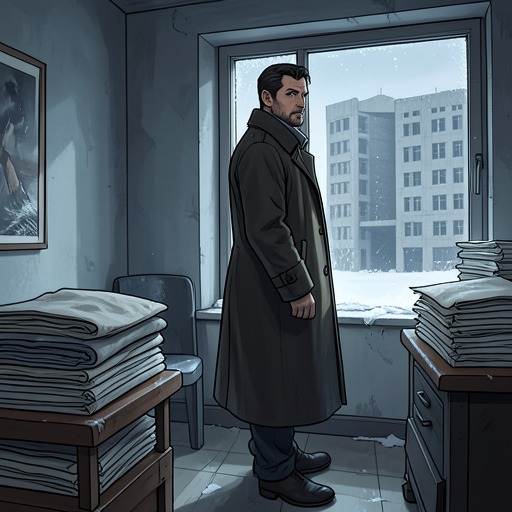
The first room extends beneath an entire wing of the building. It is low-ceilinged and lined with wooden shelves, holding large quantities of ledger paper wrapped in brown paper. The second room is arranged at right angles to the first. It has similar shelving, flat-drawer cabinets for topographical maps, and a hanging file containing hundreds of maps, some secured to brass rods. A long, locked wooden cabinet stores drilling cores—geological samples described as roughly the size of a narwhal tusk. The repository thus brings paper records and physical evidence together, preserving different kinds of traces of the company’s work.
Corporate Records and Restricted Access
The archive reflects a corporate structure in which financial oversight was substantial but incomplete. Elsa Lübing describes the company as partly state-supported, with the government represented on the board and holding 33.33 percent of the shares. Copies of the accounts were made using photostats, and portions were examined by the Audit Department. Yet cooperation with private-sector partners and the company hierarchy created complicated accounting arrangements. Some sections of the books were inaccessible even to Lübing, the chief accountant, and she believed a large corporation must also have kept a smaller confidential ledger.
The two archives formalize that uneven access. The accounts and correspondence occupy the more accessible first room; expedition reports and geological materials are kept behind it, under nominally tighter control. The building has no security system, but the basement archive key is kept in an electronic safe in the office. Lübing gives the protagonist the six-digit code, OS-1757, derived from the date she became chief accountant, and explains that one key opens both basement rooms. The practical security of the collection thus rests less on a sophisticated alarm system than on keys, controlled knowledge, and the trust involved in revealing how to enter.
This physical arrangement contrasts with the formal status of the company’s records. When the protagonist contacts the corporation, its director says the company is closing and its foundation being reorganized, and that the papers have formally been accepted by the National Archives of Denmark. Some documents, he says, are classified as general resolutions and protected for fifty years; others count as personal files and remain protected for eighty. Yet the papers are still physically held by the corporation, and the director cannot identify which materials fall under either category. Archival custody, legal transfer, and actual access do not coincide.
Finding the Expedition Report
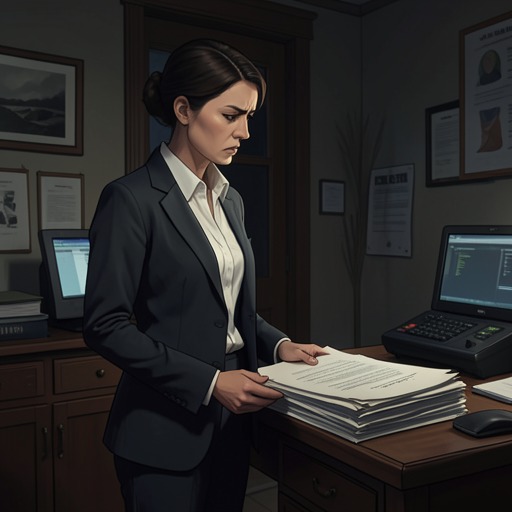
After entering the building, the protagonist passes through a small foyer whose two stairways connect the office above with the basement repository below. The office contains a large safe and a shared workspace, including the desk where Lübing spent decades as chief accountant. In the basement, the protagonist uses plastic bags to cover the high windows of the second room so that she can work with the lights on without being seen.
Lübing provides a precise guide to the reports: they are in a long wooden case on shelves above a bench, arranged alphabetically by the minerals sought. Volumes nearest the window concern expeditions with both geological and historical purposes, and the report the protagonist wants should be among the last. Following these instructions, she finds it in under two minutes. The document is a forty-page black ring binder, small enough to fit in her handbag. Its title identifies a Cryolite Corporation geological expedition to Gela Alta in July and August 1991, whose stated objective was to investigate granular ruby crystals on the Barren Glacier. The opening pages name five European expedition members, including Andreas Fine Licht, a professor of Arctic ethnology.
The report’s discovery makes the archive an active instrument of investigation rather than merely a setting. Its filing system—by mineral, shelf location, and expedition purpose—both organizes the company’s knowledge and makes a particular document findable to someone who knows how to navigate it. But the protagonist’s hurried removal of the binder also shows the difference between discovering a record and gaining legitimate or lasting access to it.
Gaps, Evidence, and Significance
The archive’s contents are not complete. At Moritz Jaspersen’s clinic, where he examines X-rays that Jean Pierre Lagermann has taken from the Institute of Forensic Medicine, the expedition report for 1966 proves to be missing. Its absence matters because the surviving evidence includes X-rays of the dead expedition members, and Lagermann’s examination raises questions about how the explosion occurred. The missing report cannot settle those questions; its removal instead marks a break in the documentary chain that might connect the images to the expedition’s official account.
Elsewhere, old laboratory equipment found in a firelit room at Gela Alta offers another kind of historical trace. Tørk Hviid identifies an electrophoresis apparatus as equipment Loyen brought on the 1966 expedition, when the investigators still believed they were dealing with some form of organic life. The instrument is not itself part of the archive, but it underscores the larger evidentiary pattern: the investigation reconstructs the past from records, images, samples, and surviving equipment, each with its own custodial history and limitations.
The twin rooms concentrate the novel’s concern with who can preserve, classify, inspect, or withhold evidence. Ledgers, confidential accounts, expedition reports, maps, and geological cores sit within one corporate institution but under different regimes of access. Official transfer to national custody does not immediately make the papers accessible; a report can be located and carried away while another is simply absent. The archive consequently represents both accumulated knowledge and the structures that govern its circulation: what can be verified depends not only on what was recorded, but also on who controls the records and whether the relevant trace still exists.