Gela Alta Island
Smilla's Sense of SnowGela Alta Island is a remote Arctic landmark whose apparent insignificance on a chart conceals its importance to the voyage of the Kronos and the novel’s final investigation. The island is described as the only one far from the coast before Ellesmere Island; it is associated with bad weather, restricted access, and a meteorite embedded beneath the ice. Its geography makes it at once a navigational clue and a place where the ship’s otherwise unexplained purpose becomes legible.
A nearly invisible landmark
Gela Alta Island first takes shape through the way it appears on a chart: under a ruler, it is only a dot, almost too small to see. Smilla identifies it as the only island so far from the coast before Ellesmere Island, and says it was discovered by Portuguese whalers during the previous century. That concise geographical description gives her a basis for reading the Kronos’s route, even though the vessel’s destination has not been disclosed to her.
The island’s small mark on the chart contrasts with the elaborate systems used to represent the Arctic. Smilla can read landscapes through maps, radar imagery, satellite scans, and other forms of cartography, treating them as different alphabets for the terrain. Gela Alta is therefore not merely a named point in empty space: its significance depends on the skill of interpreting a sparse mark against the larger route, and on recognizing what that point makes possible.
A destination that resists approach
When Smilla raises Gela Alta as the Kronos’s likely destination, the captain, Sigmund Lukas, recognizes it as a bird refuge. He describes it as a place where the weather is too severe even for birds, where going ashore is forbidden, and where anchoring is impossible. From his perspective, those conditions leave no apparent reason for a ship to go there. Smilla nevertheless bets that it is where the vessel is headed, turning a feature of the chart into a challenge to the ship’s official opacity.
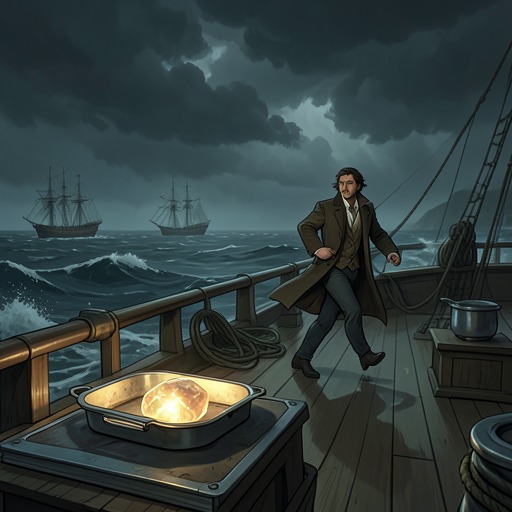
The voyage itself sharpens that contradiction. The Kronos is a 4,000-ton coaster with a couple of dozen men, heading toward a dangerous opening in the pack ice, while its passengers and crew have not initially been told their destination. Lukas tells Smilla that she is aboard only as a cabin attendant and that the earlier conversation was an employment interview; for the time being, the ship is following a northerly course without explanation. Against this deliberate withholding, the island’s identity offers Smilla a concrete way to infer the expedition’s direction.
The report and the object beneath the ice
The Gela Alta expedition report later gives the island a more specific setting in the narrative. Its final six pages are original, somewhat blurred and technically flawed aerial photographs of Barren Glacier. The images show an austere landscape associated with the island: cold, dry, wind-worn, and remote from the birds that might be expected at a refuge. The report also contains handwritten pages with figures and small sketches that Smilla cannot decipher, alongside a dozen reproduced X-rays whose subjects she cannot confidently identify. The material is suggestive, but does not immediately explain itself.
A later conversation provides the decisive link between the island and the voyage’s object. Peter Føjl tells Smilla that the target is a meteorite, described by Tørk as ancient, lodged in a kind of saddle in the cliff beneath the ice; the expedition intends to retrieve it. Smilla connects this explanation to photographs among Tørk’s papers, recognizing the Widmanstätten structure associated with meteorites. Gela Alta’s remote, hazardous setting is thus not incidental: it is the location of the concealed retrieval mission.
A landscape shaped by competing powers
The island’s role also belongs to a wider pattern in which access to Greenlandic territory is organized by outside institutions. In the account of Smilla’s Arctic expeditions, she has served nine times as navigator, using confidential maps, satellite and radar photographs, and military meteorological observations; each time, she has signed a declaration of secrecy. Such systems make remote geography knowable to selected expedition members while keeping its information restricted. Gela Alta’s remoteness is therefore both physical and institutional: the route is difficult, and knowledge of it is controlled.
The novel sets that control against Smilla’s own intimate geographical understanding. Her ability to interpret terrain is presented not simply as technical training but as a way of reading the land, an acquired vocabulary that can become transparent in practice. That distinction matters at Gela Alta, where the official expedition, the ship’s withheld destination, and the small island on the chart converge. What looks like an almost invisible dot becomes the point at which a hidden objective, a meteorite, and the larger machinery of exploration and development meet.