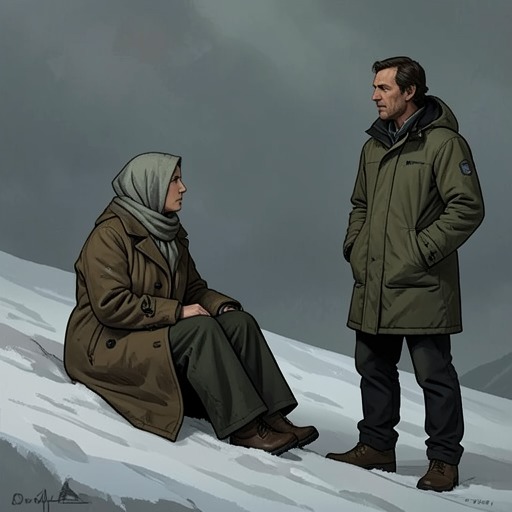
Peter Føjl
Smilla's Sense of SnowPeter Føjl, known throughout much of the narrative as the mechanic, is a close ally of Smilla whose few sharply observed scenes reveal both his practical intelligence and his guardedness. He helps her act when she is exposed to danger, yet the relationship is not reduced to utility: in a quiet kitchen scene, he asks whether he may kiss her, and her inability to answer leaves the approach unresolved. His characterization is built from such contrasts—technical competence beside difficulty with words, reserve beside loyalty, and a capacity for closeness that Smilla cannot readily receive.
Identity and Background
Peter’s occupation gives him the recurring name by which others identify him. The book also introduces him, through Smilla, as Captain Peter Fojl, Ph.D., a formal-sounding presentation that startles him when she makes it to Benedicte Clahn. Clahn responds by asking whether he is a historian too, while Peter freezes. The moment establishes the discrepancy between the imposing credentials Smilla supplies and the mechanic’s visible discomfort at being presented in that way; the scene does not explain the precise nature of his academic background.
Peter’s personal history is conveyed largely through the people around him, rather than through a sustained account in his own voice. The mechanic’s friend Birgo Lander is described as even more dyslexic than Peter, making Peter’s dyslexia a fact of his life, though its effects are not elaborated in these scenes. Later, Peter relays practical information about telephone surveillance that came from a colleague employed on the cleaning staff at the telephone company’s switching station on Nørre Street. The account describes how calls on a targeted number could be tapped through the telephone network after a court order. Peter’s contribution is concrete and cautious: he passes on what he has heard, then makes clear his dislike of telephones.
Actions and Practical Role
Peter’s usefulness to Smilla is grounded in material knowledge and assistance, not in a claim to authority. His information about the switching station gives her a reason to regard telephone communication warily; it also connects an ordinary workplace detail—the relay clips and the station’s phone system—to the possibility of police monitoring. The account comes to them in the mechanic’s living room, a private setting where information circulates through personal contacts rather than official channels.
His presence also helps connect Smilla with others who can act in the world beyond her immediate reach. When she meets Birgo, Peter is waiting on the sidewalk; after the two men shake hands, Birgo greets him with a look that suggests the feeling of being reunited with a long-absent older brother. Peter then withdraws slightly from the conversation, pushing his chair back while Smilla takes over the explanation. His retreat is not a break in the alliance: it shows that he can bring her into a useful connection without needing to dominate the encounter himself.
Relationships and Conflict
Peter’s most intimate exchange with Smilla occurs after she has spoken passionately about Greenland. She explains that the expanding number system, with imaginary square roots and complex numbers, offers a way to understand the formation of ice; she compares its receding horizons to Greenland and says that she cannot be without that landscape or bear being locked up. As she finishes, she finds herself standing in front of Peter. He asks, “Smilla,” he says, “can I kiss you?” The request is direct, but it is also explicitly framed as a question rather than an assumption of consent.
Smilla is unable to answer. She thinks of herself as a fierce woman with a big mouth, yet in this moment she feels betrayed and not properly heard, as though Peter has deceived her. At the same time, he does nothing to pressure her: he stands in front of the steaming pots and looks at her, and the moment passes. The scene preserves the mismatch between his attempt at intimacy and her reaction without converting it into a completed romance or a settled rejection. Her sense that he has not listened as he should have remains alongside the evidence that he is not bothering her.
Peter’s relationship with Birgo is conveyed in physical gestures rather than explanation. Birgo clasps the mechanic’s hand in both of his and looks at him as if reunited with a long-absent big brother; Peter, in turn, lets Smilla handle the discussion. Elsewhere, Peter meets the forensic expert after Smilla’s visit. The two men’s handshake is rendered as an awkward effort to reach one another: one stretches upward, the other hunches down, and they meet halfway. The comic image belongs to Smilla’s reflection on men who can manage intricate tasks together but become helpless when greeting a stranger. Peter’s place in that scene is not as an antagonist to the expert, but as a participant in a tentative, physically awkward connection.
Characterization and Narrative Significance
Peter is defined less by disclosure than by the small actions through which trust becomes visible: sharing useful information, waiting for Smilla, greeting a friend, stepping back so she can speak, and asking permission before moving toward her. The narrative gives him neither a full biography nor a decisive romantic resolution. Instead, his silences and practical interventions make him a point of steadiness in Smilla’s exposed, uncertain circumstances, while leaving the limits of his knowledge and the eventual shape of their relationship open.
The contrast between his mechanical identity and the scene of intellectual explanation is also telling. Smilla speaks in terms of mathematical abstraction and the immense horizons of Greenland; Peter’s response is not a counterargument but a personal request, one she experiences as a failure to meet what she has just expressed. The exchange does not establish that he intended to dismiss her meaning. It shows the distance between speaking about an irreducible attachment and answering it through intimacy, and allows Smilla’s confusion, rather than an easy romantic conclusion, to define the encounter.