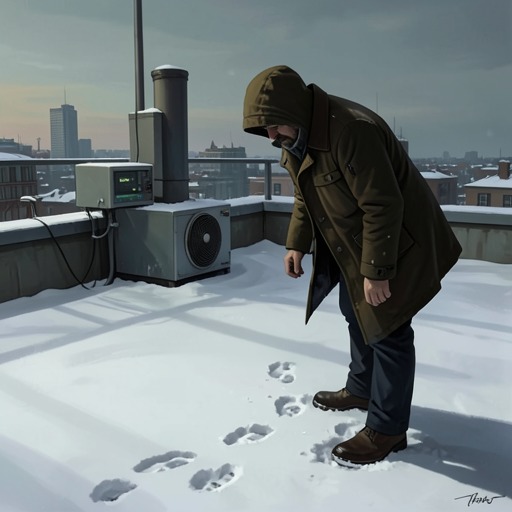
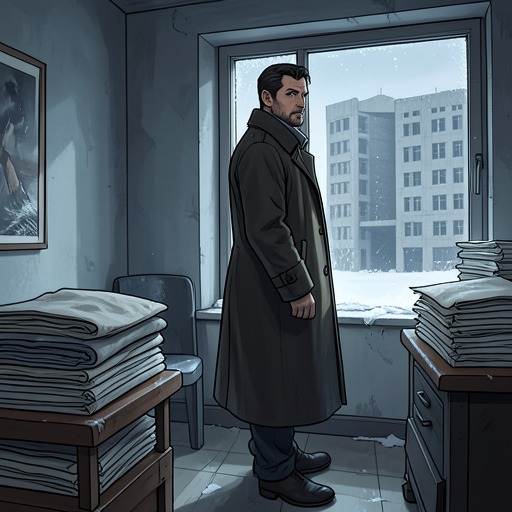
Smilla Qaavigaaq Jaspersen
Smilla's Sense of SnowSmilla Qaavigaaq Jaspersen is a Greenland-born glaciologist whose expertise in ice is inseparable from her childhood among Inuit hunters and her insistence on living knowledge over outside description. The death of Isaiah awakens in her a commitment she recognizes as absolute: she will not leave him in the lurch, even after her investigation meets institutional pressure and seems to reach a dead end. Her life is marked by a tension between scientific precision and an intimate, bodily sense of place—especially snow, ice, and the freedom of open space.
Identity and Background
Smilla was born in Qaanaaq on June 16, 1956, to Ane Qaavigaaq, a hunter, and Dr. Jorgen Moritz Jaspersen, a physician. She attended school in Greenland and Copenhagen, graduated from Birkerod High School in 1976, and studied glacial morphology, statistics, and fundamental problems of mathematics. Her career included planning Danish and French expeditions to North Greenland and scientific work from 1982 to 1985 on the ice cap, the Arctic Ocean, and Arctic North America. Her publications include work on glacial morphology and mathematical models for brine drainage from sea ice.
The official record captures the range of her qualifications but not the full measure of her field competence. A Sirius Patrol officer complained that she would not drive a dog team, yet recommended her as a navigator for any civilian expedition, even if the team had to carry her. Smilla’s answer was that she was cautious. The contrast is characteristic: she does not confuse mastery with bravado, and her authority rests on observation and orientation rather than conformity to an expected performance.
Her connection to Greenland is not presented as a simple claim of belonging. Smilla says that when she starts talking about Qaanaaq, she begins to lose what has never truly been hers. She understands another culture not through ranking or abstract comparison, but through living within it, asking to be tolerated as a guest, and learning its language. In this account, understanding arrives wordlessly; explanation can become a way of distancing oneself from the thing explained.
Childhood and Lived Knowledge
Smilla’s mother, Ane, moved across roles that her society’s conventional categories would keep separate. She gave birth to children, cared for skins, and took part in domestic life, while also shooting, paddling a kayak, and hauling meat like a man. This was not the renunciation of family life associated with some historical accounts of women who hunted as men did. Smilla sets Ane’s example beside Inuit stories and records of women hunters to show that gendered capacities could be understood as less fixed than European conventions allowed.
Ane’s hunting skill emerged in a moment of necessity. When Smilla’s maternal grandfather began losing his sight, the family faced the prospect of inadequate welfare, starvation, or dependence on relatives who also lacked enough. During a seal hunt, he missed an uuttoq; Ane stayed behind while he checked the line, and when the seal resurfaced, she shot it. The episode gives her later hunting life a concrete foundation: it is an answer to danger and material need, not an abstract symbol of cultural difference.
Smilla’s childhood knowledge is also formed through hunting, hunger, and attention to what a catch means beyond its immediate use. After she and her companions had gone twenty-four hours without food, she caught three birds with a net. The birds were females carrying food to their young. Seeing their eyes as tunnels leading to their chicks, and from there to a narwhal pup whose birth she had witnessed, Smilla turned the net over and released them. The moment does not erase the earlier birds that had been killed and eaten; it changes how she sees the living chain behind a meal.
The language of snow likewise belongs to a world from which Smilla feels partly estranged. At Isaiah’s funeral, she names the snowfall qanik: large, almost weightless crystals falling in clumps and settling as pulverized white frost. She calls the language in which she knows the word no longer hers. The precise description shows that knowledge remains vivid even when her relation to the language and place has become uncertain.
Investigation and Commitment
Isaiah’s death turns private attachment into an investigative obligation. Smilla identifies the commitment not as a decision newly made but as a pact she must have held with Isaiah all along: never to leave him in the lurch. Her inquiry therefore carries the force of a relationship, even as it leads her into official records and encounters with people who would prefer that she withdraw her complaint and avoid speaking to the press.
When pressure is applied to keep the case undisturbed, Smilla recognizes anger rather than embarrassment in her own reaction. She describes herself as imperfect: more drawn to snow and ice than to love, and more readily interested in mathematics than in affection for other people. But she also knows herself to be anchored by something constant, which she calls a sense of orientation or a grip on Absolute Space. That conviction tells her that something is wrong before she can yet establish exactly what has happened.
Her investigation reaches an apparent limit when she concludes that she has come to the end of the road in examining Isaiah’s death. This is not the same as resolution. The narrative places that impasse beside her underlying commitment and her orientation toward what does not add up; the case can appear closed to institutional process while remaining unsettled for Smilla.
Spatial Freedom and Cultural Conflict
For Smilla, freedom of movement is not a convenience but a condition of life. She recalls that in Greenland there are no prisons, and that punishment is more often a fine for offenses that in Denmark would lead to imprisonment. In her account, the Greenlandic hell is a locked room. Her childhood seemed to take place almost entirely outdoors, and her mother could not imagine living in one place for long. Smilla describes her own attachment to spatial freedom as something she cradles and worships.
This history gives confinement a specifically cultural and personal weight. An official points out that imprisonment in a small, windowless, soundproof room would be particularly uncomfortable for someone raised in Greenland. Smilla’s response is not only fear of a physical enclosure: the threat bears on the open movement, changing places, and orientation through which she understands herself. Her background therefore makes institutional power felt in the form of space as well as law.
Smilla rejects systems that grade cultures according to European scientific standards. For her, such comparisons project Western assumptions rather than establish a meaningful hierarchy. Her criticism is grounded in the difference between categorizing a people from outside and learning through lived experience. At the same time, she does not claim uncomplicated possession of Inuit life; her awareness that she can lose Qaanaaq by speaking about it keeps her account attentive to distance, inheritance, and partial belonging.
Narrative Role and Significance
Smilla’s first-person perspective makes her both investigator and interpreter. Scientific training gives her a vocabulary for measurement and pattern, while her childhood gives her detailed knowledge of hunting, hunger, weather, and open space. The novel’s movement between these modes resists the idea that one can simply replace the other: field expertise matters, but so does the practiced attention that cannot be reduced to formal credentials.
Her account also holds contradiction without forcing it into an easy solution. She can value mathematics and distrust the cultural scales through which European science ranks peoples; feel closely connected to Greenland and acknowledge that it has never fully been hers; and describe herself as more responsive to ice than to human affection while remaining bound to Isaiah by an unbreakable promise. These tensions define her not as a representative of a single culture or idea, but as a person whose orientation is tested by grief, investigation, and the threat of confinement.