Smilla's fear of confinement
Smilla's Sense of SnowSmilla's fear of confinement is the vulnerability an official threat turns into leverage, bringing her investigation of Isaiah’s death to a limit. For her, imprisonment is not an abstract penalty: the locked room is a distinctly Greenlandic image of hell, and the loss of spatial freedom reaches back into childhood. The confrontation reveals how authority can exploit that history to make a threat effective before it is carried out.
The Threat as a Demonstration of Power
The meeting is framed as a demonstration of what the official can do. He tells Smilla that she can be jailed at any time, placed in solitary confinement, or put in an isolation tank, and claims that no judge would hesitate after seeing her dossier. The threat is specific not only about punishment but about its apparent legitimacy: her record, he implies, could be made to authorize it.
His warning is backed by a display of surveillance and access. He has obtained information Smilla sent to Greenland’s government and military, tracked her movements, and reached into archives. He has even summoned an intelligence officer at six in the evening during Christmastime. The accumulation of these examples is meant to establish authenticity: the threat is not bluster, because the machinery behind it has already demonstrated its reach.
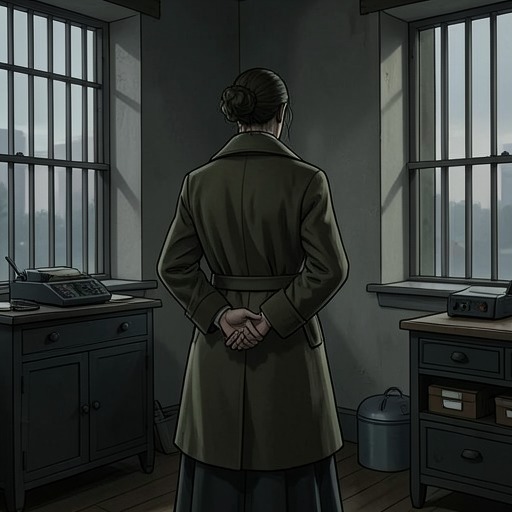
Smilla recognizes the point of the performance. He has wanted her to understand that he can act against her, and she concludes that he has succeeded. Beneath the visible proof of his power lies a more personal knowledge: he knows that confinement is not merely an unpleasant prospect for her. The meeting shifts from surveillance to psychological pressure when he names the locked, windowless room as especially uncomfortable for someone who grew up in Greenland.
Childhood and Spatial Freedom
The threat draws its force from Smilla’s account of Greenlandic life and punishment. She explains that there are no prisons in Greenland, and contrasts Greenland’s frequent use of fines for offenses that would lead to imprisonment in Denmark with the European image of hell as a rocky landscape and pools of sulfur. In her formulation, Greenlandic hell is a locked room. The contrast makes imprisonment feel less like a familiar legal sanction than a particular cultural and personal terror.
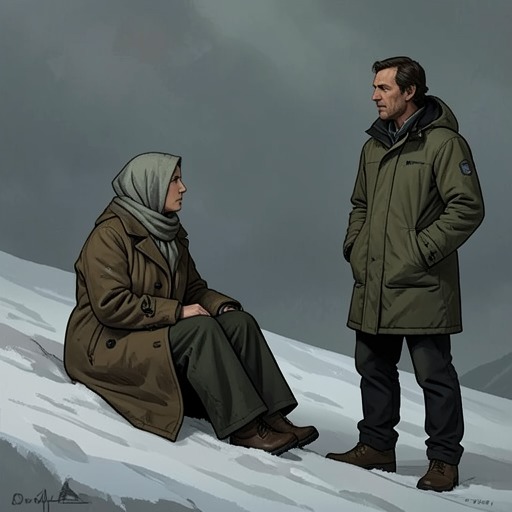
Her memories explain why that image has such power. In childhood, it seemed that she and those around her were never indoors. Her mother found it unthinkable to remain in one place for a long time. Smilla connects that upbringing to her own attachment to spatial freedom: she cradles it as if it were a baby and worships it as if it were a goddess. Her striking comparison to the way men feel about their testicles gives this attachment a bodily intensity. Freedom of movement is not a preference that can be traded away without consequence; it is something she guards as part of herself.
The official’s threat therefore works by joining state power to private history. A soundproof room without windows is not simply a possible location of detention; it is the negation of the open, mobile life that shaped Smilla. The precision of his threat suggests that he understands the difference between saying that she might be jailed and identifying the form of confinement most likely to frighten her.
Power, Fear, and the End of the Inquiry
Smilla describes no sadism in the man who threatens her. Instead, she sees a precise, perhaps faintly melancholy understanding of the instruments available to him. That observation sharpens the scene’s menace: the threat does not depend on visible cruelty or uncontrolled anger. It is delivered as measured knowledge of how authority can be exercised and of what will hurt its target most.
The scene closes with a consequential limit. Smilla says she has reached the end of the road in her investigation of Isaiah’s death. The text places that stopping point immediately after the threat and her recognition of the official’s power, linking the pressure of confinement to the obstruction of her inquiry without claiming that her fear is the only reason for its end. When the two stand, their cups remain untouched and the tea has gone cold. The abandoned tea gives the meeting a concrete, quiet ending: the exchange has produced no ordinary hospitality, only the knowledge of what can be done to Smilla.
Confinement thus functions both as an intimate fear and as an instrument of political control. The official does not need to imprison Smilla in this scene; the credible prospect of a locked room is enough to establish his authority and coincide with the closure of her investigation. Her recollection of Greenland also refuses to treat that fear as an inexplicable weakness. It has a history in a way of life shaped by movement, and it exposes the cultural distance between Greenlandic punishment and Danish imprisonment that the threat deliberately exploits.