Svajer Wharf
Smilla's Sense of SnowSvajer Wharf is a berth in Copenhagen’s South Harbor and the point where Smilla’s investigation first takes her aboard the Northern Light. Introduced as a quiet harbor basin set apart from the industrial city, it becomes a place of accumulating unease: the ship is immaculate but apparently empty, the dock is revisited under darkness, and a man found aboard has been bound and killed. The wharf’s shift from picturesque arrival point to scene of concealed violence gives it a decisive role in the story’s movement from inquiry to danger.
Setting and Approach
Svajer Wharf lies in the South Harbor, at berth 126. After a telephone conversation directs her there and tells her to ask for the curator, Smilla travels by train to Enghave Station and walks the rest of the way, having studied a map of Copenhagen at the library. The approach takes her away from the crowded inner city and into a harbor district described as nearly devoid of human presence.
The South Harbor is marked by coal smoke, chemical fumes, uncleared snow, and enormous trucks with dark windows. Industrial machinery supplies its sounds: cranes move above coal, welders crackle behind garage doors, and activity continues without voices. Against this landscape, the wharf opens suddenly into a basin ringed by low yellow warehouses. The water is frozen, and the low white-gold sun shines through the ice like a light beneath frosted glass. Small fishing boats with blue hulls sit at the wharf; farther out, the three-masted Northern Light occupies berth 126.
The Northern Light at the Wharf
At first, the harbor basin seems almost like a picture postcard, a contrast to the industrial landscape Smilla has crossed. The quiet is striking: she meets no one on the way to the ship, and the machinery sounds fall away behind her. A post bears a white mailbox and a large sign still wrapped in plastic. The ship itself is newly and lavishly renovated, with a black hull, gilded name, torch-bearing figurehead, and towering masts that give it the scale and bearing of a church.
Smilla boards by a gangway covered with a thick coir mat and fitted with railings capped by polished bronze knobs. The deck is crowded with wooden crates marked FRAGILE, planks, and paint cans, but every detail around them looks carefully maintained: ropes are coiled, the lacquered wood is dark and deep, and the white enamel gleams. The air carries the smell of polish, epoxy, and joint paste. This careful finish does not reassure her; it makes the ship’s apparent abandonment more conspicuous. A narrow ladder between the crates leads to an unlocked lacquered double door and a companionway descending into darkness. At the foot of the steps stands a motionless man leaning on a spear.
Return in the Snow
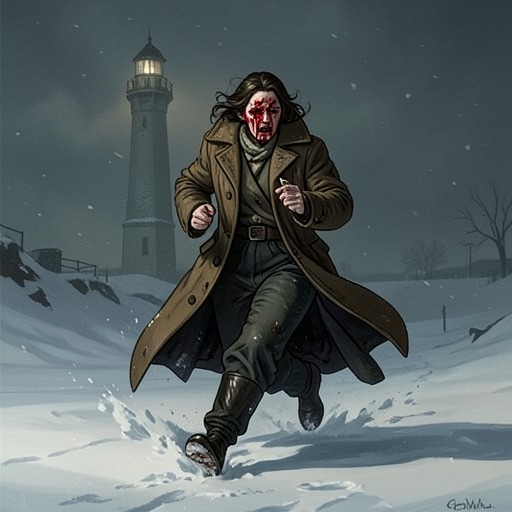
When Smilla comes back, the wharf has become a white surface under a dark sky. There are no streetlights; the cranes are silent outlines, and the new snow gathers the little light available. She follows the tracks of the only car that has been there. The sign remains wrapped in plastic, except for the small tear she had left in it, while the dock, gangway, and part of the deck have been cleared of snow.
Other changes are small but consequential: some crates have been moved to make room for a pallet of red barrels. Otherwise, the scene appears unchanged, and no light is visible aboard the ship. As she goes up the gangway, Smilla thinks through the car’s tire tracks. A tread leaves a slight backward slide within the track, and the tracks she followed lead down to the harbor but have no corresponding return trail. Since there is no other road to or from the wharf, the absent car becomes a concrete disturbance in the otherwise quiet scene.
Death and Narrative Significance
Inside, Smilla finds a man still wearing a smile-like grimace, his hands gripping the chair. On closer inspection, he is not holding the chair at all: thin copper wire binds his hands to it. His body is warm, but she can find no pulse or heartbeat. Cotton has been placed in both ears. The discovery transforms the wharf from a mysterious destination into the setting of a concealed killing; the neat, polished ship and the empty dock have not meant that the place was safe or truly deserted.
The wharf’s narrative force comes from the sharp contrasts built into its two visits. A bright patch of low winter sun gives way to darkened streets and fresh snow; a carefully renovated ship conceals death; apparent emptiness proves compatible with recent, deliberate activity. The small physical clues—the torn plastic, moved crates, red barrels, and one-way car tracks—make the setting legible as evidence. After identifying the bound man, Smilla’s curiosity gives way to the desire to go home. Svajer Wharf thus marks the point at which following a lead ceases to be an abstract investigation and becomes an encounter with immediate, physical danger.