Cem’s Gang and Djamel’s Gang Brawl in the Park
Sonne und BetonCem’s Gang and Djamel’s Gang Brawl in the Park grows out of an earlier assault on Lukas and a dispute over how he should answer it. The confrontation turns a demand to restore face into a sprawling fight: Lukas cannot bring himself to strike, but Cem attacks Djamel, and both groups rush in. The scene exposes how quickly fear, loyalty, and public humiliation can pull a gathering of young people toward violence—and how little control Lukas retains once it begins.
Causes and Retaliation
The brawl is set in motion after Djamel and his friends assault Lukas. When the group encounters Cem, Julius tells him they have just fought with the same boys. Cem immediately treats the attack as a collective affront, especially after hearing that Djamel insulted him. Lukas, whose nose is bleeding, would rather avoid another confrontation; Julius instead presses the grievance, while Cem decides that the group will go back to the park and retaliate.
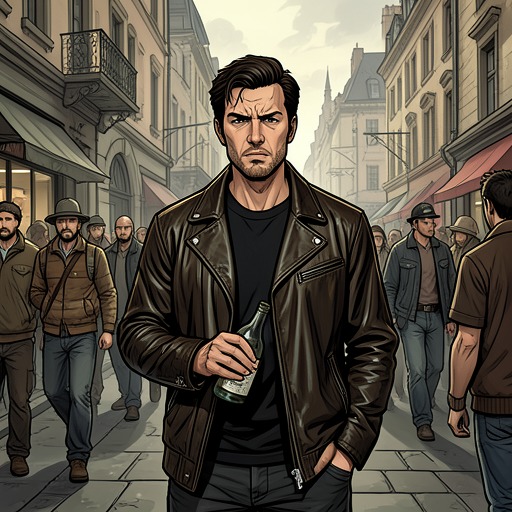
Cem makes Lukas’s participation part of that plan. He tells Lukas to strike the boy who hit him and hands him a heavy club, presenting the first blow as a test of whether Lukas will accept being beaten without answering. The weapon feels heavy to Lukas. He remembers having struck someone only once before, after his brother Marco told him not to put up with an insult, and that episode ended with fifteen people beating him. The memory sharpens the divide between the group’s expectation of an immediate show of courage and Lukas’s own reluctance to hurt someone.
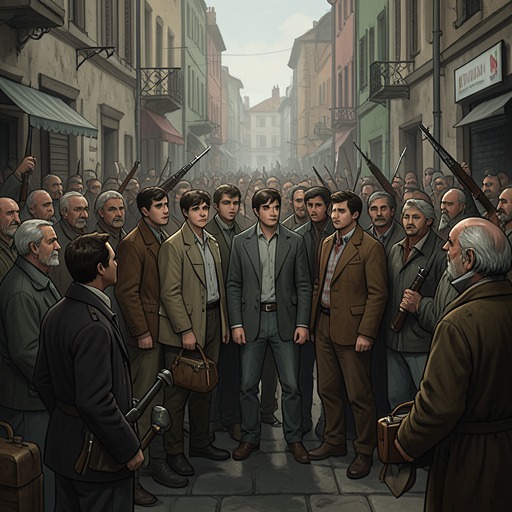
As they approach the place where Djamel’s group is gathered, Cem’s plan acquires the force of a public performance. Lukas sees at least ten boys by the bench; he suspects they may be laughing at a video they had made of him during the earlier assault. One of them whistles, drawing attention from residents leaning out of nearby apartment blocks, and the group begins moving toward Cem’s party. Cem’s brothers arrive behind them. Lukas walks ahead holding the club, trying to follow the plan to strike first, but when Djamel steps out and challenges him, Lukas stops. The expected act of retaliation falters before the assembled groups, leaving the confrontation poised to turn into a different kind of violence.
The Fight Breaks Out
When Djamel steps out from the crowd and challenges Lukas, the retaliation that Cem has arranged collapses at its first decisive moment. Lukas cannot make himself move. He looks toward Julius and Gino, shakes his head, and lets the club slip from his hand. The weapon passed to him as proof that he would strike back now lies in the grass; instead of becoming the group’s first attacker, Lukas stands frozen, unable to make sense of how he got there. Beside him, Cem stares at the other group, his pale eyes wide and fixed beneath his heavy eyebrows. The confrontation has become public and immediate, but Lukas’s paralysis leaves the challenge unanswered. Djamel mocks Cem for arriving with German companions, and Cem responds without speaking: he drives his left elbow into Djamel’s face. The blow splits Djamel’s temple, leaving his face covered in blood. Cem then shouts that he will kill him, turning the initial strike into a mass brawl. Djamel’s companions rush Cem; Engin grabs the club Lukas dropped and swings blindly, while Cem’s brothers arrive and pull attackers away, shove them down, and kick them. The fight no longer follows the planned sequence of Lukas striking first and the others joining in. It expands through overlapping blows and shouting, with no one person controlling its course. Gino breaks away first, telling Lukas he is leaving before he runs. Lukas sees Djamel gasping on the ground while Cem continues kicking him and shouting; he fears Cem may kick him to death. He jumps back, unable to watch, and turns to look for Julius, but cannot find him amid the chaos. Another boy runs up behind Cem and kicks him in the back, knocking him partly against Lukas. Cem looks at Lukas with the same wild expression, retrieves a knuckle-duster from his pocket, and charges back into the fight. Lukas again cannot locate Julius. Rather than remain among the fighting groups, he runs. His escape carries him past the adults and the bottle collector, then past the apartment block where the group had met Cem. At Johannisthaler Chaussee, Lukas stumbles down the stairs to the subway and catches a train just as its doors are closing, squeezing into the carriage at the last moment. He is left panting and sweating while passengers stare, especially some boys at the far end of the car. In the window’s reflection, the aftermath is visible on his own face: dust and dried blood cover it, and both eyes are bruised. The flight gets Lukas out of the park, but it does not restore the composure or control he lost when Djamel confronted him.
Public Shame and the Failure of Intervention
The retaliation is driven not only by Lukas’s injury but by the humiliation staged around it. During the earlier assault, Djamel confronts him after Lukas pulls Julius away, and Lukas forces himself to hold Djamel’s gaze because he fears that looking down will make him seem weak. After beating him, the boys smear blood on his shirt, grab his face, spit after him, and laugh as they leave. The later demand that Lukas strike back turns that public degradation into a test of whether he will reclaim standing through violence.
The scene also establishes how little protection the boys can expect from the people around them. A few metres from the injured Lukas, two adults smoke a water pipe, talk, and laugh; Lukas believes they saw the attack but did nothing. A bottle collector, by contrast, silently offers him a tissue. Neither response changes the danger, but the contrast matters: practical kindness arrives without authority, while the adults who might have intervened remain spectators. In the confrontation that follows, the boys answer that absence of help not by seeking protection but by gathering allies and preparing to retaliate.
The Institutional Prelude
The day that leads to the brawl begins with Lukas being shut out of school. He has forgotten his student ID, and the guard refuses to let him through under the new entry rules. Lukas points out the mismatch between the policy’s stated purpose—keeping outsiders and weapons off school grounds—and its effect on a student who normally attends. With the bell ringing and no teacher nearby to vouch for him, he gives up trying to enter and messages Gino, who arranges to meet him at Wutzkyallee. The immediate context is therefore not simply an encounter in the park: Lukas has already been diverted from school by a rule enforced at the gate, before the day’s violence gathers momentum elsewhere.
That beginning sharpens the contrast between formal control and actual safety. The school can bar Lukas for lacking a card, but the rule offers no protection once he is outside; later, adults witness his assault without intervening, while a bottle collector offers him a tissue. Against that backdrop, the park fight shows how the boys substitute retaliation and numbers for dependable protection. The brawl’s significance lies not in restoring Lukas’s security or dignity, but in exposing how quickly a failed attempt to manage danger through exclusion gives way to danger that the young people are left to confront themselves.