Fear of Exposure and Guilt
Sonne und BetonFear of Exposure and Guilt is the pressure that turns Lukas’s involvement in the school computer theft into a daily calculation of who knows, what can be proved, and whether silence can still protect his friends. His anxiety grows from rumor to suspicion as the stolen computers acquire a public trail, while the adults who might enforce rules appear alternately punitive, biased, or unable to help. The concept’s central tension is that Lukas fears the law’s reach but cannot fully trust its protection.
Rules, Absence, and the First Evasion
At the outset, the school’s entry rule makes Lukas’s precarious position visible before the theft is openly discussed. He has forgotten his student ID, and the security guard refuses to let him through the gate, even after Lukas insists that he is a regular student. The bell rings, the courtyard empties, and Lukas thinks of his repeated absences and the possibility of having to repeat ninth grade for a third time. With no teacher available to vouch for him, he gives up on getting inside and contacts Gino instead. A rule intended to control access therefore pushes him out of the ordinary school day and into another absence, establishing how quickly institutional attention becomes something to evade.
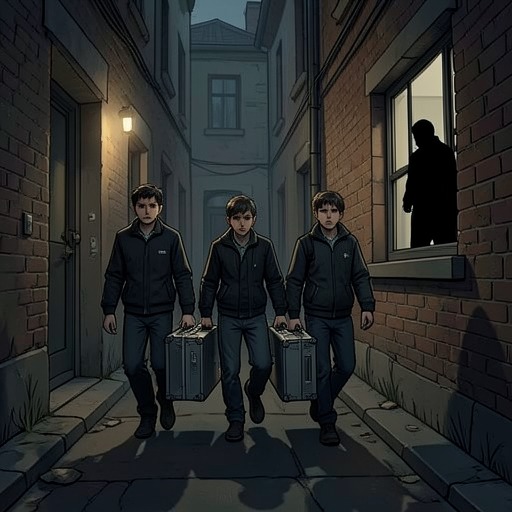
That unease acquires a sharper object when police officers address the class about the break-in. They report that computers and monitors worth several thousand euros were taken, apparently by three male suspects in black hooded jackets who transported the goods in a shopping cart toward U-Bahnhof Zwickauer Damm. Residents also reported gunshots near the station that same evening, though the officers cannot say whether the shots were connected to the burglary. The details make the crime public and potentially traceable. When Momo quietly remarks on the value of the haul, Lukas forces a smile; the class’s silence and the police account make the gap between what is known publicly and what Lukas knows privately feel increasingly dangerous.
Rumor, Evidence, and the Choice to Wait
The threat becomes immediate when Momo tells Lukas that Taner has spread word at school that Lukas was involved in the break-in. According to the account, a shopkeeper who was Taner’s uncle recognized that the group had tried to sell computers at his shop and told Taner about it. Lukas strikes his phone against his head, rushes downstairs to find Sanchez, and insists that the remaining computers must be thrown away so the police will have no evidence. His panic is not simply fear of being accused: he imagines the rumor reaching a teacher, then the police, and recognizes that the group’s silence may not hold indefinitely.
Sanchez resists the immediate destruction of the computers. He proposes waiting one more day to see what happens at school; if the situation worsens, the group can dispose of the machines in a canal, but if it does not, they can sell the remaining five computers with their monitors. He emphasizes the money still to be made, including another one or two thousand euros for each of them, while Lukas understands that destroying the computers would be the safer course. The exchange exposes two competing responses to guilt and danger: Lukas sees the remaining machines as evidence that should disappear, whereas Sanchez treats the prospect of exposure as a risk that might still be managed for profit. Lukas’s fear does not immediately make him act; friendship, money, and the hope that the danger can be delayed keep him inside the scheme.
Being Watched at School
When Lukas and Sanchez return to school, Momo is absent, and Lukas wants to avoid both seeing people and being seen. Instead, classmates stare, grin, whisper, point, and openly identify him as the person responsible. Sanchez tries to reassure him, but Lukas reads the looks around them as confirmation that the rumor has already spread. The attention is not proof of what the teachers or police know, yet it makes concealment feel impossible. Lukas’s suspicion that everyone is watching him turns the schoolyard into a public stage on which every glance can be interpreted as an accusation.
The police are still at school, and Lukas wonders whether they are questioning people, taking fingerprints, or acting on a tip. Herr Reinicke, a teacher with whom Lukas has not had lessons that year, then asks to speak with him after the first period. Reinicke’s serious manner and ambiguous suggestion that Lukas already knows the subject make the meeting feel like an interrogation before it begins. Sanchez argues that, if the police already knew enough, they would have arrested the boys; Lukas cannot accept that reassurance. Outside Reinicke’s office, a ringing telephone interrupts the conversation. Lukas waits in the corridor, shaking and struggling to steady his breathing, and considers leaving so that he can reach Sanchez and move the computers. Even a delay, not a formal accusation, is enough to make flight seem urgent.
When the conversation resumes, Reinicke asks directly what Lukas knows about the stolen computers. Lukas denies knowing anything beyond the newspaper and the police briefing, but he begins to tremble. Reinicke says that a teacher’s key was stolen during a lesson in Lukas’s class, then tries to recruit him as an informant. He frames the theft through racist assumptions about the other students and presents Lukas, as the only German in the class, as someone who should cooperate with him. The appeal is not evidence that Reinicke knows Lukas took part; Lukas concludes that the teachers still seem to know no more than they did on Monday, apart from the missing key. But Reinicke’s prejudice gives Lukas a possible shield: Lukas thinks that other teachers may discount what students say about Taner. He also recognizes the unfairness of that advantage and finds it disturbing. The episode makes concealment depend not on innocence or a sound investigation, but on the chance that racist disbelief will discredit the rumor.
Guilt, Silence, and the Limits of Authority
Herr Schiezeth’s response to the police announcement intensifies the threat of collective punishment. He explains that he had worked to secure modern equipment for the school, including dealing with government offices and allowing press coverage, and says that publication of the new equipment had been delayed to prevent the computers from being stolen. Because so few people knew about the equipment, he concludes that students from the school must have been involved. He promises that everyone responsible will be found and punished, including people who merely knew about the theft and failed to help solve it. Lukas leaves for the toilet feeling unsteady. Later, when Momo jokes that he should share the proceeds if he was responsible, the remark lands as another possible indication that others know. Lukas wonders whether the police, Herr Schiezeth, Osman, and Momo have all seen through him, while his dwindling phone credit prevents him from contacting Sanchez and Julius. The threat of punishment expands beyond the act itself to include silence and association.
Lukas’s understanding of authority is not simple faith in the police. When Karin describes a boy being targeted on his route, Lukas advises that the boy take a longer bus route through Alt-Buckow to avoid the people who harass him. He offers avoidance as the practical solution, rather than assuming the danger can be resolved by confronting the perpetrators. In another conversation, he challenges Julius’s decision to obtain Tilidin for Gino, asking why Julius does not call the police instead. Julius replies that he does not believe the police can help: Gino’s father beats Gino and his mother, keeps the family from leaving, and has taken Gino’s money. These scenes place Lukas’s fear of law enforcement beside a different fear: that official help may not protect those in danger. In the theft plot, the police represent possible exposure; in Gino’s home, they are an uncertain remedy. Neither position offers an uncomplicated route out.
The Pattern of Exposure
Across these episodes, guilt appears less as an admission than as the strain of maintaining a secret while constantly reading the world for signs that it has escaped. Lukas fears the public rumor, the remaining physical evidence, the police presence, Reinicke’s meeting, and even teasing from a friend. His silence protects his companions, but it also deepens his isolation and keeps him bound to Sanchez’s calculations about profit and delay. The recurring contrast between rules and their uneven application gives that fear its larger shape: a student can be barred from school for forgetting an ID, threatened with punishment for knowing about a theft, or offered a way to avoid suspicion through a teacher’s prejudice. Exposure is therefore both a practical danger and a moral pressure. Lukas senses the injustice in the protection available to him, even as he continues to rely on concealment.