Flee After a Failed Sale at the Computer Shop
Sonne und BetonFlee After a Failed Sale at the Computer Shop is the turning point where the boys’ plan to turn stolen school computers into quick cash meets an adult who recognizes what they are selling. A refusal at the counter becomes a confrontation, and the three split up in flight; Lukas escapes with a computer and monitor still strapped to his back.
From the Break-In to the Sale
The attempted sale follows a break-in the boys had prepared for with more confidence than caution. Julius first produced a lockpick, claiming it could open doors, cars, and cellars. Sanchez then threw down a large key ring; Julius abandoned the pick, and Sanchez’s wink left its connection to the school keys unspoken. At the school on a Saturday night, Sanchez unlocked the gate and led the way toward the entrance. Julius revealed that he had brought a silver blank-firing gun, an added danger that Lukas immediately understood could make an arrest much more serious.
Inside, the boys searched the storage area for the computers Lukas expected the school to have received. Julius grew frustrated, kicking a box and throwing a book, until Sanchez spotted unopened cartons on high shelves. They contained computers and monitors, about forty in all. Lukas stood on a step stool and passed the equipment down; Sanchez and Julius took the boxes and stacked them on the floor. The careful physical work of getting the machines out of storage gave way to the far less controlled challenge of finding someone willing to buy them.
A Buyer Recognizes the Risk
At an electronics resale shop, Julius tried to sell three computers with monitors for 1,500 euros. He argued that the flat screens made the price a good deal and that the machines could be sold on for twice as much. The man behind the counter shook his head, called into a back room, and then ignored Julius’s attempts to get an answer. Sanchez stopped Julius from escalating the exchange, pulled the computer back into a sports bag, and tried to leave the negotiation behind.
Julius instead treated the silence as an insult and accused the man of being unfriendly because Julius was German. He spat on the floor. The shopkeeper then slammed his fist on the counter, shouted at the boys, and came toward them. Three younger men rushed out of the back room, one carrying a baseball bat. The change is immediate: what had seemed to the boys like a simple transaction becomes a threat of violence, while their merchandise and their presence in the shop make retreat urgent.
A separate exchange with a shopkeeper makes the danger of selling the computers still more explicit. When Lukas says they are twenty, the man laughs, then points out that a large number of computers were stolen from a school only days earlier and that three students have suddenly arrived with brand-new machines. The boys have not made their goods look ordinary; their ages, the new equipment, and the recent theft fit together in the buyer’s eyes. The encounter reveals how quickly the attempted sale can expose the source of the computers.
The Flight Through Neukölln
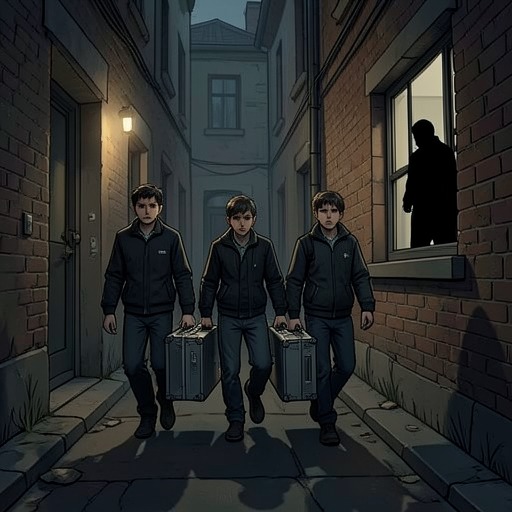
Sanchez shouts for the others to run and grabs the sports bag. Lukas clutches the straps of his own backpack and follows him and Julius outside. The sudden shift from the shop’s darkness to the midday glare briefly leaves Lukas nearly unable to see. Julius runs to the right, Sanchez to the left, and Lukas finds himself facing Taner, a student from a parallel class. Taner looks surprised and calls something out, but the noise from the shop and the street swallows his words. Lukas shakes his head and runs across a major intersection.
The computer and monitor in his heavy backpack strike his back with every stride. A car honks, but he does not stop. He turns toward Karl-Marx-Straße, where crowds and café tables force him to weave through the narrow street. People sit smoking hookah; the smell of grape tobacco and the hot coals beside the tables register in the middle of his escape, as does the person he bumps into, who curses at him. The stolen equipment is not an abstract risk: its weight follows him, announces itself with each step, and makes getting away harder.
A few hundred metres farther on, Lukas reaches a quieter spot and stops in a courtyard entrance. He looks back for the first time and sees no one following. He is out of breath and sweating, and he does not know exactly where he is, estimating that he is somewhere between Karl-Marx-Straße and Sonnenallee, in northern Neukölln, an area he does not know well. He sets the backpack down and hopes the contents have survived the run. Julius calls shortly afterward, and Lukas answers while still struggling to catch his breath.
Consequences and Significance
The escape prevents Lukas from being caught in the shop, but it does not turn the sale into a success. The group has been scattered, the buyers have become suspicious or hostile, and at least one student has seen Lukas fleeing with the stolen goods. The computer and monitor remain with Lukas rather than becoming money; the transaction has exchanged the boys’ expectation of easy profit for immediate exposure and uncertainty.
The episode also shows how the theft’s practical steps unravel in sequence. A key ring makes entry possible, a stack of new computers supplies the goods, and the resale shop is meant to complete the plan. But the boys cannot control what a buyer recognizes, how Julius reacts to rejection, or who happens to be outside. Their confidence that new equipment can be turned quickly into cash collides with the visible facts linking it to a recent school burglary. The flight is therefore more than an escape from one shop: it marks the moment when the stolen computers begin to threaten the boys as much as they promise to reward them.