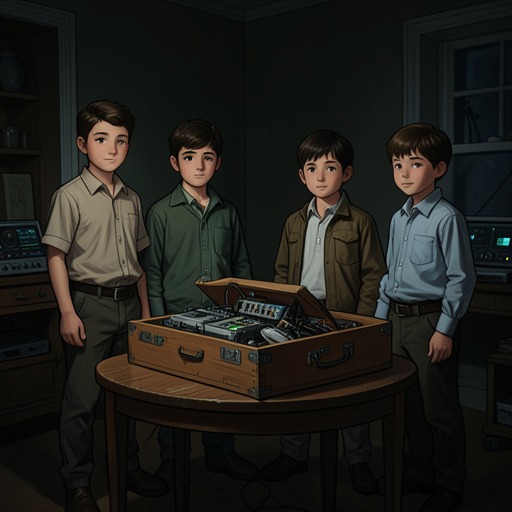
Four Plan to Steal the School Computers
Sonne und BetonFour Plan to Steal the School Computers is the turning point at which Sanchez’s access to a school key, his friends’ financial frustrations, and the prospect of a quick sale become a shared criminal scheme. The plan draws in Lukas only after he objects to it, and its promise of effortless money quickly gives way to the risks of a night break-in, an armed companion, and a buyer who sees through their story.
The Proposal and Its Appeal
Sanchez presents the opportunity as a windfall: the school is due to receive fifty new computers, complete with monitors, keyboards, and mice, and the boys can steal and sell them. He proposes a night-time break-in that weekend rather than taking anything during the day. The scale of the delivery gives his pitch a concrete target, while his talk of thousands of euros turns the theft into an imagined shortcut out of having no money.
The others respond differently at first. Julius and Gino show immediate enthusiasm; Lukas asks how the theft could possibly be carried out and warns that they could be caught. Julius produces a lockpick and boasts that it can open doors, cars, and cellars. Sanchez brushes the tool aside and throws down a large key ring. Julius recognizes its significance and abandons the lockpick; Sanchez’s key makes the proposed entry seem less like a risky technical challenge and more like a simple matter of letting themselves in.
Sanchez reinforces that impression with a sales pitch of his own. He proposes taking as many computers as they can carry, hiding them, and selling them to a technology-buyback dealer. He then assigns high prices to a computer and its accessories, multiplies the figures across thirty sets, and declares that each boy could receive twelve thousand euros. The arithmetic is part of the seduction: a speculative haul is presented as if the money were already theirs, and the ease of the imagined transaction helps suppress Lukas’s objections.
Resistance, Pressure, and Consent
Lukas is the last to agree. He recognizes that breaking into his own school could bring serious consequences, but the group does not treat his caution as a reason to abandon the plan. Sanchez dismisses the danger as a ten-minute job made easy by the key. Julius says he will help Gino even if Lukas refuses, turning the proposal into a test of whether Lukas will remain with his friends or be left out of their undertaking.
Gino’s commitment is bound to more than the promise of profit. When Lukas raises the possibility that Gino’s father might find out, Gino erupts: he says that his father already beats him, that he has no money for decent clothes, and that he wants some peace. The prospect of being beaten does not deter him because he expects the violence regardless. His outburst makes the theft a response, in his mind, to an abusive home and persistent deprivation, not simply an appetite for easy cash. Julius’s declaration of support further confirms that the group will proceed even if Lukas stays behind.
Lukas eventually looks from his friends to the key and joins them. He cites needing new shoes and not expecting his father to give him money. His consent follows the same economic logic as Gino’s, though the circumstances are not equivalent: for Lukas, the immediate appeal is being able to buy something his father will not provide; for Gino, money is entangled with violence and a desire to escape the conditions of home. The agreement gathers these different pressures under one shared fantasy of sudden wealth.
From Scheme to Break-In
On Saturday night, the plan moves from talk to action. The school stands in a quiet residential area where people are likely to be asleep, leaving the boys conscious that their presence may look suspicious. Sanchez has kicked out the lamp by the school gate, and the darkness offers concealment, but it does not make the location empty or safe. Julius adds another danger by revealing a silver blank-firing gun tucked into his waistband. Lukas understands that carrying it could make an already serious burglary appear armed, while Julius displays it with pride rather than treating it as a liability.
Sanchez directs the entry: he will unlock the gate, and the boys will cross by the basketball hoops to a door. They stop at the side entrance near the seventh-year classrooms. Lukas worries about a night watchman, cleaners, motion sensors, or cameras, and notices that the route would take them past the caretaker’s room and cleaning-supply rooms. His misgivings arrive too late to change the approach; Sanchez has already unlocked the door. The contrast between the elaborate confidence of the original pitch and Lukas’s accumulating questions exposes how little the group has established about who might be inside or what security the building has.
Once inside, they initially fail to find the computers and search the storage area in frustration. Sanchez spots unopened cartons on high shelves, with computers and monitors pictured on them. Lukas fetches a step stool and passes the boxes down; Sanchez and Julius take them from him. The shipment is not the fifty computers Sanchez had announced: Lukas estimates that the cartons hold about forty. Their discovery gives the plan its first apparent success, and Lukas describes handling the equipment as if in a trance. The computers have shifted from a promised delivery into tangible goods, but they still have to be removed and sold.
Exposure and the Limits of the Plan
The planned resale proves far less straightforward than Sanchez’s promise. At a computer shop, Lukas claims that he is twenty, apparently hoping that the boys will be taken for adults and not turned away. The shopkeeper laughs, then connects the circumstances: three schoolboys have arrived with brand-new computers just days after a large computer theft from a school. He asks whether they take him for a fool. The sharp shift from their expectation of a quick cash transaction to the seller’s suspicion reveals the plan’s central weakness: the goods are conspicuous, and their circumstances make an innocent sale difficult to believe.
The police later tell students at the school that computers and monitors worth several thousand euros were stolen over the weekend. According to residents’ accounts, three male suspects in black hooded jackets moved the stolen goods in a shopping cart toward U-Bahnhof Zwickauer Damm. The police also report that shots were heard near the station that evening, while making clear that they do not yet know whether the gunfire was connected to the break-in or whether the thieves were armed. The report does not confirm the boys’ identities or establish that the shots came from them; it does show how an attempted theft has become a public investigation, with details close enough to make Lukas fear discovery.
When the police invite students to provide information, Lukas considers admitting what he knows and wonders whether surrendering might bring a lighter punishment. Elsewhere, his argument with Matthias about the stolen computers exposes a different conflict: Lukas points to the everyday violence and weapons at school, while Matthias condemns the theft and dismisses what he sees as gang-related posturing. The plan therefore produces consequences beyond the immediate risk of arrest. It sharpens the divide between Lukas’s experience of insecurity and his father’s response, even as the attempt to turn school property into money begins to unravel under scrutiny.