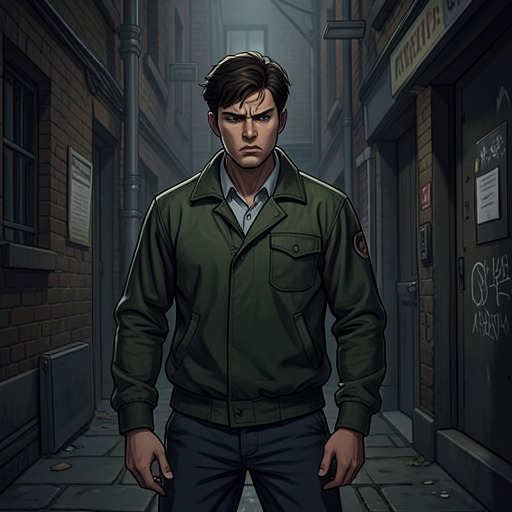
Gang Fight in the Park
Sonne und BetonGang Fight in the Park grows out of an assault on Lukas and a volatile attempt to answer it with further violence. Lukas is frightened, injured, and reluctant to fight; Cem’s insistence that he strike back instead draws several groups into a confrontation that quickly escapes anyone’s control.
Causes and Escalation
Before the brawl, Lukas and Julius encounter Djamel and his companions in the park. When Julius tries to refuse an offer from the group, he does so with a racist remark. Lukas pulls him away, prompting Djamel to challenge Lukas, shove him, and gather his companions around him. Lukas stammers an apology and tries to keep his gaze level rather than look down. The exchange ends with Djamel hitting him and leaving blood on his face and shirt. Nearby adults continue talking and smoking water pipe; a bottle collector, by contrast, silently offers Lukas a tissue. The assault thus leaves Lukas not only hurt but acutely aware that the people who witnessed it chose not to intervene.
Later, Julius tells Cem that the boys who attacked Lukas were the ones from the park. He describes their insults and presents them as having disrespected Cem, whose customers, he says, they had beaten. Cem responds by threatening to summon S44 and proposes that Lukas himself deliver the first blow. He presses a telescopic baton into Lukas’s hand and tells him to hit Djamel on the head, with a knuckle-duster as another option. Lukas knows how heavy the baton is and cannot imagine using it. His only previous attempt to stand up for himself, made after Marco urged him not to accept an insult, ended with fifteen people beating him. Yet Julius looks at him proudly, and the expectation that he must retaliate makes refusal difficult.
As Cem’s group approaches the bank, at least ten of Djamel’s companions are gathered there, laughing over a phone that Lukas suspects contains a recording of his earlier beating. One boy whistles; residents lean out from the apartment blocks to see what is happening. Djamel’s group advances, and two of Cem’s brothers arrive behind them. The public audience and the weapon in Lukas’s hand turn the proposed revenge into a confrontation in which backing down has already been made to look like another humiliation.
The Brawl
When Djamel steps out and challenges Lukas, Lukas freezes: the telescopic baton slips from his hand, and he cannot make himself strike. Cem, standing beside him, advances instead. After Djamel taunts him about arriving with Germans, Cem answers without speaking, driving his left elbow into Djamel’s face. Djamel’s temple splits, and blood covers his face. Cem then shouts that he will kill him; Djamel’s companions rush Cem, while Engin grabs the baton from the dry grass and swings it blindly. Cem’s brothers arrive and pull attackers away, but the park dissolves into shouting, blows, and kicks.
The fight turns Lukas’s planned revenge into a scene he cannot bear to watch. Gino grabs his shoulder, panicked, says he is leaving, and runs. Djamel is already gasping on the ground, yet Cem keeps kicking him. Lukas backs away and turns to flee; when one of Djamel’s companions kicks Cem in the back and Cem falls partly against him, Cem looks at Lukas with a wild expression, takes a knuckle-duster from his pocket, and charges back into the melee. Lukas cannot find Julius and runs without him, past the adults, the bottle collector, and the apartment block where they had met Cem.
At Johannisthaler Chaussee, Lukas races down the subway stairs and squeezes into a train just as its doors close. He is left panting in the crowded carriage, his face coated with dust and dried blood and both eyes bruised blue. As the train begins to leave, Djamel’s group reaches the platform carrying him between two people; his head is covered in blood and his eyes are closed. One of the boys who filmed Lukas tries unsuccessfully to open the doors, while the group strikes and spits at the departing train. Lukas escapes, but the sight of Djamel being carried away leaves the violence’s consequences unresolved.
Aftermath and the Logic of Avoidance
The immediate escape does not bring Lukas a clear account of what happened or a sense that the danger has passed. On the way away from the park, he uses his phone as a mirror to inspect his injured face and is relieved that Matthias is out all day and will not see him. He anticipates that his father will not understand that being beaten was not his fault, and thinks of the familiar maxim that the wiser person gives way as inadequate to the changed conditions around him. The incident therefore exposes a gap between an older ideal of avoiding conflict and Lukas’s sense that retreat does not prevent other people from choosing violence against him.
That tension returns when Lukas later advises Karin about a boy being robbed near Johannisthaler Chaussee. Rather than recommend that the boy confront his attackers, Lukas suggests taking a different route, even if travelling by bus through Alt-Buckow takes longer. His advice treats avoidance not as cowardice but as the only practical protection available when someone cannot defend himself and the attackers can continue taking what they want. The park encounter gives this counsel a concrete precedent: Lukas has been pushed toward retaliation by his friends, but when the confrontation becomes real he cannot strike, and getting away is what keeps him out of the continuing melee.
The episode also sits within a larger environment in which violence is described as routine rather than exceptional. In another conversation, Lukas tells his father that fights happen at school every day and that students carry knives; Matthias responds by criticizing the language and attitudes Lukas associates with Marco. The disagreement does not resolve the danger Lukas describes. Read alongside his later advice to Karin, the park fight marks a boundary between abstract arguments about toughness and the immediate calculations of someone trying to get through a dangerous place: carry out a revenge plan, risk being drawn into more violence, or find a way out.
A Reversal of the Revenge Script
The episode’s structure turns an announced act of retaliation into its opposite. Lukas is assigned the role of avenger, but the threatened blow never comes from him: his inability to move breaks the simple script of injury answered by injury, while violence proceeds around him through other hands. That reversal matters because it neither makes him victorious nor resolves the original humiliation. His escape is an immediate refusal of the fight’s logic, not proof that he is safe from it.
The closing view from the departing train preserves that uncertainty. Lukas gets away, while Djamel is carried to the platform with his eyes closed and blood covering his head; the attackers remain outside, striking and spitting at the doors. The train separates the groups physically, but offers no account of Djamel’s condition or what will follow. The scene ends on unequal, unfinished outcomes: Lukas has escaped the melee, and the consequences of the violence remain visible but unknown.