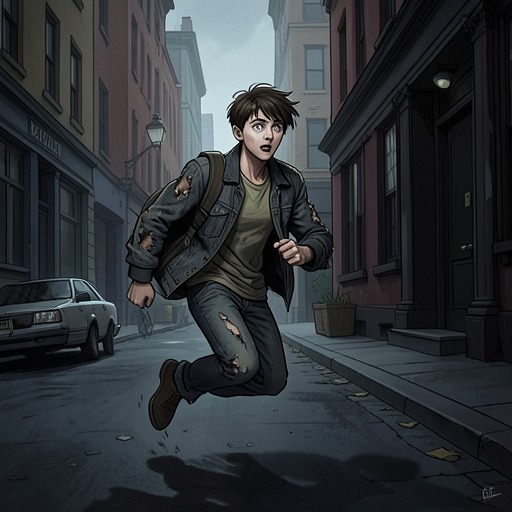
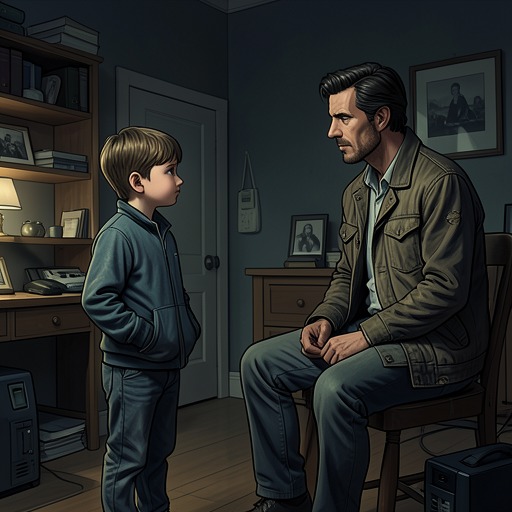
Gino’s Life in an Abusive Home
Sonne und BetonGino’s life in an abusive home is marked by the overlap of economic hardship, family responsibilities, and violence from his father. The novel first establishes the household’s precariousness in the details Lukas knows: both parents are unemployed, Gino’s mother shops, sometimes cleans for others, and takes care of tasks for Gino’s ill brother, while his alcoholic father is absorbed in drinking and playing the slot machines. The mother’s errands make the family’s needs visible in the neighborhood; the father, by contrast, is described as unable to manage anything beyond his addictions.
Household Conditions
When Gino meets Lukas near the video store to skip school, he looks anxiously around the public square, where a parent might pass by. His concern is especially focused on his mother, who regularly has reasons to be out doing errands. The scene places his truancy within a crowded family life and a neighborhood where privacy is difficult to come by. It also establishes how little dependable support the household seems to offer: his mother is occupied with work and care, while his father is portrayed as impaired by alcohol and gambling.
The abuse becomes legible through Gino’s body before he explains it. When he arrives at Julius’s apartment, his nose is swollen and his left eye is dark blue. Asked what happened, he avoids Lukas’s gaze and dismisses the question. Later, when Lukas warns that Gino’s father might beat him if the police bring him home after the planned theft, Gino erupts: he insists he has not simply fallen, says his father hits him regardless, and refuses to let Lukas speak about him. The contrast between his earlier silence and this outburst makes the injuries evidence of a recurring reality rather than an accident he is willing to discuss.
Violence, Money, and Risk
The injuries are not an isolated detail: Gino says his father hits him whether or not he gives the family a reason. When Lukas invokes the possibility that police might bring Gino home after a theft, Gino rejects the warning as beside the point. He says he has not merely fallen, and that being beaten is already part of what happens to him. His anger at Lukas’s reference to his father shows how urgently he wants control over the subject, even while the violence itself appears beyond his control. Lukas recognizes that he has crossed a line and is left unable to meet Gino’s eyes.
Gino’s decision to join the theft grows out of this pressure, but also out of material deprivation. The plan is to take fifty new computers from the school and sell them; Sanchez turns the prospect into a fantasy of thousands of euros for each boy. Gino does not answer the imagined fortune with a detailed plan of his own. Instead, he explains that he is tired of having no money and running around in shabby clothes, and that he wants peace. If his father will hit him regardless, he reasons, the risk of being beaten after the theft does not outweigh the chance to get money. His injuries, visible as he stands beneath the room’s lamp, make the argument painfully concrete: the promised cash is not simply a temptation but a possible way out of dependence, even though the means of obtaining it exposes him to further danger.
That calculation is made among friends, and their responses reveal both loyalty and pressure. Julius says he will help Gino even if Lukas refuses, while Sanchez insists that the boys should carry out the plan together and presses the imagined payoff. Gino repeats the promise of a share and urges Lukas not to turn away from him. The group offers solidarity, but it cannot undo the home situation that makes the offer of stolen money feel persuasive. Gino’s resolve comes not from confidence that the scheme is safe, but from his sense that the ordinary alternative already contains violence and want.
The father’s hold over Gino also appears in a quieter interruption. While Gino is visiting Lukas, his phone vibrates; he sees that his father is calling, goes into the living room, and shuts the balcony door. About a minute later he returns looking exhausted, says he has to leave, and offers no explanation. Lukas watches him go and expects, from past experience, that some time may pass before they meet again. The episode does not disclose what was said, but its abruptness and Gino’s changed appearance make the call another point at which family pressure cuts into his time with his friends.
The consequences continue to shape his place in the group. When the boys later divide the 800 euros earned from their first sale, Julius says Gino must receive an equal share, although Gino is not there; he is under house arrest and would otherwise have taken part. The 200 euros each boy receives cannot be treated as a simple resolution of Gino’s hardship: his absence marks the limits imposed on him at home, while the money comes from the same criminal scheme he joined because he felt he had so few alternatives. His abusive household thus presses on both sides of the story—helping make the theft seem worth the risk, then continuing to restrict his freedom after the first sale.
Violence Beyond the Home
Gino’s home life unfolds against a wider world in which violence is also public, collective, and difficult to control. In the park, a confrontation with Djamel’s group turns into a brawl: Cem strikes Djamel with his elbow, Engin grabs the fallen telescopic baton and swings blindly, and Cem’s brothers drag opponents down and kick them. Gino does not join the attack in the narrated moment. As the shouting and blows spread through the crowd, he grips Lukas by the shoulder and looks panicked. The scene does not equate this street fight with the abuse at home, but it places Gino amid another form of force whose escalation leaves little room for safety or intervention.
What Remains Unspoken
The novel never shows the conversation between Gino and his father: Gino shuts the balcony door, stays away for about a minute, then returns and leaves without explaining the call. Elsewhere, he initially brushes off questions about his swollen nose and bruised eye, before finally describing the beatings in a burst of anger. These silences and disclosures make the abuse visible through its effects without turning it into a fully narrated domestic scene. The reader is left with no account of any intervention or change at home; instead, the pattern emerges through Gino’s injuries, his guardedness, and the way an unexplained call can abruptly end time with a friend.