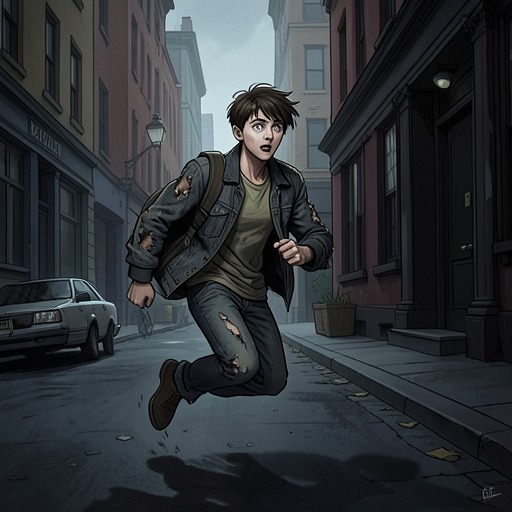
Gino’s Ongoing Confinement at Home
Sonne und BetonGino’s Ongoing Confinement at Home separates him from his friends while exposing the danger within his family. Described as house arrest, it keeps him out of sight and difficult to reach; later disclosures show that the home itself is not a safe refuge, but a place where his father’s violence leaves Gino feeling unable to protect his mother or escape with her and his brother.
The Restriction and Its Uncertain Boundaries
The confinement becomes visible through other people’s attempts to account for Gino’s absence. When Sanchez asks whether Gino has been in touch, Julius says he has not heard from him since the house arrest began. Lukas knows that this is not the whole truth: Gino had sent Julius a message on Saturday night. Lukas does not expose the discrepancy, partly because doing so would reveal that he had read Julius’s messages. The scene makes the silence around Gino more complicated than simple isolation: contact has occurred, but friends are withholding what they know from one another.
Lukas also raises Gino’s absence with his mother, Giovanna Ebert, while offering to help carry her groceries. She understands that he means the period since Gino was no longer allowed out, and says that his father, Henry Ebert, can be very strict. She has tried to persuade Henry to treat Gino differently, but says that challenging him is difficult for her as well as for Gino. Her account places the restriction within a household power imbalance rather than presenting it as an isolated disciplinary measure.
Friends as a Link to the Outside
Giovanna Ebert describes Julius as a steady presence in Gino’s life despite his confinement. Julius brings him things from school and spends time reading stories to Toni, whose reading has become difficult, or playing with him. Her recollection makes these visits practical as well as affectionate: they carry school materials into the home and maintain companionship for Gino and his brother when Gino cannot freely join his friends outside.
The contrast between this care and Julius’s earlier denial is significant. Julius’s answer to Sanchez obscures a recent message, while his repeated visits to Gino’s household suggest sustained involvement. The evidence does not explain why he conceals the message, but it shows that the friends’ communication is strained even as they continue trying to support Gino.
Confinement Within an Abusive Household
Julius later describes a more severe reality behind the house arrest. According to what Gino has told him, Henry beats Gino and Giovanna Ebert, drinks heavily, and has taken the 200 euros Gino received from the computer theft. Julius says Gino wants to leave with his mother and brother, but that his father will not let them go and locks them in. In Julius’s account, Gino sits in his room hearing his father shout and his mother scream, unable to intervene.
This disclosure recasts the confinement: Gino is restricted from leaving, but the family’s inability to get away from Henry is the deeper trap. Julius says Gino feels like a failure because he cannot help his mother. He has suggested that Gino knock his father unconscious long enough for them to escape, but Gino cannot bring himself to do it. Julius’s proposed intervention is itself dangerous, and Lukas challenges the idea of using Tilidin to address the crisis, asking why neither of them calls the police. Julius rejects that possibility, insisting that the police would not help. The episode leaves the confinement caught between violence at home, Gino’s inability to act, and his friends’ distrust of outside protection.