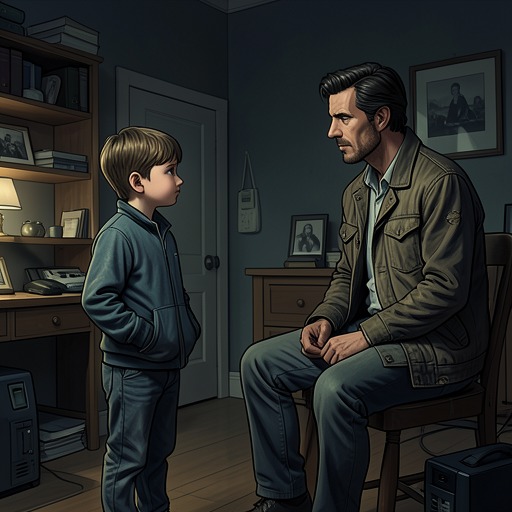
Ginos Hausarrest
Sonne und BetonGinos Hausarrest is the restriction that keeps Gino from leaving home and cuts him off from his friends. Its effects appear in small absences—no longer seeing him, not knowing whether he can be reached—and in Giovanna Ebert’s account of how difficult it is to challenge Henry Ebert’s strictness. The restriction is more than a family rule: in the context of Gino’s home, it forms part of a broader pattern of control and helplessness.
The Rule and Its Immediate Effects
Lukas learns of the house arrest when he asks why he has not seen Gino. He explains that Gino is not currently allowed out, and places their last meeting sometime the previous week. The restriction makes an ordinary visit uncertain: Lukas hesitates over whether to mention it to Gino’s mother, worried that doing so might make the subject uncomfortable.
Julius later tells Lukas and Sanchez that Gino has been under house arrest and claims that Gino has not contacted him since it began. Lukas knows of a message Gino sent on Saturday night, so Julius’s account does not fit what he has seen. The exchange leaves Lukas caught between exposing the lie and keeping quiet; he expects Julius would deny it and does not want to reveal that he has read the message.
The rule does not mean that Gino is simply forgotten. It changes the means by which his friends can reach him and makes information about him uncertain. An earlier exchange, when Lukas is turned away from school, shows Gino arranging to meet him; later references to the house arrest instead emphasize absence and restricted access. The contrast marks a change in their ability to meet, without establishing exactly when or how the restriction began.
Giovanna Ebert’s Account
When Lukas meets Giovanna Ebert, she asks after Gino and recognizes that he has not been seen since he was prevented from going out. She describes Henry Ebert as very strict and says she does not always understand his treatment of Gino. She tries to persuade him not to treat their son that way, but presents this as difficult to say to him. Her account makes the house arrest part of a strained family dynamic rather than an isolated punishment whose circumstances are fully explained.
Giovanna also stresses how much Gino’s friendships matter. She calls Lukas and Julius good friends and describes Julius bringing Gino things from school, reading stories to Toni when Toni has difficulty reading, and playing with him. These acts show how friends maintain ties across the separation: Julius’s visits and practical help offer forms of contact that the restriction itself cannot provide.
Confinement and the Limits of Help
The later account of Gino’s home gives the restriction a more serious context. Julius tells Lukas that Henry Ebert beats Gino and Giovanna, drinks heavily, and took the 200 euros Gino received from the computers. He also says that Gino wants to leave with his mother and brother but believes Henry will not let them go and will confine them. In this account, Gino’s inability to leave is bound up with the family’s wider inability to escape Henry’s control.
Lukas challenges Julius’s response to that situation, asking why he does not call the police rather than obtain Tilidin for Gino. Julius shouts that the police would do nothing. His reaction reveals how little faith he has in outside intervention, while Gino’s reported reluctance to strike his father leaves him feeling unable to protect his mother. The house arrest therefore sits within a larger impasse: Gino is kept at home, his family’s freedom is restricted, and his friends are unsure how to help without making matters worse.
Significance
Ginos Hausarrest is presented through its consequences for contact and friendship, not through a formal explanation of its terms or duration. Lukas notices Gino’s absence; Julius gives a disputed account of whether Gino has reached out; and Giovanna acknowledges both the hardship and her limited ability to change Henry’s behavior. Together, these moments make the rule a visible sign of the pressure within Gino’s household and of the distance between caring for a friend and being able to free him.