Giovanna Ebert
Sonne und BetonGiovanna Ebert, Gino’s mother, is presented through two sharply contrasting moments: a tender, candid conversation with Lukas in a supermarket and a later, panicked report of violence at home. Her memories of laughter, cooking, and friendship make the family’s deterioration tangible; the news she delivers at the end leaves Gino’s whereabouts and Henry’s condition uncertain.
Identity and Background
Lukas has not seen Giovanna for a long time when they meet again. He is struck by how much older and smaller she looks than he remembers, and by her exhausted appearance, as if she has not slept for several nights. The contrast is immediate: the woman before him seems worn down, while his recollection holds a more buoyant version of her.
That earlier Giovanna often cooked when Lukas and Julius visited and, in his memory, was usually in good spirits. She taught the boys Italian songs; Lukas can still recall the melody of one. Her familiar warmth is not erased by her present fatigue, but held beside it, giving the encounter its quiet sadness.
The Supermarket Encounter
The reunion takes place in a supermarket as Lukas chooses frozen pizza. He is hungry after a day without food and, now that he has some money, considers buying a branded pizza rather than the cheap multipacks he usually gets. Giovanna greets him by name, and he responds with the more formal Frau Ebert. She asks him to call her Giovanna, shifting their exchange toward the familiarity of their earlier visits.
Lukas offers to help carry her groceries, pointing out that there is quite a lot to take. Giovanna laughs and says she can manage, joking that she is old but not that old and that her home is not far away. Her laughter is significant because Lukas recognizes it as genuine, like the laughter he remembers from before. The exchange briefly brings their former ease into the present without hiding how different she now seems.
Their conversation returns to Gino. Giovanna starts to ask how he is, then hesitates; Lukas, unsure how to explain that Gino is currently not allowed out, stumbles through an answer. She understands what he means and takes a deep breath. Her response makes clear that Gino’s confinement is a source of difficulty for him and for her, not simply a rule she supports without question.
Gino, Henry, and the Friends
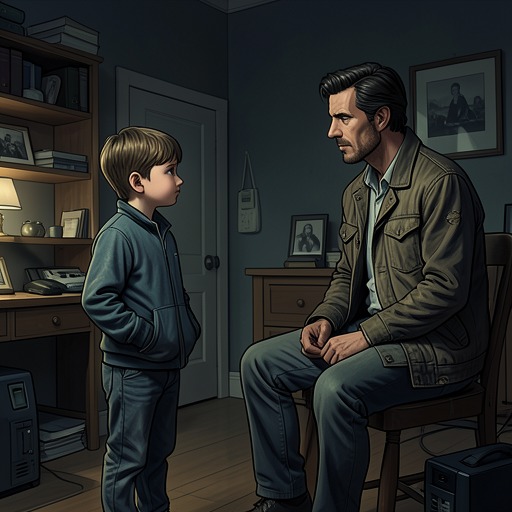
Giovanna says that Henry can be very strict with Gino. She does not always understand his treatment of their son and tries to persuade him not to be so hard on the boy, though she describes this as difficult to say to him. She also observes that Henry has changed considerably in recent years. Lukas’s recollection of the family’s earlier circumstances gives this change a material edge: Gino’s brother was then not yet so badly affected by an illness Lukas understands to be multiple sclerosis, and Henry still had a job; Lukas had not recognized at the time that Henry was an alcoholic.
Giovanna places importance on Gino’s friendship with Lukas and Julius, calling good friends the most important thing. She identifies care that is concrete rather than merely affectionate: Julius regularly brings Gino things from school and reads stories to Toni, who can no longer read as well, or plays with him. She sees that both boys have had difficult family lives. Lukas grew up without a mother, while Julius’s parents are also a source of trouble; she says Julius deserves a better family despite being such a good boy. Her remarks connect the friends’ loyalty to the hardships in their homes, and show that she notices the practical ways Julius supports her family.
At the freezer, Giovanna takes a three-pack of Margherita pizzas. She criticizes frozen pizza as inferior to fresh pizza made in an oven, then acknowledges that she buys it too because it is cheaper. The small admission links her Italian food traditions and playful complaint to an economic constraint she does not disguise.
The Family Crisis
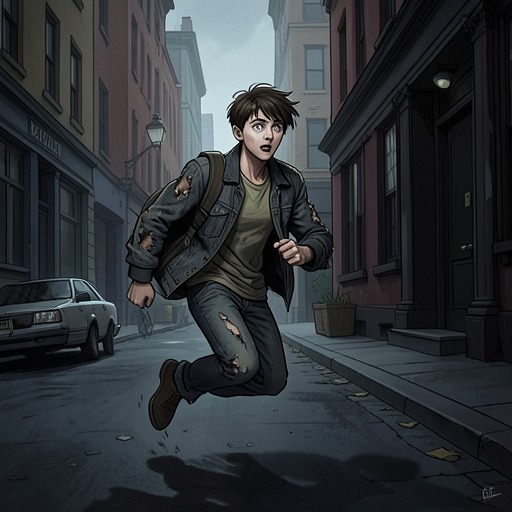
Later, the friends hear a distressed woman on Julius’s phone. The caller says Gino has run away, that everything is covered in blood, and that Henry is on the floor; she does not know whether he is still alive. Lukas recognizes the voice as Gino’s mother’s. She is hysterical and asks the boys to tell her immediately if they see Gino or hear from him. She has already called the police and an ambulance for Henry.
In a subsequent call, Julius reports that someone found Gino unconscious at a bus stop on Fritz-Erler-Allee and called for medical help. Gino is at Klinikum Neukölln, and his mother is already on her way there after being informed by the hospital. The friends do not know whether he will recover; Julius can only infer that Gino may be alive because the hospital has not told his mother otherwise. Giovanna’s actions in this sequence are limited but urgent: she seeks help for Henry, alerts Gino’s friends, and then goes toward her son.
Narrative Role and Significance
Giovanna is a secondary character whose importance comes from what her scenes disclose about Gino’s family and the bonds around him. In the supermarket, she gives Lukas a view of the household from inside it: Henry’s growing strictness, her effort to challenge it, and the friends’ role in supporting Gino and Toni. Her observations also reveal how the family’s present is unlike the more hopeful past Lukas remembers.
The later phone call turns that domestic strain into immediate danger. The woman who had laughed over groceries and spoken gently of friendship is now asking young people to help locate her missing son while an ambulance is needed for Henry. The book does not provide a resolution to her fear in these scenes. Instead, it leaves her heading to the hospital, with Gino unconscious and Henry’s survival still unknown, making her a point of contact between the friends and the crisis inside the Ebert household.