Gropiusstadt
Sonne und BetonGropiusstadt is more than the setting for the boys’ lives: its blocks, meeting places, and routes determine where they gather, whom they encounter, and how quickly ordinary movement can turn into danger. The neighborhood’s familiarity offers landmarks and vantage points, but it does not make its public spaces feel safe or its pressures easy to leave behind.
Urban setting and everyday life
The neighborhood first appears through ordinary outdoor details: high-rise blocks surround a playground where men drink on a bench, while a boy passing with music in his headphones recognizes some of them by sight. One seems to live in his building, yet does not return his greeting. The encounter gives the landscape a close, watchful quality: residents are familiar without necessarily being connected, and the prospect of adulthood is shadowed by the men who spend their days drinking nearby.
A video-rental shop and the large square outside it serve as a meeting point for Lukas and Gino when they skip school. The location is conspicuous precisely because it is central: Gino looks anxiously from side to side, aware that someone might see him, and his family’s circumstances make that possibility concrete. His parents are unemployed; his mother goes shopping, cleans, or attends to his ill brother, while his alcoholic father manages little beyond drinking and playing slot machines. Around the square, the neighborhood’s social and economic strain is not abstract background but part of who may pass by and what the boys fear being seen doing.
The built environment also holds a measure of remembered change. From a balcony, Lukas looks across at the white apartment blocks with their brightly colored balconies, opposite Lipschitzbad. He remembers the buildings as brilliant white from the time he attended after-school care and primary school there; now, he says, they grow dirtier every day. The view links the present landscape to childhood without making the past certain: the whiteness survives partly as memory, while the visible buildings register wear.
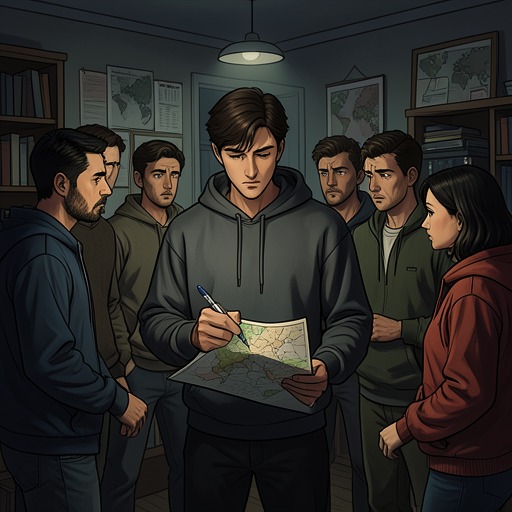
From above, the same district can briefly appear transformed. Lukas describes Dörferblick as a place from which all of Gropiusstadt can be seen, with a view that resembles New York, but rejects it as too far away. The group instead considers the rooftop of the car park at Lipschitzallee. The contrast is characteristic of the neighborhood’s geography: an expansive panorama exists, but the boys’ choices remain shaped by distance and by the nearby places they can reach.
Public space, confrontation, and escape
Gropiusstadt’s public spaces are not neutral ground: they bring people into view, make encounters difficult to avoid, and turn reputation into a practical concern. When Lukas, Julius, and Gino approach a park bench where a group has gathered, at least ten people are already there, laughing over a phone and apparently watching a recording of the earlier attack on Lukas. A whistle draws the group’s attention, and the boys see the gathering begin to move toward them. The bench is a familiar meeting place, but the audience around it changes the stakes: what began as a place to wait has become a public stage for another confrontation.
Djamel steps forward and challenges Lukas, who has brought a telescopic baton. Lukas finds that he cannot move; the baton slips from his hand. Cem, standing beside him, advances without speaking and strikes Djamel in the face with his left elbow. The blow opens Djamel’s temple, and the gathering erupts into a brawl: Engin picks up the baton and swings blindly, while Cem’s brothers pull people away, shove them down, and kick them. The rapid shift from a face-to-face insult to a fight involving the surrounding crowd shows how quickly a familiar patch of the neighborhood can become uncontrollable. Lukas’s immobility and Cem’s sudden violence are sharply opposed responses to the same public pressure.
The danger is not confined to one encounter. After Lukas has been beaten, he considers retaliation and exposure together: resisting could bring the attackers searching through all of Gropiusstadt or arriving at school in greater numbers. In his understanding, violence always has an aftermath, because those who feel challenged will not let the insult go unanswered. This expectation makes withdrawal less a simple choice than a calculation about where the next encounter might happen.
That calculation also governs travel through the district. Speaking to Karin about a boy being repeatedly robbed on Johannisthaler, Lukas recommends avoiding the route and taking buses through Alt-Buckow, even though the journey would take longer. He does not propose confronting the attackers or resolving the conflict through conversation; he presents concealment and rerouting as the workable protection. Karin’s silence registers the bleakness of that advice: in Gropiusstadt, knowing the streets can mean knowing which path to avoid, not how to make it safe.
Belonging, suspicion, and the school
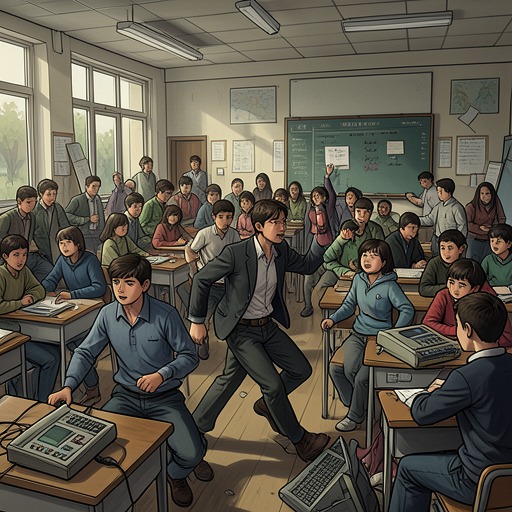
Gropiusstadt’s tensions also enter the school, where the neighborhood is made into an argument about who belongs and who can be trusted. After a newspaper reports the burglary at Gesamtschule in der Gropiusstadt, Lukas sees his school’s entrance pictured beneath the headline and realizes that the stolen computers are now a public story. Later, Herr Reinicke privately tries to recruit him as an informant, claiming that the thieves must be immigrant students and urging German students to stand together. He casts the school’s high proportion of students with migration backgrounds as evidence that the neighborhood has ceased to be German, and treats the burglary as confirmation of that prejudice rather than as a crime whose perpetrators remain unknown.
The school’s suspicions do not fall evenly. Lukas recognizes that teachers know little beyond the stolen key and the fact that the culprit was probably in his class, yet he also sees how Reinicke’s bias might protect him: teachers may dismiss what immigrant students have heard about his involvement because they are immigrants. That protection makes him feel both fortunate and repelled by the injustice. Gropiusstadt is thus not only a place where students encounter one another in streets and parks; its divisions travel into institutional rooms, shaping whose account is believed and whose presence is treated as a problem.
Across these settings, racialized insults and assumptions turn ordinary encounters into tests of status. In the street, Lukas is taunted as a German victim and tries to hold the aggressor’s gaze rather than look down; at school, Reinicke offers him solidarity on explicitly ethnic grounds. The scenes differ in scale and authority, but both expose the pressure to choose a side in a neighborhood divided by suspicion. Lukas’s refusal to embrace the teacher’s prejudice sits beside his awareness that its unfairness may work to his advantage, leaving belonging neither secure nor morally simple.
Aftermath and the limits of safety
After the beating, the neighborhood’s violence is registered first on Lukas’s body: he touches his nose carefully, where the blood has partly dried and turned sticky, then accepts a cigarette from Julius without further discussion. The quiet does not amount to relief. Julius and Gino look down, and Lukas admits to himself that he might have stood frozen too if their positions had been reversed. His judgment complicates any easy division between courage and cowardice: intervention could have escalated the attack, while doing nothing leaves the injured person alone with its consequences.
The boys count what they escaped as well as what they suffered. Lukas is grateful that the attackers took only a few swings and did not also seize their phones; he believes they would have been unable to stop them. The calculation makes ordinary possessions part of the danger and safety a matter of having avoided a worse outcome, not of being protected. Even after the assault, the group turns toward its original plan to visit Cem and obtain cannabis, trying to treat the trip as something other than a complete waste. In Gropiusstadt, movement resumes, but the threat does not disappear: it remains folded into what the boys expect from one another, from bystanders, and from the next encounter.