Herr Schiezeth
Sonne und BetonHerr Schiezeth is the principal of Lukas’s school, a figure who moves between routine discipline and high-stakes public scrutiny. He demands order in the classroom and insists on accountability after the school’s new computers are stolen, but the theft also exposes how personally he has invested in improving the school. Students call him Jürgen, a familiar first name that makes his formal authority seem both real and vulnerable to mockery.
Identity and Authority
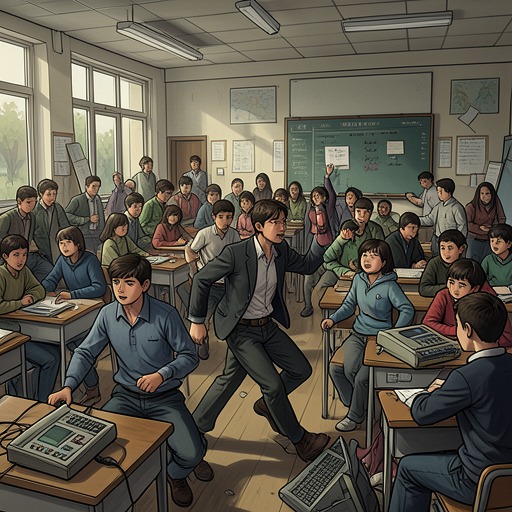
Herr Schiezeth first appears in Lukas’s classroom during a disruption. He enters with a teacher and an unfamiliar student, while the class is preoccupied with a wallet that Momo has placed on Lukas’s desk. Someone calls the principal Jürgen, and the room laughs; Samir then calls for Jürgen to keep quiet. The exchange establishes an informal student culture in which even the head of the school is addressed by his first name, though the principal himself continues to speak from the position of authority. The scene gives no account of how the students learned his name, leaving that small breach of formality unexplained.
His authority is expressed most sharply when he returns to a classroom that needs cleaning. He shouts at the students, demands that everything be put in order within two minutes, and threatens consequences more serious than a note in the class register. Lukas notices that Herr Schiezeth is unusually dressed in a shirt and jacket, unlike the way he has seen him before. The formal clothes and the principal’s anger make the classroom feel like part of a larger occasion, although Lukas does not yet know what is being prepared.
Discipline and Public Stage
After inspecting the cleaned room, Herr Schiezeth praises the students for making it look different and asks them to attend an assembly at the start of the next lesson. He describes the announcement as important, says it will take ten minutes, and promises that ordinary lessons will resume afterward. He also warns the students that members of the press are visiting and asks them to behave. His brief return to the classroom thus turns a disciplinary episode into preparation for a public event: the students are not only expected to restore order, but to present themselves acceptably before outsiders.
Lukas associates the assembly and the journalists with an earlier tragedy. The previous time the school gathered, he recalls, a student named Marcel had been stabbed three times on a crowded daytime train after intervening when a man bothered Marcel’s girlfriend. Journalists then focused attention on the school and Gropiusstadt. That memory belongs to Lukas, not to Herr Schiezeth, but it gives the principal’s mention of the press a weight beyond school ceremony: public attention has previously arrived through violence and grief.
The Theft and the Principal’s Anger
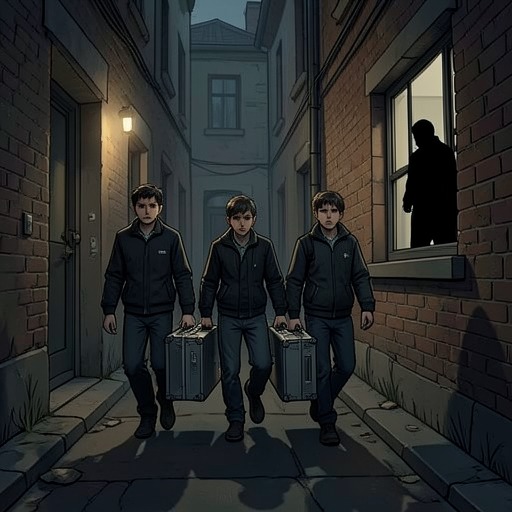
When the Berliner Polizei later addresses the students, Herr Schiezeth introduces the officers and says, with evident reluctance, that they have something to announce. The officers report a weekend break-in: computers and monitors worth several thousand euros have been taken. Witnesses described three males in black hooded jackets moving the stolen property in a shopping cart toward U-Bahnhof Zwickauer Damm; shots were also heard nearby, though the officers say they do not yet know whether the incidents are connected. The police appeal for information, placing the students in the room between an official investigation and the possibility of implicating someone they know.
Herr Schiezeth then explains why the loss matters to him. He says he had worked hard across numerous offices and with the Bildungssenat des Landes Berlin to equip the school with up-to-date technology. He had even agreed to let the press film so that the mayor could receive publicity, but had asked that news of the new equipment not be published until that day because he feared that someone might try to steal it. In his account, only the students could have known about the computers in advance, so he concludes that pupils from the school must have been involved. The theft is therefore not merely damage to school property: it turns an anticipated improvement into a breach of trust and makes his efforts appear to have enabled the crime.
His anger breaks through the careful public arrangement. He strikes the teacher’s desk with his fist, his eyes wide; Lukas thinks he looks close to tears. Herr Schiezeth calls the students’ actions a betrayal of the opportunity he had tried to secure for them. He promises that everyone involved will be found and punished, including those who played only a marginal role or knew about the theft but failed to help solve it. After delivering that warning, he nods to the officers and leaves with them. The door slams, a draft pulls papers from the wall, and the room falls silent. His departure gives the threat a physical punctuation, while the silence that follows registers the force of the accusation.
Character and Narrative Significance
Herr Schiezeth is presented through visible acts of authority rather than through private history: he enters, orders, inspects, announces, and finally condemns. Yet the computer episode complicates the image of a principal concerned only with control. His account identifies a practical goal—providing students with modern equipment—and a personal investment expressed in the labor he says he put into securing it. The same episode also reveals a tension in his leadership: the public celebration of the school’s new resources is bound up with press access and the mayor’s publicity, while the sudden theft turns that public-facing project into a crisis.
The students’ use of Jürgen supplies a counterpoint to his official role. In ordinary classroom disorder, the first name makes the principal an object of teasing; when the stolen computers are discussed, he speaks with the institutional force to threaten consequences for an entire group. His response is not detached procedure alone: he describes his own work, his disappointment, and his sense that the students have rejected an opportunity. At the same time, his promise to punish even those who knew but stayed silent widens the stakes from identifying the thieves to defining what responsibility means within the school. Herr Schiezeth’s scenes thus connect school discipline, public image, and the fragile trust on which the promise of better equipment depends.