Lukas Hides the Truth About the Theft, Quarrels with His Father, and Leaves
Sonne und BetonLukas Hides the Truth About the Theft, Quarrels with His Father, and Leaves traces how the school burglary turns into a rupture at home: Lukas tries to protect himself with denial, but the argument exposes a deeper conflict over whose account of life in the neighborhood deserves to be believed. Matthias’s concern about the stolen computers collides with Lukas’s sense that violence affecting students has long gone unheeded, and Lukas leaves without confessing what he knows.
The Burglary Behind the Denial
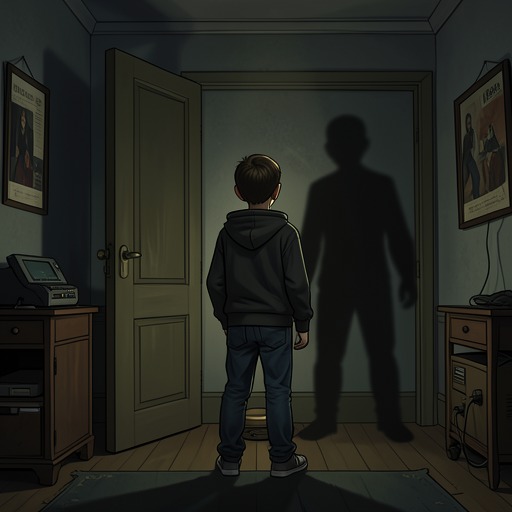
The confrontation follows the theft of new computers from Lukas’s school. Two nights earlier, Lukas and his companions had entered the building using a key to the school gate; Julius had also brought a lockpick and displayed a silver blank-firing gun. At the side entrance, Lukas’s fear of a night watchman, cleaners, motion sensors, or cameras made the danger tangible. Once inside, the group searched the storage area until Sanchez spotted unopened cartons of computers and monitors on high shelves. Lukas climbed a step stool and passed the equipment down to the others. The find made their scheme feel suddenly achievable: the computers were not an imagined prize but a large, visible stock that they could carry away. The burglary’s practical details sharpen the meaning of Lukas’s later evasions. The group had chosen a Saturday night, and Sanchez had kicked out a streetlamp by the school gate so they could remain in darkness. Their entry was planned around the school grounds and the side door, but their uncertainty about who might be inside shows how little control they had over the risks. When the stolen computers became public news, the boys’ private sense of having pulled off a plan gave way to the possibility that adults, police, and the city were already looking for whoever had done it.
News Reaches Matthias
At home, Matthias tells Lukas that he has read about a school break-in in which new computers were stolen. The story is already circulating in the news. Lukas registers the speed of the coverage with alarm: incidents such as fights or people being robbed, he thinks, rarely receive comparable attention, while the theft of publicly funded equipment quickly becomes news across Berlin. Matthias asks what happened at school, but Lukas answers that he knows nothing beyond what other people have done. His denial is carefully mixed with partial truth. Police had visited the classroom with the principal, told students that a break-in had occurred, and asked them to report anything they knew. Lukas tells Matthias that much, while presenting himself as an uninformed witness rather than a participant. He also insists that he did not know the theft was such a major story. The account protects the secret but leaves him exposed: he is trying to sound casual while worrying that the police will identify the boys.
Two Accounts of the Neighborhood
The argument turns on what Matthias considers worth worrying about. He objects to people breaking into the school and stealing its new computers. Lukas counters that theft, beatings, and robbery are routine at his school, and asks why this particular crime has suddenly attracted attention. He says the police did not describe the burglary as vandalism, pushing back against the newspaper’s depiction of the intruders as having damaged the building as well as stolen equipment. Matthias responds by distinguishing the burglars from the violence Lukas describes. He tells Lukas to stop repeating Marco’s gangster talk and dismisses the violent language associated with Bushido as empty performance. He also claims that, having grown up in the area himself, he knows what it is like there. For Lukas, this does not establish shared understanding; it repeats a familiar pattern in which Matthias treats reports of violence as exaggeration. Lukas recalls that his father reacted similarly when Marco had been beaten, and says the two of them used to argue over it. Lukas’s defense of the neighborhood is not a defense of the burglary. He says that even if these computers had not been stolen now, they would have been stolen the following week. The claim shifts the focus from his own responsibility toward a wider expectation of disorder, but it also exposes the evasive logic of his position. He condemns Matthias for ignoring daily violence even as he uses that violence to make the theft seem almost inevitable. Matthias, in turn, hears Lukas’s language as evidence that he has adopted the very tough-guy posture he distrusts.
The Argument Breaks Open
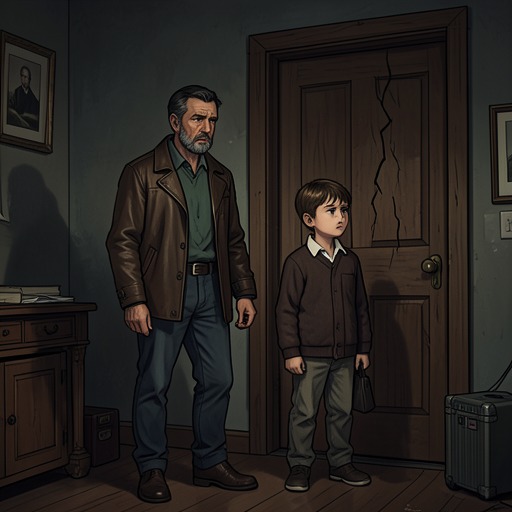
The exchange escalates when Lukas brings up a shooting at U-Bahnhof Zwickauer Damm, a detail he says the police had mentioned at school. Matthias asks why Lukas is defending the people involved and why ordinary conversation between them has become impossible. Lukas answers that Matthias is the one who cannot listen: he accuses him of living in a falsely peaceful world shaped by Karin and of caring more about the stolen computers than about the people around him. The dispute becomes physical only in its gestures, not in an attack between them. Matthias strikes the living-room table with an open hand, knocking over two glasses, and shouts for Lukas to leave. Lukas echoes the command mockingly and goes. The overturned glasses give the quarrel a concrete, domestic consequence, while his response shows how little remains between the two of them in that moment beyond anger and repetition. His departure is not a confession or an attempt at reconciliation; he leaves the truth of the theft unspoken.
Leaving and the Next Step
After going, Lukas asks Sanchez to call Julius because Lukas has no phone credit. Sanchez gets through, and Julius asks whether they can meet outside to discuss what to do next. The immediate consequence of the argument is therefore not an end to the boys’ plans but a return to their shared circle, where the stolen computers and the threat of discovery still await them. The scene links secrecy at home to secrecy among friends. Lukas has a chance to tell Matthias what he knows, but instead offers fragments of the official account and argues over the injustice of selective attention. Once Matthias orders him out, the son who could not make his father hear about the neighborhood turns back toward companions who share the concealed crime. The move deepens the separation between father and son while showing how the burglary’s consequences extend beyond the school: it has entered the family conversation, altered what Lukas can safely say, and left him seeking his next move elsewhere.