Lukas Is Attacked in the Park
Sonne und BetonLukas Is Attacked in the Park begins with an effort to avoid trouble and ends with Lukas beaten in front of his friends. The assault exposes how quickly an ordinary walk through a familiar park can become a test of public respect, and how the bystanders’ presence intensifies the humiliation rather than preventing the violence.
Entry into the Park
Lukas objects when Julius leads him and Gino through the park instead of taking the route around it. He expects Cem and the other boys to be at the far end and does not want to pass the group of Arab drug dealers near the entrance. His unease is grounded in the park’s reputation: a dealer on a bench offers the boys amphetamines, cocaine, or cannabis, and Lukas knows that lingering there invites trouble. He keeps walking and avoids answering, aiming simply to reach Cem and then go home.
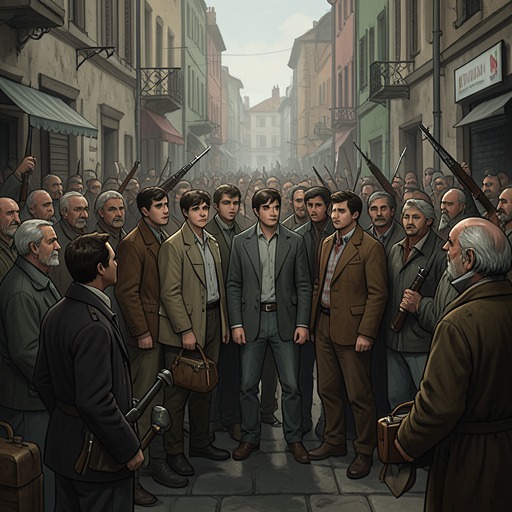
Julius, however, stops to refuse the offer, then says that they would not buy from Turks even if they wanted anything. Lukas pulls at Julius’s hoodie, trying to get him moving and away from the exchange. The remark transforms a tense encounter into a direct provocation. Djamel turns his attention to Lukas, steps in front of him, and shoves him; his friends spread into a semicircle around the three boys. Lukas’s attempt to leave has become a confrontation in which the group’s attention, the insult, and the public challenge all raise the stakes.
The Assault and Its Escalation
Lukas tries to lower the temperature by apologizing and saying that the three boys are in a hurry. Djamel does not accept the explanation. He treats Lukas’s attempt to pull Julius away as an insult, taunts him for stammering, and threatens to hit him. The encounter has become a public contest over respect: Djamel stands close, presses his forehead against Lukas’s, spreads his arms, and demands that Lukas look at him. Lukas forces himself to hold Djamel’s gaze because he believes looking down would mark him as an easy target. Fear is already visible in his quickening heartbeat and trembling, but he tries to answer without provoking another move.
Julius then appeals to a connection from their childhood, explaining that he and Djamel went to primary school together and invoking their former teacher and classmates. Lukas is startled that Julius knows Djamel, and that he has not mentioned their shared history sooner. The appeal does not interrupt the confrontation: Djamel keeps his attention on Lukas, insults him, and spits beside him. Lukas’s eyes reflexively follow the spit. Djamel’s fist strikes his cheekbone before he can recover his gaze, and the sound seems to reach him a moment after the blow. As Lukas staggers, one of Djamel’s friends kicks him in the stomach while another records the attack on a phone. Gino and Julius remain frozen nearby.
Djamel orders Lukas to look at him and fight, then punches him in the nose. Lukas’s eyes water, his vision blurs, and blood runs over his mouth onto the dry grass. A third blow to the solar plexus leaves him struggling for breath. Djamel wipes the blood from his fist onto Lukas’s T-shirt, grabs his face, and pushes it away as the group sends the boys off with further insults and spits after them. His threat to stab Lukas makes plain that the assault is not presented as a fair fight: Lukas is outnumbered, beaten while his friends stand by, and dismissed only when his attackers choose to let him go.
The Aftermath and Return
The beating continues to shape the scene after Djamel lets the boys go. Lukas holds his bleeding nose while Julius and Gino say nothing. Nearby, two adults smoke a water pipe, talking and laughing as if they have not witnessed anything. Their silence is its own injury in Lukas’s account: he believes they saw the assault and could at least have called out, but they leave him and his friends to fend for themselves. A bottle collector, by contrast, approaches, looks at Lukas, and silently gives him a tissue. Lukas accepts it with a distracted nod, then uses the back of his phone as a mirror to see the bloodied state of his face.
The phone also brings Matthias to mind. Lukas is relieved that his father is away for the day and worries that Matthias will see him injured and again fail to understand that getting beaten was not his fault. The familiar maxim Der Klügere gibt nach offers little comfort; Lukas feels that his father’s experience of growing up in the area no longer explains the conditions Lukas faces. The mismatch between the maxim and the immediate danger sharpens his frustration: avoiding a fight has not spared him violence, and the adults who might have intervened have not helped.
Once they are away from the attackers, Julius says he had been about to act. Lukas rejects the claim as empty hindsight, accusing Julius and Gino of standing by while Djamel hit him. He also reproaches Julius for stopping to answer the dealer and for the insult about not buying from Turks, which turned a tense exchange into a more dangerous one. Both friends stare down at the ground. Lukas then asks for a cigarette; Julius silently offers his pack, and Lukas takes two deep drags. The small exchange does not resolve the accusation, but it follows the moment in which Lukas has forced his friends to face their failure to help.
The violence returns when the boys later approach the bank, now surrounded by at least ten people. They are laughing over a phone, and Lukas suspects it is the video of his beating. A whistle draws attention from the nearby apartment blocks as the group slowly advances. Cem’s brothers arrive behind Djamel’s side, while Lukas grips a telescopic baton and urges himself to strike. Djamel steps forward and challenges him, but Lukas freezes: his legs will not move, and the baton slips from his hand. The weapon in his grasp has not made him feel in control; at the decisive moment, he cannot act.
Cem instead advances without speaking and hits Djamel in the face with his left elbow, splitting Djamel’s temple and covering his face with blood. Djamel’s companions rush at Cem. Engin picks up the fallen baton and swings blindly, while Cem’s brothers pull attackers away, shove them down, and kick them. The park erupts into overlapping shouts and blows; Gino grabs Lukas by the shoulder, looking panicked. The return does not restore the dignity lost in the first assault. It turns the earlier humiliation into a larger group fight, with Lukas again caught in the violence and unable to control how it unfolds.
A New Threat Within the Group
The park’s violence is followed later by another confrontation in which Lukas tries to stop a dispute from widening. He tells Cem that they already have other problems and asks him to settle matters calmly because their brothers are friends. Cem agrees that they will talk, but then turns on Julius, giving him thirty seconds to explain why he had been seeing Cem’s girlfriend. Julius reveals that he, too, has been involved with her for several weeks and says she had lied about being busy the previous evening. Cem’s anger shifts from the wider group to the private betrayal, and he tells the others to leave while he resolves it. The exchange extends the episode’s pattern of violence: an appeal to friendship briefly holds out the possibility of restraint, but concealed grievances quickly turn it into another threat.