Lukas and Sanchez’s Friendship
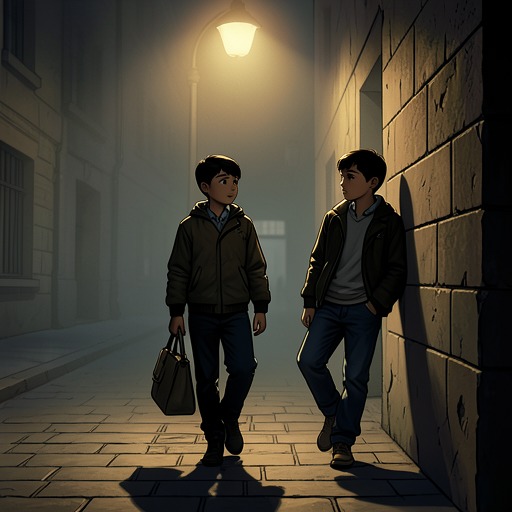
Sonne und BetonLukas and Sanchez’s friendship grows from an accidental neighborly introduction into a close, conspiratorial alliance. Sanchez offers Lukas company and practical cover, but also recruits him into a school burglary whose profits and risks bind them together. Their exchanges reveal both an easy intimacy and a fault line: when fear pushes Lukas toward destroying the evidence, Sanchez argues that they should hold out for more money.
A Neighbor Becomes a Friend
Sanchez first appears at Lukas’s apartment after seeing him enter the building. He tells Lukas they are neighbors, and the discovery quickly turns into an invitation: Sanchez has only recently moved in, his mother has left his father, and their apartment is still filled with boxes. With his mother away until late, he suggests that they smoke together and retrieve the rest of his belongings. Lukas accepts partly because he would rather not stay at home with his father’s girlfriend. Their friendship begins not with a grand declaration but with shared convenience, a new neighborhood, and the prospect of company.
When Lukas asks his new neighbor’s name, Sanchez gives it plainly. The easy exchange establishes the informal rhythm that continues between them. Sanchez speaks in Berlin dialect and presents himself as Cuban, showing Lukas a necklace with a Cuban-flag pendant. Their conversation also touches on the ethnic divisions Sanchez perceives around them: he contrasts the people in his former area with the population around their new home and makes broad, racialized generalizations. The scene places their budding friendship within the surrounding pressures of belonging and prejudice without making those pressures disappear between them.
Familiarity and Mutual Cover
As the friendship develops, Lukas and Sanchez move with the ease of people who understand one another’s cues. When Sanchez arrives at Lukas’s home while Lukas’s father is still there, Lukas silently gestures toward his room. Sanchez catches the warning and loudly says that they need to hurry or they will be late for school. The pretense gives Lukas a way to leave without explaining himself to his father. It is a small favor, but a revealing one: Sanchez notices what Lukas cannot say openly and supplies the cover without requiring an explanation.
Their later conversation on the way to meet Julius has the same casual texture. Lukas asks whether anything happened at Sanchez’s place the previous day; Sanchez answers that they went to Shooters and then Foot Locker, and shows off his new white Reebok Classics. Lukas jokes that, with the right clothes, Sanchez will be an official Neukölln resident. The teasing and the display of new shoes give their friendship an ordinary, companionable dimension alongside the danger that soon takes over their shared story.
The Burglary That Binds Them
Sanchez is the one who turns financial frustration into a concrete criminal plan. He tells Lukas, Gino, and Julius that the school is due to receive fifty new computers and proposes stealing them to sell for cash. When Julius offers a lock pick, Sanchez produces a school key ring instead, shifting the idea from a speculative scheme to an operation with a means of entry. Lukas objects that breaking into his own school is reckless, while Sanchez dismisses the danger as a quick job made simple by the key.
Lukas eventually agrees. He says he needs new shoes and that his father will not give him money. That admission makes the friendship part of the crime’s immediate appeal: Sanchez’s plan offers the boys a way to get what they want without asking adults for help. At night, Sanchez leads the way to the school gate and unlocks it. Lukas follows, nervous about guards, cleaners, cameras, and the possibility of an alarm. The fear does not stop him from entering. When the boys find cartons of computers and monitors on high shelves, Lukas climbs a step stool and passes them down while Sanchez and Julius take them. Their work is coordinated, and the successful discovery makes the theft feel, for a moment, astonishingly easy.
The consequences soon press back on the partnership. Police tell the school that computers and monitors worth several thousand euros have been stolen, and that witnesses saw three hooded males moving the goods in a shopping cart toward U-Bahnhof Zwickauer Damm. They also report that shots were heard nearby, though they do not yet know whether the gunfire was connected. Lukas hears the account in class while Herr Schiezeth watches him; Sanchez, who is absent, is already a point of comparison in Lukas’s anxious thought that he should have stayed home too.
At an attempted sale, Lukas claims to be twenty, but the shopkeeper recognizes the danger in three school-age boys offering brand-new computers just days after a school burglary. Sanchez denies that they are from any school, but the explanation cannot make the goods seem legitimate. The failed sale shows the limits of the confidence that powered their plan: the key can get them inside, but it cannot make the stolen machines safe to sell.
Fear, Money, and Divided Judgment
After Taner spreads the story at school that Lukas was involved, Lukas tells Sanchez that their exposure may be only a matter of time. He wants to get rid of the remaining computers so that nobody can use them as evidence. Sanchez, however, urges him not to act hastily. They should first see what happens at school the next day, he argues; if the rumor proves serious, they can dispose of the machines, but if not, they can sell five more computers with monitors. He emphasizes the money each could receive and insists that the remaining goods could mean another substantial payout.
The disagreement brings out a difference in judgment that the shared crime had temporarily concealed. Lukas focuses on the danger of being caught and on the possibility of removing evidence; Sanchez keeps returning to the unrealized profit. Lukas understands the logic of caution but also recognizes the pull of the money and the pressure in Sanchez’s persuasion. Their friendship remains intact in the scene, yet it is being tested by the same scheme that brought them together: the opportunity to earn more makes it harder for either boy to choose safety cleanly.
Solidarity Under Pressure
The friendship is also visible outside the burglary. During the fight involving Julius and Cem, Sanchez jumps in when Cem attacks Julius, kicking Cem away and then repeatedly trying to separate them. Lukas runs in as well, attempts to pull Cem off the others, and finally helps pin him down with Sanchez and Julius. The intervention is chaotic, and Lukas is struck in the face as he tries to stop the violence. The scene does not resolve the conflict between the boys, but it shows Sanchez and Lukas acting on the same immediate impulse: to intervene when their friend is being beaten.
Taken together, these moments make their friendship neither a simple refuge nor merely a criminal partnership. Sanchez can recognize Lukas’s need for cover and companionship, and the two act together when violence erupts; he can also draw Lukas deeper into a risky plan and urge him to keep pursuing its rewards when Lukas fears the consequences. Their closeness is carried through gestures—the silent warning at the apartment, the offered company, the shared labor, the argument over the remaining computers—rather than through explicit declarations. That practical intimacy is precisely what makes the partnership powerful and dangerous.