Momo
Sonne und BetonMomo is Lukas’s one somewhat close friend at school, a classmate whose loud humor and easy mischief make him part of the daily classroom atmosphere. Their relationship is both more limited and more consequential than that label might suggest: they have known one another for years but, as Lukas reflects, may never have spent time together outside school. When rumors connect Lukas to the stolen computers, Momo crosses that boundary by calling him, passing on what he has heard, and advising him how his absence may look to others.
Identity and School Life
Momo is tall and broad, but his laugh, as Lukas describes it, squeaks like a little girl’s. The narrator recognizes it instantly and says Momo has laughed that way for almost four years. This distinctive sound belongs to a student who often turns the classroom into a stage for jokes, interruptions, and shared amusement.
Momo joined Lukas’s class in seventh grade after repeating a year. The two repeated ninth grade together as well, giving their acquaintance a history shaped by the same school and successive years in the same cohort. Lukas calls him the only person at school with whom he is somewhat friendly, then immediately qualifies the closeness: he does not think they have ever done anything together outside school. The friendship is genuine, but its known setting is the classroom and the routines around it.
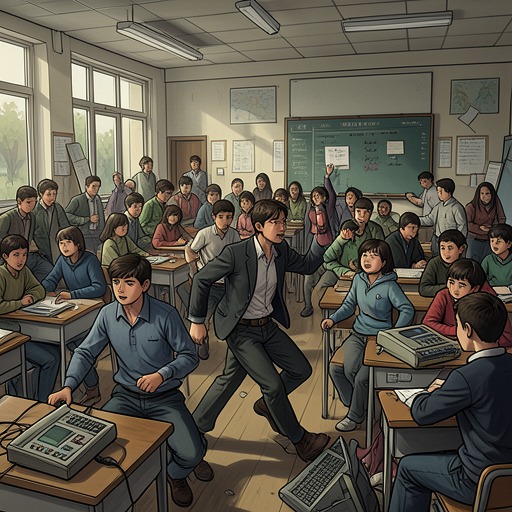
That setting shows Momo’s taste for comic disruption. When a teacher from the neighboring class enters amid the noise, Momo calls out that the substitute teacher has given everyone a reprimand despite their claim that they did nothing. He then tells Lukas to watch the teacher get into trouble. The exchange treats school discipline less as a serious sanction than as material for a joke shared between classmates. Momo also presents himself as someone who can keep a disturbance going: after students return from smoking outside, the class’s laughter and coughing continue while the substitute teacher struggles to regain control.
Humor, Violence, and the Classroom Audience
Momo’s humor is not confined to teasing teachers. He shows Lukas a phone video of two people beating a third until the victim falls, while the person filming laughs. Momo identifies the attackers as his cousins and laughs as he describes the beating. Lukas remembers his laugh as particularly funny, but the scene places that amusement beside recorded physical violence. The video has become entertainment for the classroom audience, and Momo joins in rather than treating the assault as a cause for concern.
The scene also establishes how easily violence and joking occupy the same social space in the school. Momo’s broad build and high, squeaking laugh are part of Lukas’s affectionate portrait, yet his response to the video is not reflective or solemn. He makes the violence into a story about his cousins, performs amusement, and shares the clip with Lukas. The narration does not show what Momo thinks beyond that reaction, but it does show how the classroom turns an assault into something to watch and laugh over.
His comic ease has a more supportive use when he notices Lukas’s face. Momo asks what happened, and Lukas says he had trouble the previous day. Momo follows up by asking whether it was a fight; Lukas briefly nods. The exchange is small, but it shows Momo noticing an injury or visible sign of conflict that others have not yet asked about. He is curious and direct, without pressing Lukas for a fuller explanation in the moment.
Friendship with Lukas
Lukas’s account of Momo is marked by the difference between being friends at school and being close beyond it. Their shared history—nearly four years of knowing each other, a year repeated together, and another shared repetition in ninth grade—has made them familiar. Yet Lukas cannot recall them meeting outside school. Momo’s later call therefore matters not because it establishes a deep off-campus friendship, but because it breaks with the usual limits of their connection.
When police visit the school to discuss the computer theft and solicit information, Lukas worries that someone may identify him. After the visitors leave, Momo shakes his hand as Lukas heads toward the subway. Momo is waiting for a girl and calls after him with a joking request for a share if Lukas was the one who stole the computers. The line is teasing rather than a direct accusation, but it lands in a moment when Lukas is already alert to looks and insinuations. He wonders whether people know more than they have said. Momo’s joke gives that fear another possible sign, without establishing that Momo knows the truth.
The later phone call makes the relationship more complicated. Lukas is shopping with Sanchez when Momo’s name appears on his phone. Their first attempt to connect fails because Lukas is in a basement shop without reception; he goes outside, and Momo calls again. Lukas notes that they may never have spoken by phone before. The unusual contact carries important news: Momo says Taner is telling people that Lukas stole the computers.
The Rumor and Momo’s Intervention
Momo reports the substance of Taner’s story rather than simply repeating a bare accusation. Taner claims to have seen Lukas outside his uncle’s shop, attempting to sell computers with two other people, and says one of Lukas’s companions then caused trouble. Momo says he told Taner to stop talking, but that other people had already heard. He then asks Lukas plainly whether the story is true.
Lukas denies the theft indirectly, saying he had been to several shops with a friend who wanted to get rid of an old computer. His voice falters, and he hopes Momo believes him. The scene gives no confirmation of what Momo concludes from the answer. What it does establish is that he has brought Lukas the rumor, challenged him about its truth, and allowed him to respond rather than treating Taner’s account as settled fact.
Momo’s advice is practical: Lukas should return to school, because continuing to stay away at precisely this moment will look conspicuous. He reassures Lukas that the teachers will not hear Taner’s story, while stressing that absence itself could draw attention. This is a significant form of help within their limited friendship. Momo does not offer a plan to resolve the accusation or promise that the rumor will disappear; he identifies the immediate risk of looking guilty by avoiding school and urges Lukas to go back.
Lukas later calls Momo to ask whether he is still coming, then tells Sanchez that Momo will not come. No reason is given, and the episode does not establish a lasting break between them. Momo’s arc remains grounded in brief school encounters, a first consequential phone call, and advice offered at a moment when Lukas is increasingly exposed. His role is defined by that contrast: he can laugh at violence and use suspicion as a joke, but when a damaging rumor reaches Lukas, he also acts as the messenger who warns him and urges him not to disappear.