Neukölln as a “Battlefield”
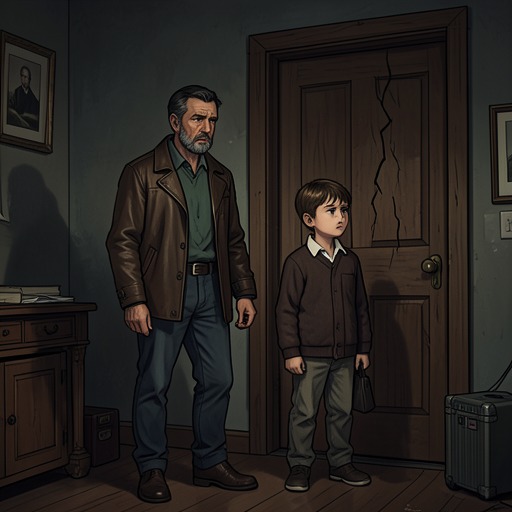
Sonne und BetonNeukölln as a “Battlefield” names the atmosphere of continual threat that shapes Lukas’s understanding of life in and around the district. Violence is not confined to spectacular confrontations: it enters school access, journeys between neighborhoods, and judgments about whether the police can help. The battlefield is therefore both a place marked by real danger and a mental map of routes, appearances, alliances, and risks that Lukas feels he must constantly read.
Everyday Life as Risk Calculation
Lukas’s encounter with the new security arrangements at school makes the contradiction between protection and exclusion immediate. He has forgotten his student ID only that day, but the guard refuses to let him through the gate. It is shortly after ten, the third lesson is about to begin, and Lukas worries that his absences may leave him repeating ninth grade for a third time. He argues that the guards are meant to keep outsiders and weapons out, not to bar enrolled students, but the guard ignores him and blocks the entrance. With no teacher nearby to confirm his identity, Lukas gives up and heads away from school to meet Gino at Wutzkyallee.
The scene turns an ostensibly protective rule into another uncertainty for Lukas to navigate. The school’s gate is meant to control danger, yet its rigid enforcement leaves him outside; his response is not to appeal to an authority but to abandon the attempt and contact a friend. The district’s hazards are registered through practical decisions—where to go, whom to find, and which route to take—rather than through any assurance that a formal system will make him safe.
The District as a Map of Threats
When Karin asks Lukas for help because her son Fabian has been targeted, his account of the danger becomes explicitly geographic. Fabian has already lost his phone and wallet and was threatened with two knives while changing trains on the way to school. The incidents happen around Johannisthaler in Gropiusstadt; Karin, who lives in Marienfelde, cannot escort him every day and is unsure whether the police could help. She has asked Lukas’s father for advice, but that conversation has not reassured her.
Lukas reads Fabian’s vulnerability through both his appearance and his lack of local connections. He thinks that changing clothes would not solve the problem once the boys have noticed him, and that Fabian cannot defend himself or rely on people who have influence in the area. His advice is to avoid the place where the attackers gather: Fabian could take buses via Alt-Buckow, accepting a longer journey to avoid Johannisthaler. The recommendation is starkly limited. Lukas does not offer intervention or protection; he treats detour and concealment as the only workable response to a threat that may recur.
His explanation of the district is not detached local knowledge. Lukas describes being blond and knowing nobody as a condition of permanent vigilance: he weighs who is watching, how long to hold eye contact, which subway carriage to enter, whom a stranger knows, and whether to hand over a phone, run, fight, or endure a beating. He cannot translate this constant calculation into a reassuring lesson for Karin. His sense that Neukölln is a battlefield arises from the accumulation of such choices, in which even a journey becomes an assessment of exposure.
Public Authority: Protection and Punishment
The school burglary brings another version of danger into the classroom. Berlin Police report that computers and monitors worth several thousand euros were stolen over the weekend. Witnesses described three male suspects in black hooded jackets carrying the goods in a shopping cart toward U-Bahnhof Zwickauer Damm; shots were heard nearby that evening, though the officers do not know whether the gunfire was connected to the theft or whether the thieves were armed. The students’ silence and Momo’s remark about the money expose how the crime is heard inside the class: not only as a police matter, but as a possible source of profit.
Herr Schiezeth’s response shifts attention from the unknown intruders to the school community. Because the new equipment had not yet been publicly announced, he concludes that students at the school must have been involved. He vows that everyone responsible will be found and punished, including people who only knew about the crime and failed to help investigators. His anger makes the school a site of both investigation and collective suspicion. Lukas, already uneasy under Herr Schiezeth’s gaze, leaves the classroom hoping his unsteady steps will not show; afterward, Momo’s joking request for a share of the computers deepens his fear that others may know who was involved.
Across these scenes, law appears in conflicting forms. The school guard enforces a rule without distinguishing Lukas from an outsider, while the police investigate a serious theft and Herr Schiezeth threatens punishment for both perpetrators and silent bystanders. Yet when Karin asks how to protect Fabian, Lukas cannot imagine that reporting the attacks would be effective. The formal authorities are visible, but visibility does not amount to trust or dependable safety.
Violence at Home and the Limits of Escape
Lukas’s question to Julius about Tilidin extends the battlefield beyond streets and school grounds. Julius explains that Gino’s father beats Gino and his mother, drinks, and stole the 200 euros Gino received from selling computers. Lukas asks why Julius does not call the police and challenges the idea of supplying a drug instead, fearing that it could help precipitate a lethal confrontation. Julius rejects the police as a solution and describes Gino’s wish to flee with his mother and brother: his father will not let them leave and keeps them confined. Gino hears his father shouting and his mother crying but feels unable to intervene.
The exchange brings the article’s geography of danger into the home. Escape is desired but blocked, and the proposed recourse to police is met not with confidence but with Julius’s angry insistence that they cannot do anything. Lukas’s image of Neukölln as a battlefield thus connects public intimidation, precarious movement, and domestic violence without making them identical. What joins them is the repeated absence of a reliable path to safety: a gate can keep the wrong person out, a longer bus route can only reduce exposure, and a family’s attempt to leave can be prevented altogether.