Police Brief Students at School on the Theft and Investigate
Sonne und BetonThe police briefing at the school converts a burglary into a crisis of exposure. Officers publicly describe the stolen computers and monitors and ask students to help the investigation; Herr Schiezeth then discloses that news of the equipment had been deliberately kept quiet. For Lukas, who knows the theft from the inside, each official detail makes the distance between a general appeal and a direct accusation feel smaller.
The Visit and Its Setting
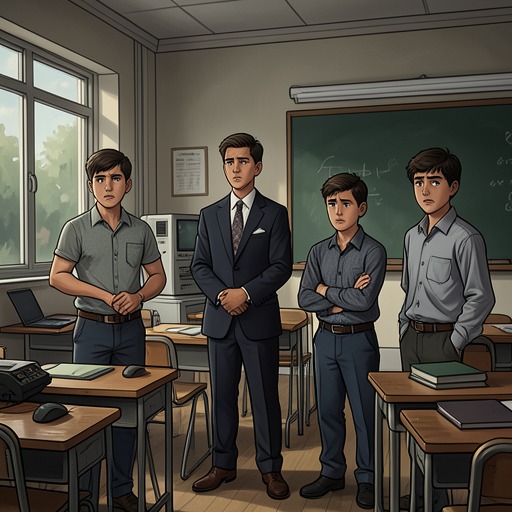
Lukas realizes the significance of the visit before it begins. The principal has arrived in class with two officers from the Berlin Police, and Lukas worries that leaving at that moment would look suspicious. He tries to appear as though the interruption is ordinary, even as Herr Schiezeth’s gaze unsettles him. The scene places the investigation in the classroom rather than in a station or an interrogation room: the students are addressed together, but Lukas experiences every pause and glance as potentially personal.
The school’s controls form a telling background to the report. Earlier, a new security guard had refused to let Lukas through the gate because he had forgotten his student ID, despite his insistence that he attended the school. He had missed classes frequently and was anxious not to repeat ninth grade, but the guard would not make an exception. That routine enforcement had made entry depend on a visible credential; the burglary now exposes how little such a rule could reveal about who had access through other means. At the briefing, the police still do not know how the burglars entered.
What the Police Tell the Students
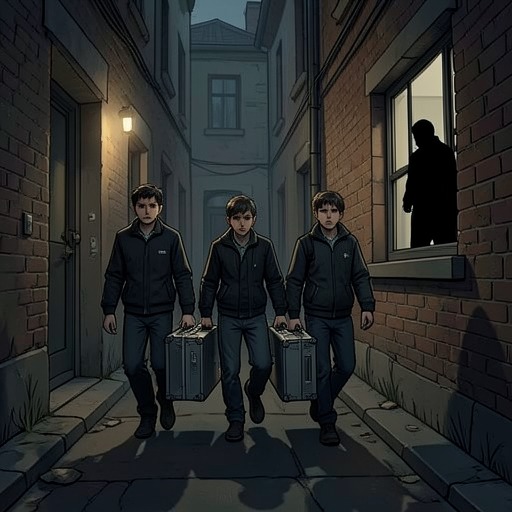
Herr Schiezeth introduces the officers, Thomas Werner and Lothar Steinfeldt. One explains that the school was broken into over the preceding weekend, probably on Saturday night, and that computers and monitors worth several thousand euros were taken. According to accounts from residents, three male figures in black hooded jackets carried the stolen goods in a shopping cart toward U-Bahnhof Zwickauer Damm. The police have not established how the thieves got inside.
The account also includes a second, unresolved report. Gunshots were heard near U-Bahnhof Zwickauer Damm on the same evening, but the officers say they do not yet know whether the shots were connected to the burglary. They raise the possibility that the suspects were armed without presenting that possibility as a confirmed fact. The distinction matters: the report gives the class a route, a number of suspected participants, and a possible sign of danger, while leaving a crucial part of the crime unexplained.
The officers say an investigation is underway and invite anyone with relevant information to contact the Berlin Police or speak up then and there. Their request is open to the whole class, not directed at Lukas. Yet the reported details make the appeal feel less abstract to him. He knows the theft was planned and fears that the officers already have enough information to work out who was responsible; he considers whether confessing might bring a lighter punishment. The briefing’s public form leaves him caught between the official invitation to cooperate and the danger of revealing himself.
Herr Schiezeth’s Anger and the Hidden Announcement
After the officers finish, Herr Schiezeth explains why the new equipment mattered to him. He says he had worked through thousands of administrative offices to secure modern computers for the school and had agreed to let press crews film so the mayor could publicize the upgrade. He had specifically asked that the announcement of the new equipment not appear until that day, hoping to prevent anyone from getting the idea to steal it. In his view, that limited knowledge: students at the school must have been involved.
The revelation sharpens the police account. The burglary was not simply an opportunistic theft of equipment that happened to be stored on school grounds; the announcement had been carefully timed, and the principal believed that access to the information itself narrowed the field of suspicion. His anger also carries disappointment. He had expected students to welcome the prospect of learning with proper computers, but instead sees the break-in as a betrayal of the effort made to provide them.
Herr Schiezeth promises that the people responsible will be found and punished. His warning extends beyond those who entered the school: he includes anyone who played a marginal part, knew what happened, or failed to help resolve the crime. The threat changes the meaning of the officers’ request. Silence, which might otherwise seem like a way to avoid involvement, is now explicitly presented by the principal as grounds for punishment too. He leaves with the officers, and the slammed door and fallen papers punctuate the sudden silence in the room.
The Class After the Briefing
The students’ responses do not provide the police with a clear disclosure. Momo whispers about the value of the stolen computers, and Lukas manages a forced smile. When someone calls Osman a snitch, Osman only turns the moment into a joke by asking to go to the toilet; Lukas, who had feared the classmate might accuse him, realizes that the apparent threat was not an accusation. The episode leaves his anxiety intact, but shows how quickly the language of informing can circulate among students even when no one has supplied the police with evidence.
The teacher acknowledges that the announcement has unsettled the class and tries to resume the lesson, allowing Osman and Lukas to use the toilet first. Lukas gets up with unsteady steps. Momo offers him a handshake on his way out, then suggests that if Lukas was responsible for the theft, he should share the proceeds. The remark is not proof that Momo knows what happened, but Lukas reads it as another possible hint and wonders whether the principal, Osman, or Momo has already guessed. He leaves thinking that he needs to speak with Sanchez, while lacking enough phone credit even to make the call. The investigation has barely begun, yet the briefing has already made the school feel less like a place where guilt can remain private.