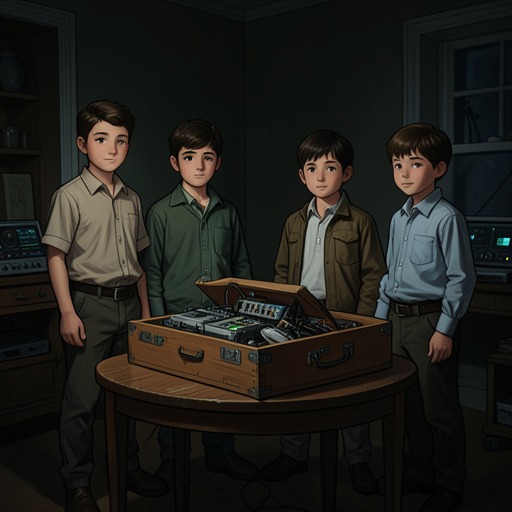
Sanchez’s Key Ring
Sonne und BetonSanchez’s Key Ring is the practical instrument that helps the boys enter their school at night and pursue the theft of its new computers. First displayed as proof that Sanchez can provide access, the bulky bundle seems to make the plan nearly effortless. At the gate, however, its keys clatter, fail, and provoke anxious improvisation; later, one key’s selection depends on Julius’s confidence rather than Sanchez’s certainty. The ring thus embodies both the boys’ access to an opportunity and their inability to control what happens once they take it.
Appearance and Promise
Sanchez produces the key ring during a conversation about breaking into the school. Julius has been rummaging beside his bed and offers a lockpick, boasting that it can open doors, cars, and cellars. Sanchez dismisses that tool by throwing a large bundle of keys onto the floor. Julius stares at it with reverence, asks quietly whether the keys belong to their school, then puts away the lockpick. Sanchez answers with a wink rather than an explanation.
The object immediately changes the plan’s character. A lockpick is a device that might get them through a barrier; the ring appears to offer legitimate access to the building itself. Julius leaps toward Sanchez in excitement, while Gino quietly agrees to join. Their reactions make the bundle more than a piece of equipment: it becomes evidence, to them, that the theft can really happen. But the ring’s promise is not the same as mastery. The boys do not know which keys fit which locks, and their confidence rests on Sanchez’s unexplained possession of the bundle.
The Night Entry
On Saturday night, the boys approach the school in a quiet residential area where few people are about. Sanchez has already kicked out the lamp by the school gate, leaving them in darkness, and Julius has brought a silver blank-firing gun despite the risks Lukas recognizes. Sanchez proposes opening the gate and leading them past the basketball hoops to a door. The key ring is now a working part of the plan, not merely a boastful display.
At the gate, its physical presence becomes conspicuous. Sanchez takes it from his jacket pocket, and the keys clink loudly against the entrance bars as he tries them one by one. The first does not fit, nor do the second and third. On the fourth attempt, the key catches; Sanchez struggles to turn it, and a crack makes Lukas fear it has broken. The noise and delay expose the gap between the boys’ imagined easy entry and the actual mechanics of getting in. Then the key turns, Sanchez signals them over, and the gate opens. The ring has delivered access, but only after making their presence audible and their escape plan feel vulnerable.
The Storage-Door Problem
Once inside, the boys stop at a side entrance near the seventh-year classrooms. Lukas worries that someone may be on night duty, that cleaners may be working, or that motion sensors or cameras could alert the police. The building’s darkness offers some cover, but it does not remove the risks; the route also passes the caretaker’s room and cleaning-supply rooms. The keys therefore matter in a setting where every failed attempt could bring them closer to discovery.
At another lock, Sanchez says he has tried every key without finding the right one. Julius picks up the ring, examines the keyhole, holds the keys to the light, and selects one with apparent certainty. Sanchez protests that he has already tested them all and insists he is not incompetent. Julius tells him to try again, and Lukas urges him to do so because they have little alternative. The episode gives Julius a brief role as the ring’s interpreter: possession belongs to Sanchez, but identifying the useful key becomes a matter of observation and trust. The evidence does not dwell on the lock’s movement; the next decisive discovery is inside the storage room, where the boys find the computers on high shelves.
From Access to Exposure
The ring helps make the theft possible, but access is only the beginning of the operation. The boys find unopened cartons containing computers and monitors—about forty units, by Lukas’s estimate—and use a small step ladder to bring them down. The keys do not solve the further problems of removing bulky goods from the school or finding a buyer. Later, when Sanchez, Lukas, and Julius attempt to sell computers at a shop, the dealer points out that a large number of computers were stolen from a school a few days earlier and treats three students offering brand-new machines as an obvious warning sign. Their entry into the building has not made the goods easy to sell; instead, the circumstances of the theft follow them into the attempted transaction.
Narrative Significance
Sanchez’s Key Ring concentrates the story’s movement from fantasy to consequence in a single, ordinary object. At first, its size and apparent authority eclipse the lockpick and help turn hesitation into agreement. At the gate, the same bundle becomes noisy, uncertain, and physically difficult to use. At the storage door, even a confident owner cannot identify the needed key without help. Each change narrows the distance between the boys’ belief that the plan is simple and the practical obstacles that make it dangerous.
The ring also marks how access depends on uneven knowledge. Sanchez supplies the keys, Julius claims to read them, and Lukas weighs the possibility of alarms and witnesses; none has complete command of the situation. The object opens a route into the school, but it cannot guarantee that the boys can move safely through the building or convert stolen computers into money. Its promise is real enough to start the crime, and limited enough to reveal how little the boys have planned beyond getting inside.