Stealing the School Computers
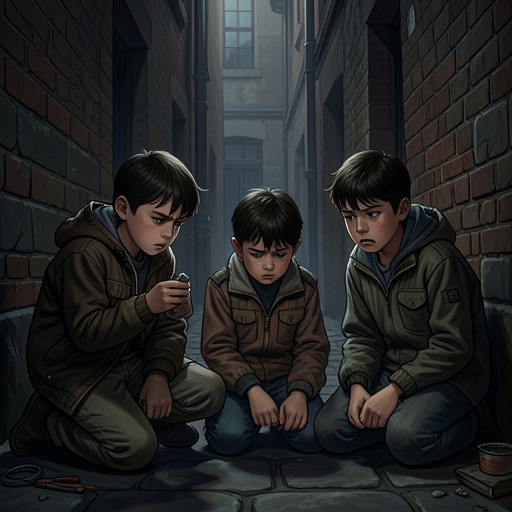
Sonne und BetonStealing the School Computers is the break-in that converts a scheme among three schoolmates into a crime with public consequences. Lukas, Sanchez, and Julius enter their school at night and take newly delivered computers and monitors; the method depends not on Julius’s lock-picking boast but on Sanchez’s school keys. The theft brings police scrutiny, exposes how much the school community already suspects, and leaves Lukas caught between concealment and pressure to inform.
Planning and Access
The plan takes shape around the school’s new computer equipment. When Lukas questions whether breaking into their own school makes sense, Julius produces a lock pick and boasts that he can get into doors, cars, and cellars. Sanchez answers with a far more direct means of entry: he throws down a large key ring. Julius puts away the pick, recognizing that the keys are for their school.
On the night of the break-in, the three approach the building on a Saturday when the surrounding residential area is quiet and their presence seems conspicuous. Sanchez has kicked out the lamp by the school gate, leaving them in darkness there, and proposes a route past the basketball hoops to the entrance. Julius then reveals a silver blank-firing gun tucked into his waistband. Lukas had thought Julius was joking about bringing it; now he worries that discovery could turn a burglary into a much more serious offense.
They stop at the side entrance by the seventh-year classrooms. Lukas fears that a night watchman or cleaners may be inside, and wonders whether motion sensors or cameras could alert the police. The entrance is especially troubling because the route beyond it passes the caretaker’s room and the cleaning-supply rooms. Sanchez unlocks the door before Lukas can voice his second thoughts. The pause at the threshold gives way to action: none of them speaks, and they go in.
Finding and Taking the Equipment
Lukas expects the new computers to be somewhere in the school and searches the storage area with the others. Julius grows frustrated, kicking a crate, spitting on the floor, and throwing a book against a wall. The room seems too small for them to have overlooked the shipment, until Sanchez points up at the shelves.
There, in unopened cartons marked with pictures of computers and screens, the equipment is visible at last. Lukas estimates that there are about forty cartons. The discovery briefly makes the plan feel effortless: the computers are new, the monitors are flat screens, and the three need only get them down and out. Julius spots a small step ladder. Lukas climbs onto it and passes the machines down one by one; Sanchez and Julius receive them and set them on the floor. The account’s shift from anxious searching to practiced handling captures the theft’s central temptation: a difficult, risky crime can momentarily look like a simple route to money.
Discovery and Suspicion
When police address the students, they say the break-in probably happened on Saturday night and that computers and monitors worth several thousand euros were taken. Residents have described three male figures in black hooded jackets transporting the stolen goods in a shopping cart toward U-Bahnhof Zwickauer Damm. The officers do not yet know how the thieves entered. They also report that shots were heard near the station that same evening, while making clear that they do not know whether the gunfire was connected to the burglary.
The announcement makes the crime harder for Lukas to hold at a distance. Momo quietly remarks on the amount of money involved, and Lukas responds with a strained smile. When the officers invite anyone with information to come forward, Lukas considers admitting what happened, thinking that the investigation may soon catch up with them and that turning himself in might reduce the punishment.
Herr Schiezeth’s anger adds a second source of pressure. He explains that he had worked to secure modern equipment for the school, had agreed to publicity around the new facilities, and had delayed publication of the announcement so that the computers would not attract thieves. Because few people knew about the equipment, he concludes that students from the school must have been involved. He promises punishment not only for those who committed the burglary but also for anyone who knew about it and failed to help solve it. His threat makes silence feel consequential even before the police identify anyone.
The theft also attracts suspicion beyond the school. At a computer shop, Lukas claims to be twenty when asked his age. The shopkeeper points out the coincidence: only days after computers were stolen from a school, three school-age boys have appeared with brand-new computers for sale. His suspicion turns the attempted sale into another exposure risk rather than a clean way to dispose of the goods.
Aftermath and Meaning
The school’s investigation gives Herr Reinicke an opening to approach Lukas privately. Reinicke says that a teacher’s key was stolen during a class and that the suspects must therefore have been students from Lukas’s class. He then tries to enlist Lukas as an informant, framing the request through racist assumptions about the students and treating Lukas as trustworthy because he is the only German in the class. By invoking Klein-Istanbul and urging Germans to stand together, Reinicke turns a question about stolen equipment into an exclusionary appeal for loyalty. Lukas denies knowing anything and trembles as he answers.
The crime’s proceeds also surface later in Julius’s account of Gino’s home life. Julius says that Gino’s father took the 200 euros Gino had received from the computers. The stolen goods have thus not produced uncomplicated freedom or security: money associated with the burglary becomes another point of vulnerability within an abusive household.
Across these episodes, the school is both a place the boys know and a guarded institution they can violate with the right access. Earlier, a security guard refuses Lukas entry when he forgets his student ID, and Lukas leaves rather than wait for a teacher to vouch for him. The contrast is sharp: the official rule can exclude a student from his own school, while a set of keys lets the boys cross its threshold after hours. Once inside, however, access does not mean control. Witnesses, police questions, a wary shopkeeper, and a teacher seeking an informant each narrow the space in which the group can keep the theft secret.