The Lure of Crime and Self-Deception
Sonne und BetonThe Lure of Crime and Self-Deception is the process by which Lukas, Julius, and Sanchez make a school burglary seem manageable even as its risks accumulate. The plan begins with a concrete breach of trust—the group has access to the school’s new computers—and grows through successive acts of rationalization: a lockpick and school keys make entry seem easy, a risky first sale makes the theft look profitable, and the money already earned becomes a reason not to stop. Lukas recognizes the danger, but his friends repeatedly recast caution as needless surrender.
From access to opportunity
Julius first presents a lockpick as a universal solution, boasting that he can open doors, cars, and cellars. Sanchez dismisses the tool and produces a large key ring instead. Julius abandons the lockpick and regards the keys with reverence; Sanchez’s knowing wink leaves the implication clear that they include the school’s keys. The exchange makes their access feel almost effortless, while also revealing how little separates their bravado from an actual crime.
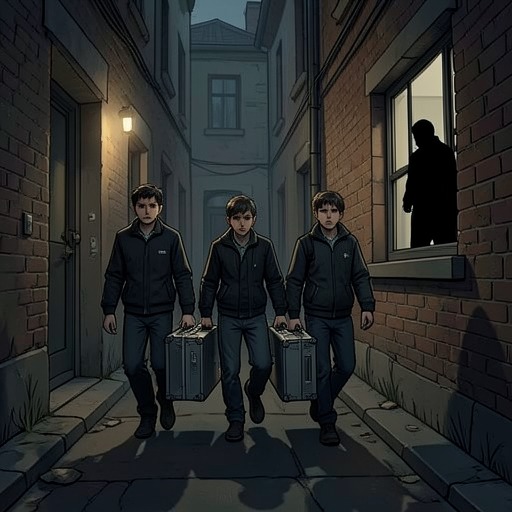
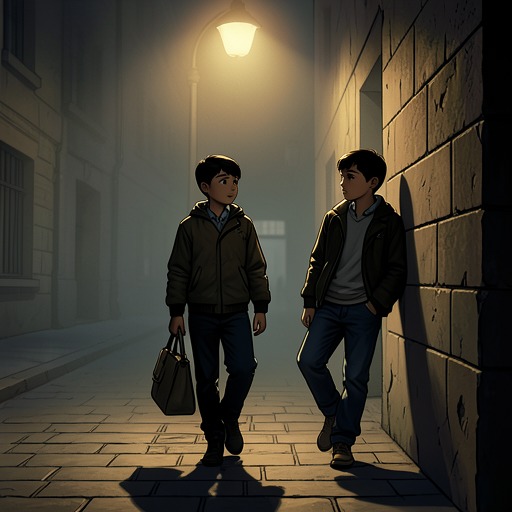
The entry is planned for a Saturday night, when the school stands in a quiet residential area. Lukas understands that the stillness cuts both ways: there are no busy streets or crowds to blend into, and anyone outside at that hour may look suspicious. Sanchez has kicked out the lamp by the school gate, leaving the group in darkness, but Julius then reveals a silver blank-firing gun tucked into his waistband. Lukas had thought Julius was joking when he mentioned it. Now he imagines the consequences of being caught with a weapon during a break-in, and the plan’s apparent simplicity gives way to the prospect of a much more serious offense.
At the side entrance near the seventh-year classrooms, Lukas’s fear becomes physical: his heart beats so fast it hurts. He worries about a night watchman, cleaners, motion sensors, and surveillance cameras, and realizes that this entrance will take them past the caretaker’s room and the cleaning supplies. He has not thought through the route before arriving. Sanchez unlocks the door before Lukas can voice his doubts, and the group goes in. Their forward motion repeatedly outruns their assessment of risk.
The computers and the first sale
The theft turns possibility into temptation when Sanchez spots unopened cartons on high shelves, with computers and monitors printed on them. Lukas estimates that there may be around forty boxes. For a moment, the boys simply stare; then the discovery makes the scheme feel validated. Lukas thinks of how quickly they might obtain more money than they could earn through ordinary work. He climbs onto a step stool and passes the computers down while Sanchez and Julius receive them. The movement is methodical, but Lukas describes himself as reaching for the cartons as if in a trance: the imagined reward has begun to overtake the fear that preceded entry.
Selling the computers exposes the weakness in that fantasy. After five shops refuse to buy them, Lukas proposes going home and disposing of the machines somewhere they cannot be found. Julius insists they should keep trying, and Sanchez agrees that abandoning the sale would make the entire operation pointless. Julius imagines that one willing buyer will take the remaining computers the next day. His confidence offers no new solution; it converts persistence itself into a plan.
At another shop, Lukas claims the boys are twenty rather than sixteen. The dealer recognizes the obvious pattern: computers have recently been stolen from a school, and three students have suddenly appeared with brand-new machines. His suspicion makes the danger explicit. Yet he offers 800 euros in cash for the computers, without a receipt, on the condition that the boys leave and never return. Julius wants to counter with 1,200, convinced the dealer would pay more. Sanchez urges them to accept the 800, and Julius eventually agrees. The quick cash rewards the very recklessness the dealer has just identified.
Storage, delay, and self-justification
The first sale does not end the problem; it leaves the remaining computers to hide and dispose of. Julius reports that his brother found them in his room and erupted over the possibility that police might come to the apartment. Julius told him that he was storing them for a friend who would collect them that day, and his brother believed him. The lie buys time, not safety. Lukas regards his friend’s brother as unusually gullible and says that his own brother, Marco, would have killed him; the contrast emphasizes how precarious the cover story is.
Lukas again argues for abandoning the goods, suggesting that they throw them into a canal. In his calculation, the 200 euros each has already received is enough: they have been lucky, and destroying the remaining evidence would let them leave with some money rather than risk more. Sanchez counters that his room can hold the computers among moving boxes, and that his mother is away from 4 p.m. until night. He proposes using large removal boxes to carry them there. A temporary hiding place is presented as a practical pause, but it also keeps the stolen property available for another attempt at profit.
Sanchez then asks Lukas to wait until the next day, when they will know what is happening at school. If the situation worsens, they can still dump the computers; if not, he argues, the remaining machines may bring another one or two thousand euros, with another 500 for each boy. His reasoning turns waiting into a way to preserve both options. He promises to abandon the plan if even a small thing becomes worse, while pressing Lukas not to decide prematurely. Lukas remains unconvinced: the computers could stay in Sanchez’s room until the police trace them, and they still do not know a buyer. Sanchez replies that they have tried selling for only three hours and already moved three machines. He proposes asking around for a buyer willing to take the rest at once and making calls to Hellersdorf, predicting a sale by the weekend.
A pattern of temptation
The group’s shifting explanations expose the central self-deception. The lockpick and keys make entry seem easy; the darkened gate seems to reduce the chance of discovery; the buyer’s cash makes the theft appear successful; the brother’s belief and Sanchez’s spare space make the remaining computers seem containable. Each fact is real, but none resolves the underlying danger. Instead, each becomes a justification for taking the next risk.
Lukas serves as the recurring counterweight. He notices the weapon, anticipates detection, proposes abandoning the computers after five failed shops, and later argues that the money already earned is not worth prolonging the danger. Yet his objections are repeatedly met with assurances that the group has time, that the police will not find them, or that another sale will make everything worthwhile. The promise of profit keeps changing shape—from quick money to 800 euros, then to the imagined proceeds of selling the rest—while the unresolved exposure remains constant. The episode presents criminal temptation not as one decisive surrender but as a chain of small revisions in which success is measured by money acquired and danger is treated as something that can always be managed tomorrow.