The Stolen School Computers and Monitors
Sonne und BetonThe Stolen School Computers and Monitors are both the target of the boys’ burglary and the tangible evidence that threatens to expose it. Newly delivered for a school in Gropiusstadt, they seem to Lukas and his friends like an effortless route to money; once stolen, their bulk, recognizability, and difficulty of resale turn that promise into a persistent danger.
The Goods and the Break-In
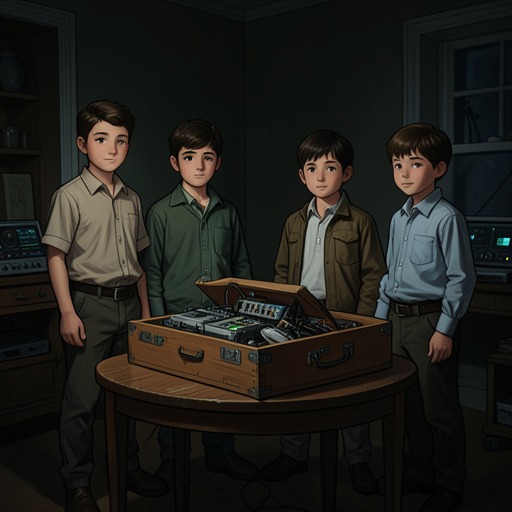
The equipment consists of new computers and flat-screen monitors, still in unopened cartons and stored inside the school. The boys believe that the new machines must be somewhere on the premises, but their search initially seems to contradict that assumption. When Sanchez looks up and spots the boxes on shelving, the discovery transforms their plan from a possibility into a haul they can touch: Lukas climbs a small step stool and passes the machines down, while Sanchez and Julius receive and set them on the floor. The computers are small but heavy; the monitors are light. Lukas handles the cartons in a rush of excitement, imagining how easily the equipment might become money.
Getting inside depends not on the boys’ improvised lock-picking but on Sanchez’s access to a school key. Julius has brought a pick and displays it as a way into doors, cars, and basements, but he puts it away when Sanchez produces a large key ring. On the night of the burglary, Sanchez unlocks the gate and leads the others across the grounds toward a door near the basketball courts. The route and the school’s nighttime quiet heighten the sense that the stolen goods are being taken from a place where any unexpected presence could be noticed. Julius also reveals that he has brought a blank-firing gun, adding a dangerous potential charge to an already serious theft.
Recognition and the First Sale
The computers prove much harder to convert into cash than to carry away. At a computer shop, Lukas claims to be twenty, hoping to avoid being turned away as a sixteen-year-old. The seller instead recognizes the circumstances: a large number of computers have recently been stolen from a school, and three students have arrived with brand-new machines to sell. A newspaper makes the connection explicit. Its front-page report identifies a break-in at a comprehensive school in Gropiusstadt, values the stolen teaching computers at 15,000 euros, describes the school as vandalized, and shows a photograph of the school entrance.
That public report changes the computers from merchandise into recognizable stolen property. The boys try to deny the link, but the seller’s questions leave them unable to control what the machines signify. Sanchez first asks 1,500 euros for three computers with flat-screen monitors. After the failed encounter, the group returns to the shop and accepts 800 euros in cash. The buyer counts out eight green notes, warns the boys that the transaction never happened, and tells them not to come back. Sanchez and Lukas leave the three computers and monitors on the counter; Julius takes the money and counts it. The quick payment offers immediate relief, but the buyer’s warning confirms that this is not a dependable outlet for the rest of the haul.
The Remaining Computers Become a Liability
Five computers remain at Julius’s home. When Julius’s brother finds them while looking for something in his room, the stolen equipment threatens to bring the burglary into the household. Julius says his brother exploded, asking what he was doing and warning that he would be in serious trouble if the police came to the apartment. Julius has persuaded him that the machines are being stored for a friend who will collect them that day, but the explanation buys only temporary time: the computers still have to be removed from his room.
The friends consider returning to the shop, hiding or discarding the machines, and getting rid of them in the Teltowkanal. Sanchez objects that the buyer explicitly ordered them not to return. He argues instead for waiting to see what happens at school the next day. If the news there is bad, they can dispose of the equipment in a canal; if not, he sees a chance to sell the rest and earn more. He urges Lukas not to throw away what might become a profitable haul, while Lukas focuses on the danger of keeping evidence where the police might find it. Their disagreement is not about whether the computers are stolen, but whether further profit is worth the growing risk.
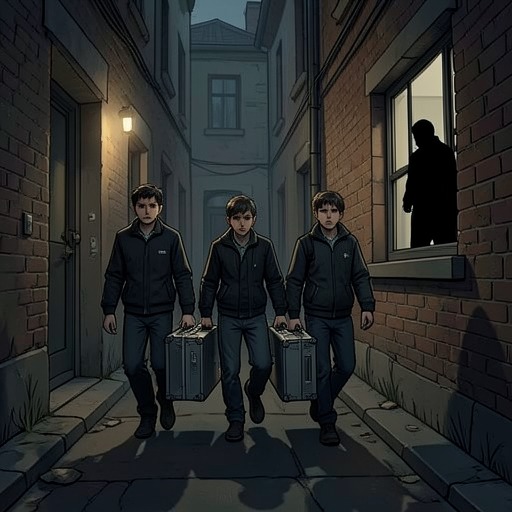
Sanchez tries to make that risk manageable through planning. He argues that the first sale took only three hours of trying and succeeded, and proposes asking around for a buyer who might take all the remaining machines at once, with calls to Hellersdorf as one possibility. As the equipment is prepared for transport, he folds one of Julius’s moving boxes with a few practiced movements. Julius packs two computers and two monitors into a box and checks that it will close. The ordinary efficiency of packing contrasts with the illegal cargo: the machines are not yet safely gone, only made more portable.
The Theft Enters Public View
The school’s response makes clear how widely the loss is known. When police address Lukas’s class, they say that an investigation is under way and ask anyone with useful information to contact the Berliner Polizei or speak up directly. The school’s head, Herr Schiezeth, explains that he had worked to secure modern equipment, dealt with officials from the Bildungssenat des Landes Berlin, and delayed publicity about the new machines to prevent anyone from getting the idea to steal them. His account links the equipment’s arrival to a deliberate effort to improve the school and underscores the scale of the betrayal.
At school, the stolen computers also become a focus of suspicion and rumor. Classmates look toward Lukas, whisper, point, and call him Tony Montana; one student is heard telling a companion that Lukas was responsible. Sanchez reassures him, but Lukas reads the watching faces as evidence that people know. Three police officers emerge from a stairwell as the two boys continue along the corridor. The stolen machines are not present in that scene, yet their absence does not make them invisible: the theft has altered how Lukas is seen.
Herr Reinicke then summons Lukas to a private conversation about the stolen computers. He says that students from Lukas’s class must have been involved because a teacher’s key was stolen during a lesson. Instead of presenting a neutral request for information, he uses racist assumptions to single Lukas out as the only German student in the class and asks him to listen for information and report back. His approach shows how the burglary’s investigation can itself become entangled with prejudice. It does not establish who stole the equipment; it reveals the way suspicion is being directed at Lukas and his classmates.
From Property to Evidence
The computers’ role changes at each stage of the story. In their unopened cartons, they are school property whose promised usefulness excites the boys’ fantasy of easy money. In the shop, their newness and the newspaper report make them legible as stolen goods. At Julius’s home, the remaining machines become a source of conflict and an immediate risk if the police search the apartment. At school, even without the equipment in view, the burglary shapes rumor, police attention, and Herr Reinicke’s attempt to recruit Lukas as an informant.
That progression gives the goods a force beyond their price. The first three machines produce 800 euros, but the cash does not settle the theft: five remain, the only known buyer has refused further dealings, and the group is divided between destroying evidence and seeking another sale. Each attempt to treat the computers as ordinary commodities makes their criminal origin more consequential. Their physical presence demands concealment and transport; their recognizability carries the story into the classroom, the shop, Julius’s home, and the school’s investigation.