Three Men Robbed During a Computer Sale
Sonne und BetonThe robbery during the computer sale is the point at which the trio’s attempt to turn stolen school equipment into money collapses: the men they expect to buy the computers take them without paying, and the friends’ own mistake leaves Marco furious and Lukas afraid that the damage will escalate. The scene is built around a small but decisive failure of recognition. A deal that Marco presents as arranged and simple depends on meeting the right person; at Beusselstraße, the boys never establish that they have done so.
Background and Arrangement
The computers have been stolen from the school, where Lukas, Sanchez, and Julius found unopened boxes of computers and monitors stored high on shelves. Their efforts to sell them meet an immediate obstacle when they approach a computer shop. The shopkeeper recognizes the suspicious timing: only days after computers were stolen from a school, three school-age boys arrive offering brand-new equipment. His suspicion exposes how difficult it will be to turn the goods into cash through an ordinary business.
Marco offers a different route. After making calls, he tells Lukas that acquaintances of an acquaintance will buy everything the boys have in one transaction. He says the meeting will take place that night in Moabit and that he will negotiate the price beforehand. The boys are to meet Abdul, collect the money first, hand over the computers, and leave. Marco will not accompany them because he has to work and cannot change his shift. His confidence makes the sale sound nearly effortless, but the plan leaves the boys to handle the meeting themselves.
The instructions include a warning: they are to speak only to Abdul, not to anyone else. Marco singles out Julius as someone especially likely to cause trouble. Yet Lukas asks who the buyers are and how Marco knows them, and Marco dismisses the question as irrelevant. He ends the call by telling Lukas not to do anything foolish. The arrangement therefore has a clear procedure but little protection against a stranger pretending to be the expected buyer: the boys have been told whom to meet, but the evidence does not show that they have been given a reliable way to identify him.
The Meeting and the Loss
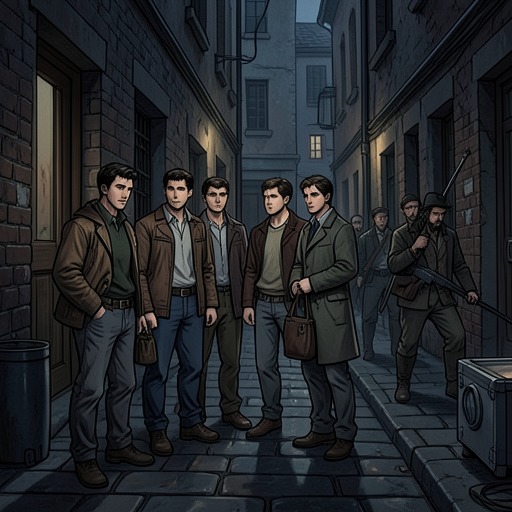
Lukas later explains that the three followed the plan as they understood it. They went to Beusselstraße, to a parking lot behind a bridge at a hardware store, and waited. Two cars arrived a few minutes later. One man got out and said something that the boys took as a reason to hand over the bags so he could inspect them. They complied. He put the bags in a car, got in beside them, and the cars drove away. The whole exchange happened so quickly that they did not manage to stop him. No payment is described; the computers are simply gone.
Marco’s first response is to ask how the boys could have been robbed. Lukas struggles to recount the encounter and cannot give a precise description: he recalls the man as older than them, perhaps nineteen or twenty, with black hair, a close-cropped haircut, and a chain. Marco immediately identifies the mismatch that turns the incident from an unexplained loss into a botched meeting. The Abdul he had described had long hair, and he had told Lukas to speak only to him. The man who took the bags was not that Abdul.
Lukas protests that he had no way of knowing which person was Abdul and reasons that the group’s arrival at the right time cannot have been a coincidence. But that observation cannot establish who the man was. The boys treated the apparent timing and the man’s claim to inspect the goods as enough confirmation; once they handed over the bags, he and the computers were beyond their reach. The scene’s central reversal is therefore not just that an illicit sale fails. The proposed buyer becomes the thief, while the boys’ role as sellers leaves them with no safe or credible way to resolve the loss.
Aftermath and Significance
Marco says he will make calls and sort out what happened. Lukas tries to stop him, insisting that the men cheated the boys, not Marco, and that the mistake was theirs. He asks Marco not to do anything that could bring further trouble. Marco rejects that appeal, shouting that people who rob younger boys cannot simply be allowed to get away with it. He promises to handle the matter and ends the call without telling Lukas what he intends to do.
The aftermath returns to the boys on the S-Bahn. Julius grips a bottle of vodka, Sanchez rests his head against the window, and the lights of houses and streetlamps blur past. Lukas still holds the phone to his ear for a moment after Marco hangs up, then remembers that Marco has sounded like this before when he was close to doing something reckless. That recollection gives the robbery a second consequence: the threat of retaliation now hangs over the loss. Lukas’s plea was meant to prevent another incident, but Marco’s answer leaves the next step unresolved.
The event exposes the fragility of the whole scheme. The boys had broken into their school, found the computers, and hoped a single sale would convert stolen goods into cash. At the final handoff, however, the same informality that made Marco’s offer seem convenient—an acquaintance’s contact, an instruction to trust one named buyer, and a meeting handled without him—becomes the opening through which the goods disappear. The stolen computers are lost, the expected money never arrives, and the effort to avoid consequences risks producing another conflict.