Violence and Insecurity in Gropiusstadt
Sonne und BetonViolence and Insecurity in Gropiusstadt is a persistent condition of the boys’ lives, not a single confrontation: danger influences where they walk, how they behave under scrutiny, and whether they believe anyone can protect them. The narrative connects public assaults and neighborhood rivalries with school rules, family abuse, and distrust of official help, showing how insecurity can make both withdrawal and retaliation seem necessary.
Everyday Exposure and Restricted Movement
The threat begins before a fight. At school, Lukas arrives without his student ID and is refused entry under a new security rule, even though he says he is a student and fears falling further behind after frequent absences. With no teacher available to confirm his identity, he leaves rather than risk missing more class. The scene links institutional control to a wider feeling of being exposed: the measure intended to keep strangers and weapons out does not offer him a way to resolve his immediate problem.
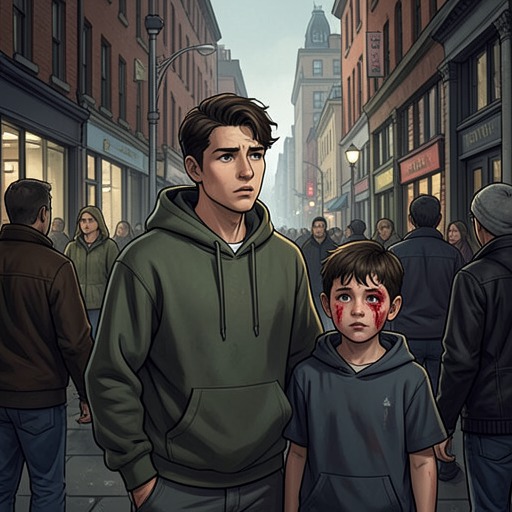
The boys’ movement through the neighborhood is similarly shaped by anticipated danger. When Gino, Julius, and Lukas cross the park, Lukas would rather take a longer route because he expects trouble near the groups gathered there. He describes the park as a place he hates, with discarded beer mats and broken glass across the grass; a man sitting with companions approaches them to offer drugs. The encounter confirms Lukas’s sense that their route has taken them into a space where casual contact can quickly become threatening.
Public Humiliation and the Logic of Retaliation
The meeting escalates after Julius responds to the offer with an insult. The man confronts Lukas, shoves him, and his companions close around the three boys. Lukas feels his heart race and begins to tremble; he tries to apologize and explain that they are in a hurry. Djamel, whom Julius recognizes from primary school, rejects the attempt to calm things down. Lukas forces himself to hold Djamel’s gaze because he believes looking down would make him an easier target. The exchange makes the pressure of an audience part of the threat: the boys are watched, challenged, and expected to perform a version of toughness.
Djamel and his companions attack Lukas while Gino and Julius remain frozen. One person records the assault on a phone. Afterward, Lukas does not treat his friends’ failure to intervene as simple disloyalty. He reasons that joining in could have made the violence worse, and that fighting back might bring retaliation later, either from people searching across Gropiusstadt or from a larger group appearing at school. His fear is therefore not limited to what happens in the park; it includes the possibility that the encounter will follow him into other places and days.
Instead of leaving the matter behind, the boys go to Cem. Julius calls for them to return and confront the people who attacked Lukas, and Cem urges Lukas to strike Djamel, handing him a baton. When Djamel challenges him, Lukas cannot move and lets the weapon fall. Cem then attacks Djamel, prompting a wider fight as others seize the baton and people rush into the confrontation. Lukas’s paralysis and Cem’s sudden violence mark two different responses to the same demand: Lukas cannot make himself carry out the revenge expected of him, while Cem turns the challenge into a physical clash. The account of the earlier assault later becomes a warning from Marco, who tells Lukas that he was fortunate Cem had been present and that an encounter with a knife could have ended differently.
Honor, Self-Defense, and Inherited Rules
Marco’s advice exposes a contradiction in the neighborhood’s code. He recalls that he once tried to follow their father Matthias’s counsel to stay out of trouble and give way, but says that doing so left him vulnerable to being beaten. He began boxing and working out, and he describes how his group acquired a reputation that made others less likely to target them. In his formulation, adults say that the wiser person gives way, whereas street life reverses the rule: the wiser person strikes first. Yet Marco also urges Lukas to run from someone with a knife or surrender his phone rather than risk his life, even offering to replace it. His guidance moves between practical avoidance and the bravado of fighting back, rather than resolving the conflict between them.
The confrontation also shows how neighborhood and ethnic labels intensify ordinary encounters. Julius’s remarks about the people in the park, and the insults directed at Lukas during the standoff, turn the encounter into a contest over identity as well as personal respect. Later, Cem’s claim that their brothers are friends helps bring the boys together, but it also frames loyalty through group affiliations. Such language does not prevent violence; in these scenes, it can sharpen the divisions through which a slight becomes a challenge and a challenge invites retaliation.
Violence Beyond the Street
Insecurity also enters the school. Police tell students that computers and monitors worth several thousand euros have been stolen, apparently by three people carrying the equipment in a shopping cart toward U-Bahnhof Zwickauer Damm. Residents also reported hearing gunshots near the station that night, though the police do not know whether the shots were connected to the burglary or whether the thieves were armed. The uncertainty matters: even the official account cannot establish what happened, while the possibility of weapons makes the theft feel more dangerous. Herr Schiezeth responds by warning that everyone involved, including those who knew about the crime and failed to help investigate it, will be punished. School authority appears forceful, but its threat does not itself settle the students’ fear or suspicion.
At home, Gino’s situation shows that the danger is not confined to public space. Julius tells Lukas that Gino’s father beats Gino and his mother, drinks, and took the 200 euros Gino received from the computers. Gino has reportedly spoken of wanting to escape with his mother and brother, but believes his father will not let them leave. Julius says Gino feels unable to help while hearing the abuse from his room. When Lukas questions why Julius is arranging Tilidin rather than contacting the police, Julius rejects the idea that the police can help. The exchange reveals a crisis in which a friend’s attempt to intervene is shaped by Gino’s helplessness and by their lack of confidence in outside protection; it does not establish that the drug will solve the danger.
Recurrence and Significance
The later confrontation between Julius and Cem shows how quickly the same public rules return. Julius and the others try to calm matters by appealing to friendship between their brothers, but Cem still gives Julius a short deadline to explain his relationship with Cem’s girlfriend. The threat makes clear that appeals to connection can coexist with intimidation rather than ending it. Across these episodes, violence repeatedly moves between a perceived insult, a public test of loyalty, and the expectation of consequences afterward. Gropiusstadt is rendered as a place where the boys calculate danger constantly, but where avoidance can feel like surrender and retaliation can create the next threat.