Walter-Gropius-Schule
Sonne und BetonWalter-Gropius-Schule is a school in Berlin whose ordinary functions—lessons, attendance rules, assemblies, and new educational equipment—become entangled with the novel’s conflicts. For Lukas, it is at once a place he needs to reach, a public setting where violence is discussed, and a building whose computers are stolen after their arrival is announced. The school’s changing significance is made tangible through its thresholds: a gate that keeps a student out by rule, and a side door that later lets a group in at night.
Institutional Setting and Public Attention
The school is presented as an institution trying to respond to insecurity while continuing its educational work. Security staff have been placed at the entrances and on the grounds under a new access arrangement. The stated purpose, as Lukas understands it, is to prevent outsiders from attacking people or bringing weapons into the school. Yet the rule’s strict application creates a different problem when a student forgets his identification card: the system meant to protect the school does not distinguish him from a stranger.
The school also becomes a stage for official announcements. Herr Schiezeth summons students to the assembly hall for an important statement, with press representatives present. The gathering carries the memory of an earlier public crisis: Marcel was stabbed three times on a crowded daytime subway after telling a man to leave his girlfriend alone. Journalists then made the school and Gropiusstadt prominent subjects of coverage. The new assembly therefore takes place under the shadow of violence already associated with the area, even before the students learn what has brought the press back.
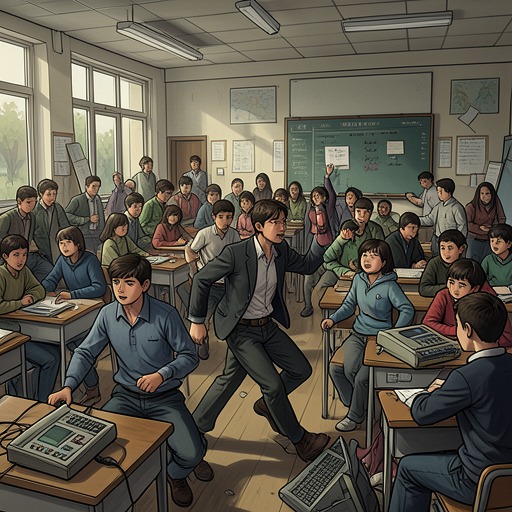
At the assembly, Herr Schiezeth announces that Berlin will provide fifty new computers. Herr Reuter, representing the Berlin education senate, is introduced as the person responsible for securing them. The machines are intended to bring practical computer instruction to the school, with lessons due to begin the following week and delivery expected in two days. The announcement joins a concrete educational promise to the school’s public image: the institution is not only a setting for reports about violence but also a place seeking resources for students’ future working lives.
Access, Routine, and the School as a Meeting Place
Lukas’s encounter at the gate makes the school’s rules immediate and personal. He has forgotten his student card for the first time, insists that he normally carries it, and asks the guard to let him in. The guard refuses without looking at him, repeating that students without identification cannot enter. Lukas checks the time: it is shortly after ten, and he is about to miss the beginning of the third lesson. He is already worried about his absences and about having to repeat ninth grade for a third time, so missing more school is not a trivial inconvenience.
He looks for a teacher who might confirm that he belongs there, but no familiar teacher appears. As the bell rings and the schoolyard empties, he argues that the security measure is supposed to stop attackers, not exclude ordinary students. The guard remains unmoved, steps directly in front of the gate, and turns to his phone. Lukas leaves rather than wait. He messages Gino, who arranges to meet him at Wutzkyallee near a video shop. In this episode, the school’s boundary redirects the day: a missed card becomes a missed lesson and an improvised meeting outside the school routine.
The grounds also serve as a place where people come looking for connection, not only for lessons. Cem tells Lukas that he has been waiting at Walter-Gropius-Schule to find Denise, whom he met at a swimming pool. He lost the paper on which she wrote her number and does not even know whether she attends the school. He describes her as the person he wants to see again and says that, if she does not appear, he will try another school the next day. The episode makes the school a recognizable landmark in the neighborhood, even for someone uncertain whether the person he seeks belongs there.
The New Computers and the Nighttime Entry
The fifty computers announced at the assembly soon acquire a second meaning. Lukas tells Julius and Gino that the equipment is due to arrive in two days, including monitors, keyboards, and mice, then proposes stealing it and selling it. The school’s investment in practical instruction becomes, in his account, an opportunity for quick money. The gap between the official purpose of the machines and the boys’ plan gives the theft its central irony: equipment intended to prepare students for work is recast as loot before it has even arrived.
When the group returns at night, the familiar school building becomes an uncertain and threatening space. They stop at a side entrance serving the seventh-grade area. Lukas worries that a night watchman or cleaners may be inside, and wonders whether movement sensors or surveillance cameras could alert the police. He realizes that this entrance brings them close to the caretaker’s room and the rooms where cleaning supplies are kept, places where someone might be working. Before he can reconsider, Sanchez has already unlocked the door.
Inside, the school is dark and quiet. Their steps echo along a long linoleum corridor, while the unlit ceiling tubes give off a low, steady hum. Lukas tries to move without making noise and takes out a flashlight from his father’s backpack, only to find that it will not turn on. Details that are unremarkable during the day—the corridor, the entrance, the equipment kept nearby—become sources of suspense because the boys have crossed into the building unlawfully. The school’s architecture shapes the scene: the side door offers access, while the exposed passage toward staff and cleaning areas intensifies their fear of being discovered.
Investigation and Significance
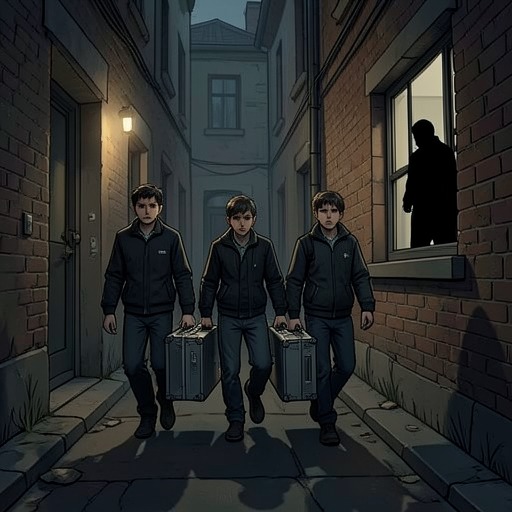
The burglary becomes public at school through a police briefing. Officers from Berliner Polizei tell the students that computers and monitors worth several thousand euros were stolen over the previous weekend. Residents reportedly saw three male suspects in black hooded jackets moving the stolen goods in a shopping cart toward U-Bahnhof Zwickauer Damm. The police also mention gunshots heard near the station that same evening, while making clear that they do not yet know whether the sounds were connected to the break-in or whether the thieves were armed.
As the officers describe the case, Herr Schiezeth looks at Lukas. Lukas avoids his gaze and stares at the floor, thinking that he should have stayed home, as Sanchez did. The school is thus not merely the place where the crime occurred; it is also where the investigation’s public account meets the private knowledge of someone involved. The assembly hall and classroom turn the school into a pressure point between official uncertainty and Lukas’s concealed guilt.
Across these episodes, Walter-Gropius-Schule is defined by competing uses and meanings. It teaches, restricts entry, hosts public announcements, serves as a neighborhood reference point, and becomes the object of a planned theft. Its security rule cannot prevent a student’s exclusion, while its physical defenses and possible surveillance are only matters of anxious speculation to the intruders. The same building that promises educational opportunity through new computers is made vulnerable by the boys’ decision to treat those computers as a source of cash.