Angels
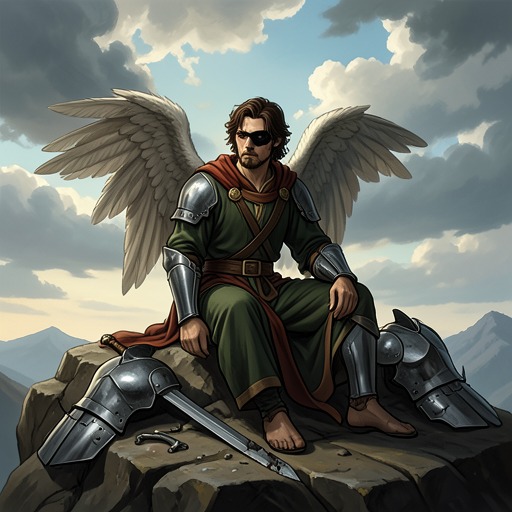
Soul Guardian: A Hellishly Cozy FantasyAngels are the celestial beings of Heaven and one of the book’s chief instruments for overturning conventional religious imagery. They possess immense authority and terrifying military power, but they are not treated as uniformly wise or benevolent. Instead, the narrative places their grandeur beside petty frustrations, bureaucratic inflexibility, personal vice, and moral uncertainty. Their resulting contradiction—holy power administered by recognizably flawed personalities—shapes the book’s conflicts between Heaven, Hell, and the mortal world.
Nature and Power
Angels belong to an organized heavenly order whose influence extends into apocalyptic planning, warfare, adoption, judgment, and the regulation of supernatural identities. Metatron appears as a biblically accurate angel with twenty pairs of eyes and multiple wings, an embodiment of scriptural otherness made awkwardly physical. His many eyes are not presented only as a sign of omniscience: during allergy season they become a source of misery, turning divine excess into an ordinary bodily inconvenience. He also carries a lasting hatred of boats because the Great Flood failed to destroy humanity, giving a supposedly sacred historical event the emotional afterlife of a personal grudge.
Their destructive capacity remains genuine even when the narration mocks them. Bael remembers ordinary rank-and-file angels as easy enough to kill, while archangels are described as vastly more dangerous opponents, comparable to tanks that cannot be neutralized by inadequate force. Gabriel’s appearance reinforces this martial dimension. His short salt-and-pepper hair, clean-shaven jaw, immaculate black suit, and matching leather shoes make him look like a soldier, and his preference for black is linked to its practical ability to conceal dirt and blood. Angelic holiness therefore coexists with military discipline and violence rather than replacing them.
Heaven, Institutions, and Daily Conduct
Angels operate through institutions as much as through miracles. The Arms of the Angels Adoption Agency is so openly named that Maharet regards it as evidence of angelic lack of subtlety. In her assessment, Angels favor sulfur, brimstone, rigid procedure, and direct authority over guile or wit; their characteristic answer is effectively that matters proceed their way or not at all. The agency nevertheless performs a genuine social function, helping children find good homes. Zephyr, despite his scheming nature and fondness for vice, remains an angel whose work is to help people.
Zephyr’s conduct exposes the distance between heavenly ideals and lived angelic behavior. In the agency’s back room he strums an acoustic guitar while eating Doritos with chopsticks, drinking Arizona Iced Tea, and smoking funny cigarettes. He dislikes the orange dust on his fingers but enjoys the chips because processed food is forbidden in Heaven, where the available strawberries and water are described as exquisite but cannot satisfy every earthly craving. His attempt to compose a song eventually gives way to playing R.E.M.’s “Losing My Religion,” while Gabriel objects to what he regards as corruption associated with an unclean instrument, even after Zephyr points out that the object is a guitar rather than a sword. The scene makes angelic culture appear less like an unreachable ideal than a restrictive institution whose members improvise small rebellions.
The same institutional rigidity affects supernatural identity and legal status. Zephyr discovers that Six has been recorded as having drowned two years earlier, a false death entry that threatens Maharet’s attempt to have her adopted. The record likely resulted from one of Mike’s followers working in the coroner’s office, allowing Mike to treat Six as available for sacrifice while the outside world considered her dead. The angelic system is therefore not merely a source of protection; its documents and procedures can become obstacles that must be corrected before a vulnerable child can be recognized as legally alive.
Alliances, Conflict, and Moral Contradictions
Angels stand in continual opposition to Demons, but the boundary between the two sides is less morally secure than their official cosmology suggests. Lucy and Metatron meet in the black void between worlds to decide how the apocalypse will begin, agreeing that it should occur on Christmas Day, late enough for people to open their presents but before they discover that the batteries are missing. The scene places an angelic participant inside an explicit conspiracy against humanity and treats the end of the world as a logistical problem requiring negotiation over timing and method. Metatron’s resentment over the failed Great Flood further shows that heavenly power can be directed by grievance as readily as by doctrine.
Angels also participate in the management of those who do not fit cleanly into Heaven’s categories. Ganon-Sharoth, possessing the body of a priest, declares that he has forsaken Hell and will not return there. His position reveals a crisis in the supposed moral geography of the universe: he may be excluded from Heaven not because of a new offense, but because rules and tradition refuse to recognize his changed allegiance. The elderly bishop who shares his body argues that even the Devil is a child of God and can be loved, while Bael regards that claim as blasphemous. Through this exchange, angelic and heavenly order is measured against the possibility of redemption, and the institution appears less generous than the theology it claims to administer.
Gabriel represents the most violent form of angelic opposition. In the final confrontation, Bael sends Six away not only to protect her but also to prevent her from seeing him kill Gabriel. Bael invokes his authority as a baron of Hell to banish Gabriel from the infernal realm and all associated territories, then drives a sword through Gabriel’s heart. Gabriel’s soul cannot return to Heaven, enter Hell, or even reach purgatory because purgatory lies on the outer edges of the infernal realm. The consequence is not ordinary death but exclusion from every recognized destination: his soul is trapped between dimensions and begins to unravel through exposure to the void. Angelic status thus does not guarantee a secure afterlife; once Gabriel is removed from the systems that define belonging, even his soul becomes vulnerable to cosmic disintegration.
Narrative Significance
The Angels function as a comic and theological counterweight to the Demons. Bael is a baron of Hell who can be summoned away from a gripping grimoire, a warm nook, and tea with honey and lemon, while Angels are capable of plotting the apocalypse yet still complain about boats, processed food, or guitars. The contrast does not make the celestial order powerless. On the contrary, the humor draws attention to how immense authority becomes strange when embodied by individuals with habits, grudges, appetites, and institutional blind spots.
Their scenes repeatedly connect sacred symbols with practical consequences. Christmas Day becomes the scheduled opening of Armageddon; the Great Flood becomes the origin of Metatron’s hatred of buoyant objects; a church’s splendor becomes, in Bael’s eyes, blood, sweat, and tears wasted on a deity that wants no such excess; and an adoption agency becomes the site where angelic benevolence confronts forged mortal records. Angels therefore embody the book’s broader reworking of religious myth: Heaven is real, its representatives are formidable, and its categories matter, but none of those facts prevents divine institutions from becoming absurd, compromised, or cruel.
Most importantly, Angels are associated with the unresolved question of whether order is the same thing as justice. They can protect children, oppose demons, and command extraordinary force, yet their rules can preserve exclusion even when a being has rejected its former allegiance. Their authority can also turn punishment into annihilation, as Gabriel’s banishment leaves him outside every afterlife. The celestial host is consequently neither a simple force of good nor a parody emptied of power. It is a rigid sacred bureaucracy whose members reveal, through both comedy and violence, the costs of a universe in which salvation, identity, and belonging are governed by institutions that may be less merciful than the ideals they represent.