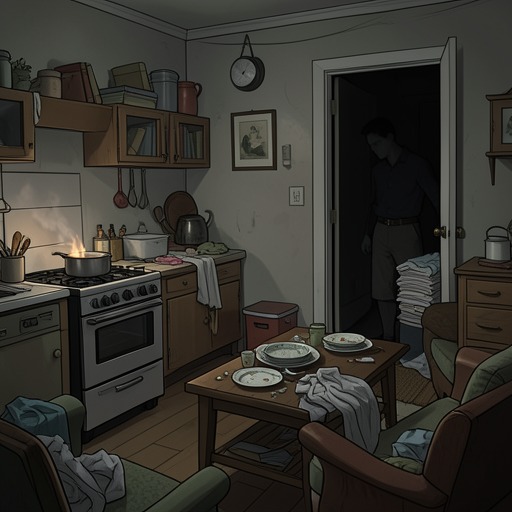
Bael-Sharoth and Maharet Flameheart
Soul Guardian: A Hellishly Cozy FantasyBael-Sharoth and Maharet Flameheart are defined by a relationship that begins in institutional hostility, becomes a contest of infernal wit, and eventually turns into an intimate bond with physical, emotional, and moral consequences. Their history makes love neither a simple reconciliation nor a retreat from conflict: it is a transformation of rivalry into mutual dependence, with Six at the center of the change.
Rivalry in Hell
When Hell was still being built, Bael-Sharoth and Maharet Flameheart collaborated on several important projects. Their partnership ended after a difference of opinion, leaving their professional relationship strained. The old antagonism remained embedded in the bureaucratic structure of Hell: Bael-Sharoth’s department later blocked Maharet Flameheart’s plan to run a pipeline through the Forest of Suicides. Against that background, her visit to his office carries the flavor of both reconnaissance and provocation. She praises his presentation on minor torments and torture fatigue, then presses him to explain how he developed it, implying that she suspects he did not produce the work entirely alone.
Their conflict is therefore not merely personal. It is conducted through departments, projects, professional credit, and rank within Hell. Maharet Flameheart approaches Bael-Sharoth as a former collaborator who knows his habits and weaknesses, while Bael-Sharoth receives her with suspicion because her appearance follows so closely after his department’s obstruction of her plan. Their shared history gives every polite exchange a second meaning.
The Wager and the Forced Partnership
Maharet Flameheart’s decisive challenge comes after she has been contained in a summoning chamber. Sitting inside a protective circle, she tests the magical barrier with living flame and finds no opening through which she can escape. Instead of continuing to attack a barrier without weak points, she chooses negotiation. She proposes that Bael-Sharoth find a suitable human family for Six by the first day of the New Year. If he succeeds, she will keep silent about his fraternizing with the living; if he fails, he must surrender his position as a baron of Hell and remain exiled to Earth forever.
The wager turns their antagonism into an enforced collaboration. Bael-Sharoth recognizes that the apparent simplicity of the bargain conceals decisive conditions, since battles of wit are a familiar path to advancement in Hell and depend on identifying the one detail that changes everything. He eventually exploits the mechanics of their shared summoning. Maharet Flameheart expects to return to Hell alone, but Bael-Sharoth explains that when two objects are summoned together, both must return together. Because Six has been summoned with them, Maharet Flameheart cannot simply abandon the mortal-world problem or escape the wager’s consequences; she must work with Bael-Sharoth to find Six a family. Her repeated declaration of hatred records the moment when his technical knowledge becomes a tactical victory over her.
The wager also exposes the relationship’s larger stakes. Bael-Sharoth’s contact with the living has become a professional liability, while Six’s orphaned status gives the dispute a human and ethical center. What begins as a contest over secrecy, office, and exile is redirected toward the question of whether two demons can take responsibility for a vulnerable child.
The Traveler’s Bond
Their forced proximity becomes supernatural when Bael-Sharoth and Maharet Flameheart travel through a portal together. Bael-Sharoth first experiences the result as an unexplained emotional disturbance. A fading dream leaves him angry and frightened about Six’s possible danger, but the anger abruptly gives way to concern. He realizes that the emotion is not entirely his own and asks Maharet Flameheart what she has done to him.
Maharet Flameheart identifies the cause as the Traveler’s Bond. Because they came through the portal together, parts of each demon have bonded with parts of the other. The connection is not metaphorical companionship but a transformation produced by interdimensional travel; the longer the journey, the deeper the bond. The book extends the principle to humans, observing that couples who travel together often become conspicuously close without understanding the causal relation. In Bael-Sharoth and Maharet Flameheart’s case, the bond makes emotional boundaries porous and turns their former separation into involuntary mutual sensation.
The bond initially threatens Bael-Sharoth’s sense of self. Anger and concern no longer remain securely attached to one person, and the connection forces both demons to confront an intimacy they have not chosen in ordinary terms. Yet the same loss of separation becomes the condition for desire. When Maharet Flameheart pins Bael-Sharoth to a bed during their play fighting, both perceive that they began as separate beings but have become two halves of the same demon. The physical closeness gives the supernatural bond an embodied form: shared warmth, breath, pressure, and anticipation make their emotional entanglement visible.
From Desire to Love
Their relationship crosses into sexual intimacy amid explicit danger and uncertainty. Bael-Sharoth warns that there is no knowing what may happen if they proceed, a warning that reflects both the intensity of the Traveler’s Bond and the instability of their new connection. Afterward, smoke rises from the bed while the two demons lie wrapped around each other. Bael-Sharoth experiences the scene as a rare moment of wholeness: with Maharet Flameheart resting her head on his chest, he feels that everything is right and that, for the first time since entering the mortal realm, he is no longer cold.
The aftermath preserves the relationship’s comic and infernal physicality. Maharet Flameheart breathes smoke and explains that she does so only when the encounter has been especially satisfying. The joke does not cancel the tenderness; it gives their intimacy a distinctive shared language, joining grotesque demonic physiology to an unmistakably affectionate domestic moment.
Later, their attachment is stated directly rather than left as an implication of the bond. After playful tickling and fighting have again become sexual, they lie on the kitchen floor while the ghost retreats into the cookie jar because even a ghost finds the situation embarrassing. Maharet Flameheart blows a smoke ring toward Bael-Sharoth, then tells him that, inconveniently for her, she thinks she really loves him and asks him not to break her heart. Bael-Sharoth answers that he loves her too. The exchange is important because it distinguishes imposed magical connection from chosen emotional commitment: the Traveler’s Bond makes intimacy possible, but the declaration of love gives that intimacy meaning.
Love, Six, and Moral Choice
By the later development of the relationship, Maharet Flameheart is not simply Bael-Sharoth’s former opponent or magically attached companion. She is part of the emotional framework through which he understands his obligations to Six. Bael-Sharoth admits that he does not know whether a higher purpose brought him and Six together, and he recognizes the contradiction of a demon wondering whether God is guiding him. His answer is not certainty but a distinction between the fate one fights and the fate one makes.
That distinction gives the relationship ethical weight. Bael-Sharoth chooses to continue loving and caring for Six as well as he can, even while uncertain about the forces that arranged their circumstances. He rejects the alternative of becoming angry and fighting destiny by making Six suffer, because she has already endured enough. Maharet Flameheart’s presence is part of the path by which this responsibility becomes shared rather than private: the wager, the forced return, the bond, and the love story all place the two demons alongside one another in the work of protecting a child.
The relationship’s significance lies in this movement from rivalry to interdependence without erasing conflict. Bael-Sharoth and Maharet Flameheart retain the wit, suspicion, teasing, and strategic maneuvering that marked their earlier association, but those qualities are gradually redirected toward cooperation and care. Their love is born through a magical violation of boundaries, tested through competing interests and possible exile, and confirmed through repeated acts of closeness and responsibility. It becomes one of the book’s clearest examples of chosen attachment emerging from circumstances neither demon initially controls.