Found Family
Soul Guardian: A Hellishly Cozy FantasyFound Family is the principle that family can be made through choice, care, and loyalty rather than secured by blood or legal inheritance. In the story, the idea gives shape to Six’s movement from abandonment and exploitation toward a household whose members repeatedly decide to protect her, stay with her, and accept obligations that cannot be reduced to convenience. It also transforms Bael-Sharoth and Maharet Flameheart from reluctant collaborators into parents, spouses, and participants in a family whose bonds are tested by fear, deception, danger, and the difficult work of becoming better than their origins.
From Orphanhood to Chosen Belonging
Six begins from the most literal absence of family. At five, she was Marleene Quinzel, the sole survivor of a station-wagon crash at Devil’s Slide that killed the rest of her family. After months of recovery in a hospital, she spent two years moving through the foster-care system, passing from one household to another without finding permanence. Her vulnerability was then exploited by Mike, whose cult leader status concealed a plan to sacrifice her to a demon. He renamed her Six because he considered her birth name unsuitable for the ritual. The name therefore begins as an instrument of possession: a label imposed on a child whom adults have treated as material for their purposes.
Bael-Sharoth’s arrival does not immediately solve that history. He defeats the cult’s immediate plan, but his presence creates a new crisis. The cult’s summoning succeeds only by chance, and the members pay for it by being encased in 24-karat gold; the supernatural rescue leaves Bael-Sharoth and Maharet Flameheart responsible for a human child in a world they do not understand. Maharet asks how adoption works because neither of them is from the mortal realm, and Bael-Sharoth realizes that helping Six will require assistance from an angel. The household is thus formed under pressure rather than by a prepared domestic ideal, yet its improvised beginning is precisely what makes it a chosen family: its members must decide what responsibility means after the old family structures have already failed Six.
Six initially experiences their decision to stay as another loss of control. When she learns that Bael-Sharoth is not going away, she screams at him, tries unsuccessfully to send him back to Hell, and locks herself in her room while muffled sobs pass beneath the door. Bael-Sharoth feels the rejection as a wound and is left in a cold, empty house with a child who hates him. His instinct is to flee, but he remains. Maharet Flameheart explains that Six had imagined Bael-Sharoth as a magical friend she could summon when needed and dismiss afterward; his permanent presence means that she is no longer in control of the arrangement. Her fear is not ingratitude but the terror of another adult determining her future.
Care as a Practice, Not a Claim
The family’s bonds become credible through actions that impose obligations on the adults. Around the hearth, Bael-Sharoth expects Six to be pleased that they are seeking a new family for her, but Maharet Flameheart recognizes why she cannot simply accept the prospect. Six knows that she cannot remain alone forever and will eventually need a family to care for her, yet recognizing necessity does not make separation emotionally acceptable. Maharet frames that conflict through the image of summer ending: childhood may be temporary and change unavoidable, but no child genuinely wants the season to end. The metaphor makes family less a legal solution than a passage through loss, attachment, and reluctant maturation.
Titan intensifies this principle by turning protection into an oath. When Six enters danger and returns angry that she might have starved in a maze, Maharet Flameheart reminds her that Titan would never have allowed harm to come to her. As a pup of Cerberus, he would rather die than fail in that duty. Six is horrified by the implication and clings to Titan, insisting that nobody should die for her. Titan answers that protecting her is his honor and that Bael-Sharoth and Maharet Flameheart share the same honor, even if they express it differently. The scene reveals that the family is held together by different forms of care: Titan’s is an explicit martial vow, while the adults’ is expressed through decisions, planning, discipline, and continued presence.
Bael-Sharoth attempts to release Titan from the oath, but Titan refuses. The hellhound declares that Bael-Sharoth cannot break another being’s word, and identifies himself as Titan, son of Cerberus and second guardian of the gates of Hell. Neither a baron, an angel, nor Satan herself can invalidate a promise once given; while Titan draws breath, Six remains under his protection. Bael-Sharoth then accepts the refusal and formally decides that Titan will stay and guard their daughter. The exchange is initially revealed as a test, since Bael-Sharoth had attempted to see whether Titan’s commitment was genuine, but the result exceeds the test: Titan’s loyalty is not a disposable service arrangement. He claims a place in the family by choosing the obligation and defending it against authority.
Six’s response is equally important. She does not treat protection as a right to consume other people. Her distress at the prospect of Titan’s death shows that she is learning to understand herself as someone loved by others, not merely as someone endangered or used. Found Family therefore carries an ethical cost for every member. Six must accept care without believing that her existence requires sacrifice, while the adults must protect her without turning protection into another form of control.
Choosing to Stay
Bael-Sharoth’s decisive family commitment comes when he chooses to remain with Six for ten years. He has the bureaucratic means to take extended leave from Hell, having accumulated an extraordinary number of unused days and discovered that the employee handbook permits him to apply them in an unconventional way. He has already approved the vacation paperwork, despite knowing that his absence will leave Hell shorthanded and create countless administrative problems. The comic bureaucracy surrounding the decision does not diminish its seriousness. Bael-Sharoth is using the machinery of his old life to create time for a new one.
He tells Maharet Flameheart that postponing the decision is unfair to Six and that he will stay because he could never forgive himself for abandoning her. He does not demand that Maharet stay with him or present the decision as a test of her love. Instead, he asks her to do what is best for her while admitting that he would feel safer with her beside him. That distinction matters: chosen family is not created by coercing someone into a role, but by making a vulnerable commitment and allowing another person to answer it freely. Maharet Flameheart teases him for needing help, then remains emotionally and practically involved.
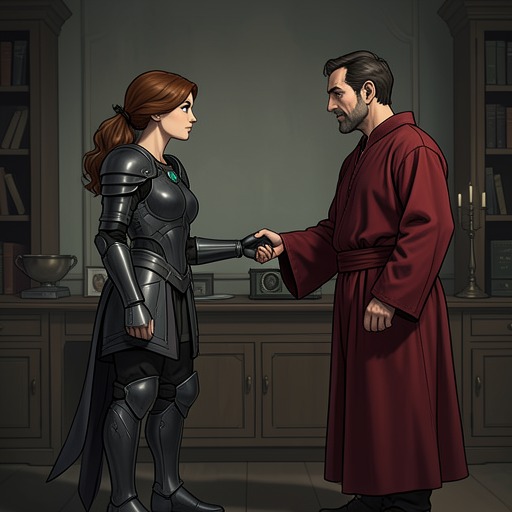
Their relationship becomes an additional foundation for Six’s household. Maharet Flameheart tells Bael-Sharoth that she loves him despite the inconvenience and asks him not to break her heart; he answers that he loves her too. Their affection is playful and embodied, but it is also linked to decisions about the future. Later, while preparing for Bael-Sharoth’s departure, Maharet Flameheart says that they are in this together, now and forever. Bael-Sharoth kisses her hand and promises that when he returns they will discuss their wedding and plan the rest of their future. She rests his hand on her belly and says that they will get through whatever comes together.
These moments establish a family that is not limited to the child-adult relationship. Six becomes their daughter through the responsibilities they accept, while Bael-Sharoth and Maharet Flameheart become partners through mutual choice. The planned wedding and the unborn child extend the household into a future that has not yet been secured. Family is consequently represented as an ongoing project: it exists because its members continue to choose one another under changing circumstances.
Protection, Trust, and the Danger of Control
The concept remains complicated because the people constructing this family carry histories of manipulation. Bael-Sharoth is a liar and a deceiver by nature, accustomed to plotting for later advantage. Even while trying to act as a father, he recognizes that he is tempted to use a powerful young witch for his own purposes. He tries instead to set aside his old grievances, cultivate forgiveness, and avoid making Six suffer for wounds inflicted by others. His effort is morally significant precisely because it is incomplete. He admits that anger still exists inside him: hatred toward Lucy Morningstar for creating him as a weapon in her war with Heaven, toward the angels who slaughtered his brothers, and toward demons who fight among themselves. Found Family asks whether a damaged person can choose not to transmit damage, even when the damage has not vanished.
Bael-Sharoth’s parenting is therefore an attempt to give Six what his own methods would otherwise deny her: a choice about who she will become. He does not want her to become like him, a bitter demon who lies to everyone nearby. His care is not merely protective; it is aspirational. He wants Six to have room to form an identity outside the roles assigned by Mike, the cult, supernatural power, or Bael-Sharoth’s own expectations. Yet the narration also acknowledges that his motives remain mixed. He lies to Six while fishing, partly hoping to create a father-daughter bonding activity, but also because deception is woven into his demonic nature and his mind immediately searches for a future advantage. The family’s moral work is thus shown as practice rather than purification.
Trust is tested again through Lucy Morningstar. Bael-Sharoth offers her a stark choice: support and protect his family forever, or leave and face confinement. He understands that death would be permanent and that his threat can be revised if she misbehaves, so the offer contains genuine leverage rather than sentimental appeal. Lucy Morningstar accepts the terms, promising full support and protection for Bael-Sharoth and his family. Her acceptance is both an alliance and a binding obligation, since the agreement will remain in force even if she regains her full power.
The arrangement exposes the unstable boundary between chosen family and chosen allegiance. Lucy Morningstar joins the family’s protective network by decision, but Bael-Sharoth does not trust her completely. Before leaving, he tells Maharet Flameheart that something feels wrong, that Lucy Morningstar may be waiting for the right moment to betray them, and that Gabriel may be preparing for further conflict. Maharet Flameheart agrees to watch Lucy Morningstar and report through their link if trouble appears. Her promise that they are together forever is not naïve reassurance; it is a practical commitment made with the danger fully in view.
The Wider Meaning of Found Family
The concept also appears in the contrast between chosen belonging and institutions that sort people by inherited status. At Saint Drogo’s School, Ryan Thomas explains that Six cannot be admitted because the school must restrict new enrollment and she is neither a legacy nor a continuing student. The exclusion makes explicit what Six’s household resists: a system that treats continuity, lineage, and institutional inheritance as proof of worth. Six’s family is not accepted because it has the right ancestry; it must be made through action against a world that repeatedly measures belonging by what someone already possesses.
The same tension appears in the school’s broader uncertainty. Bill Sharoth questions Ryan Thomas about the school’s failing situation, and Ryan admits that he cannot shake the feeling that Bill is withholding the truth. Bill confirms that he is not revealing everything and distinguishes his wide view of the future from Ryan’s concern with daily details. Yet Bill also says that he is repairing the school not because he has a grand plan, but because he has no plan. His labor becomes a parallel to the family’s construction: when inherited structures no longer guarantee a future, people can still maintain a place for others through sustained work, even without knowing exactly what will come next.
Found Family is consequently less a comforting substitute for biological family than a demanding alternative to fatalism. Six is not rescued into effortless happiness; she must learn to tolerate permanence after years of abandonment, and the adults must learn to care without possession. Titan’s oath gives protection an almost sacred form, Bael-Sharoth’s leave converts supernatural authority into domestic time, and Maharet Flameheart’s partnership turns survival into a shared future. Even Lucy Morningstar’s conditional inclusion demonstrates that family can expand through deliberate alliance while still requiring vigilance.
At its deepest level, the concept defines Bael-Sharoth’s attempt to fight his own nature. He cannot erase his history, his hatred, or his talent for manipulation, but he can choose what to do with them. His effort to give Six a choice, to stay when fleeing would be easier, and to build a future with Maharet Flameheart turns family into an act of moral resistance. The household is chosen, provisional, and threatened, yet its members keep answering danger with renewed commitment. That repetition is the point: belonging is not proved once by origin; it is proved again whenever someone stays, protects, forgives, or accepts responsibility for another person’s future.