Gabriel's Assault on the Campground
Soul Guardian: A Hellishly Cozy FantasyGabriel's Assault on the Campground is the decisive attack that transforms a quiet family outing into the opening clash of a renewed war between Bael-Sharoth and Heaven. Its force comes from the collision between domestic routine and celestial violence: Six is fishing for trout, bass, or bluegills while Bael sits beside her, yet the empty campground and an abandoned steaming mug reveal that ordinary human life has already been removed from the scene. Bael recognizes the attack before Six does and responds not by fleeing, but by converting the tools of leisure into a lethal trap.
Causes and Background
The assault follows a period in which Bael-Sharoth has been trying to become a better father, forgive those connected to the conflict, and preserve an illusion of peace. The campground initially appears to offer precisely that peace. Six casts her bait and bobber into the water, jokes about the unpredictability of fishing with worms, and notices that no one else is awake. Bael, however, sees the absence differently. There is no one walking a dog, talking, or preparing breakfast, and an abandoned cup of coffee continues to steam in the cold air. The disappearance of the surrounding humans is not a coincidence but a calculated act.
He understands that the angels have removed the witnesses before attacking. Their assumption that they can rapture away the humans without being noticed exposes the contrast between angelic power and demonic subtlety. Bael regards angels as poor at guile, while deception is one of the skills he has developed through his existence and his history in the wars of Heaven and Hell. The attack therefore begins before the first visible movement: Bael senses the angels above him, preparing a sneak attack, while they remain unaware that their concealment has failed.
What Happens
Bael orders Titan to take Six home and instructs Maharet Flameheart to lock the doors because visitors may be arriving. The command separates Six from the battlefield before the fighting begins, making protection rather than confrontation his immediate priority. Titan seizes Six by the hand and disappears, while Bael catches the fishing pole she drops, reels in the line, and casts it back into the water. His continued fishing is a deliberate performance of normality, but it also conceals the preparation of his weapon.
The hook no longer carries a worm. Instead, the line has acquired a distinctive golden sheen. Bael has transformed an ordinary fishing setup into an instrument of magic, turning patience and meticulous control—qualities associated with fishing and with his character—into tactical advantages. When wings flutter and announce the attack, he steps back and yanks the rod upward as though setting a hook. The gesture releases a supersonic crack, followed by the surprised cries of the attacking angels.
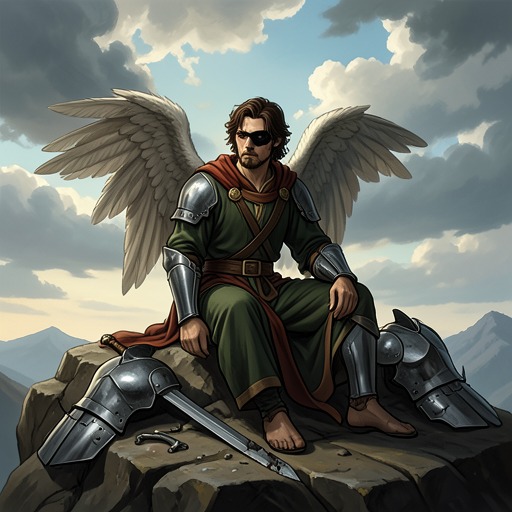
The golden line lashes outward like a whip and spins in an arc around Bael. It cuts through everything in its path: trees fall, and bloody feathers rain down. A single attack kills half the angelic force and wounds the remainder. The wounded angels struggle to stay airborne and stare at the demon in shock, while Gabriel, the archangel leading the host, is the only attacker left untouched. The battlefield thus reverses the expected power hierarchy. Heaven arrives with overwhelming numbers and the advantage of surprise, but Bael's preparation and precision reduce the assault to a confrontation between himself and Gabriel.
Bael sets down the fishing rod carefully and walks toward the surviving angels. His response to the attack is marked by sardonic restraint rather than triumphal spectacle. He tells Gabriel that a rejection letter would have been sufficient and that there had been no need for Heaven to come in person. The remark reduces a military assault to the language of bureaucratic correspondence, preserving the book's comic deflation of grand religious conflict while emphasizing how completely Bael has neutralized the attack's first wave.
Consequences and Aftermath
The immediate consequence is the destruction of most of Gabriel's force and the wounding of the rest. The campground, once a place of fishing and possible family bonding, becomes a devastated combat zone marked by toppled trees and fallen feathers. Six is removed from danger, Titan becomes the means of her evacuation, and Maharet's home is placed on alert. Bael remains behind alone, facing Gabriel after deliberately concealing the true nature of his attack until the last possible moment.
The scene also makes the end of summer literal and symbolic. Bael has wanted to be a good father, to let go of old hatred, and to believe that his family can occupy a peaceful space outside the inherited conflict. The angels' assault shatters that possibility. Their intervention demonstrates that Bael cannot simply withdraw from the war: Heaven is willing to pursue him into an ordinary human setting and to endanger the fragile peace surrounding the people he protects.
Participants and Stakes
Bael's objective is divided between safeguarding Six and answering the attack. His first action is protective, but once Six has been taken away he uses the environment and the fishing equipment to defeat the invading force. Titan's role is brief but essential: the hellhound carries Six out of the danger zone exactly as Bael commands. Maharet is not present in the exchange itself, yet Bael's instruction to secure the doors extends the battlefield's consequences to the household and confirms that the attack threatens the entire found family.
Gabriel's objective is ideological as well as strategic. He insists that he will not allow Bael to pollute Heaven and claims he would rather die than see a demon pass through the pearly gates. His words frame the conflict as a struggle over contamination, legitimacy, and access to the sacred order. Bael's survival and tactical victory do not erase that larger dispute; they bring it into sharper focus. The attack is not merely an ambush against one demon, but an attempt to prevent Bael's movement toward Heaven and to preserve the boundary that Gabriel believes must separate demons from angels.
Narrative Significance
The event turns a comic domestic episode into a threshold crossing between everyday life and open supernatural war. Elsewhere in the story, magical agency is attached to unexpected nonhuman actors: Murphy, the animated SUV, possesses local knowledge while ignoring traffic laws; a paper creature demands to be read; Six persuades a divination book to help her escape; and the Om-Nom-Nomicon seeks a new master to corrupt after falling through a weakness in reality. Gabriel's Assault on the Campground extends that pattern into combat. A fishing rod, a line, a vehicle, books, and dimensional weaknesses all participate in changing what the characters can do.
The event also reverses conventional sacred imagery. An angelic host performs the violent intrusion, while a demon acts as the protector of a child and the guardian of a threatened household. That reversal does not make Bael innocent or Heaven uniformly villainous, but it complicates the moral geography of the story. The golden line becomes an emblem of that complication: it is beautiful, precise, and deadly, carrying the visual suggestion of celestial power while serving Bael's demonic defense. The assault ends the pretense that peace can be maintained by ignoring the old war, and it leaves Bael confronting Gabriel with the family he is trying to protect temporarily beyond reach.