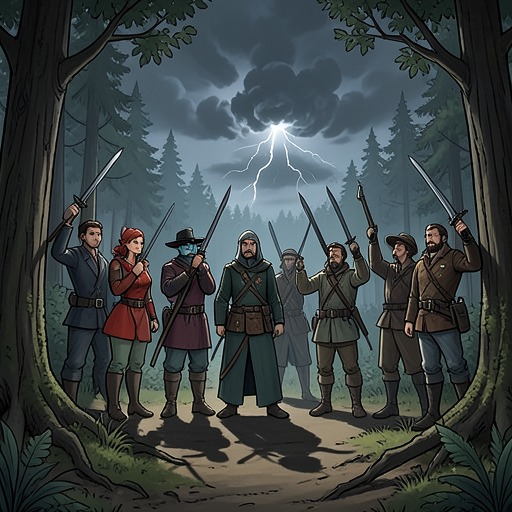
Gabriel’s Assault on Bael
Soul Guardian: A Hellishly Cozy FantasyGabriel’s Assault on Bael is the decisive campground confrontation between the baron of Hell and an angelic force sent against him. It begins while Bael is trying to give Six an ordinary fishing lesson, but the angels’ attempt to remove the surrounding humans and launch a surprise attack forces him to choose between preserving the appearance of peace and revealing the lethal power he has spent much of his life trying to outgrow. The battle ends with Gabriel dead, excluded from both Heaven and Hell, and exposed to the unraveling emptiness between dimensions.
Causes and Background
Bael and Six appear to be enjoying a quiet morning at a campground. Six fishes from a folding chair and explains that worms might bring trout, bass, or bluegills because fishing never guarantees what will be caught. She also notices that the campground is unnaturally empty: no one is walking a dog, talking, or preparing breakfast, while an abandoned mug of coffee still steams on a table. Bael recognizes that absence as a warning rather than an ordinary lull.
Bael orders Titan to take Six home and tells Maharet to lock the doors. His protective decision is practical, but it is also emotionally revealing. He has been trying to become a good father and to preserve a fragile domestic peace, yet he understands that an attack is approaching and that Six cannot remain nearby. The angels’ removal of the humans is itself evidence of their arrogance: they assume that Bael will fail to notice the disturbance, even though concealment belongs more naturally to demons than to angels.
The assault also arises from a larger conflict over Heaven’s judgment and the threatened apocalypse. The apocalypse has been scheduled for Christmas Day, after everyone has opened presents but before anyone discovers that the batteries are missing. Gabriel therefore attacks Bael in a world already placed under the shadow of Armageddon and in a dispute involving Metatron’s orders, Heaven’s authority, and Bael’s contested movement toward the heavenly realm. Gabriel later admits that he would have killed Six first, making Bael’s decision to send her away an act of both tactical caution and paternal protection.
The Campground Attack
Bael continues casting and retrieving his line while sensing the angels above him. The fishing rod becomes a concealed weapon: there is no worm on the hook, and the line has acquired a distinctive golden sheen. When the attacking angels descend with a flutter of wings, Bael steps back and jerks the rod as though setting a hook. The gesture releases a supersonic crack, and the thin golden line lashes outward like a whip.
The line sweeps around Bael in an arc, cutting through everything in its path. Trees topple, bloody feathers fall, and half of the angelic force is killed in a single attack while the rest are wounded. Only Gabriel, the archangel leading the assault, remains untouched. The contrast between the harmless-looking fishing scene and the sudden devastation gives the battle its central reversal: an activity associated with patience and leisure becomes the mechanism of an ambush, and Bael’s apparent vulnerability becomes complete tactical control.
Bael sets down the rod and walks toward the surviving angels, treating their attack with mocking understatement. Gabriel declares that he will not allow a demon to pollute Heaven and would rather die than see Bael pass through the pearly gates. Bael answers that neither of them possesses absolute freedom: if God wants him in Heaven, he will go there, and if God wants Gabriel to fall, Gabriel will fall. The exchange frames the combat as more than a contest of strength. It is also a dispute over agency, obedience, and whether divine hierarchy excuses individual choices.
Bael then pulls his hand, tightening dozens of golden threads around the remaining angels. In seconds, Gabriel is the only one left. The attack has failed not because Gabriel’s force lacks supernatural power, but because Bael has converted the battlefield into a web whose tension and direction he controls. Gabriel’s army is reduced to shredded remains while Bael remains standing, still able to turn the encounter into a personal judgment.
The Showdown with Gabriel
The confrontation continues as Gabriel lands and advances on Bael, accusing him of sending Six away because she might summon help. Bael rejects the suggestion that his daughter is helpless, calling her resilient despite being mortal. Gabriel’s flaming sword gives the encounter a recognizable symbol of heavenly authority, but Bael’s response turns that authority against its bearer.
Gabriel lunges, and Bael catches the blade between his clasped hands. The sword’s holy fires gutter out and are replaced by an unnatural cold. Bael explains through action that heat is a form of kinetic energy and uses his magic to suppress it, an ability ordinarily associated with keeping ice cream from melting but now repurposed to disable an archangel’s weapon. He takes the sword, pins Gabriel to the ground with metal tendrils, and holds the stolen holy blade at Gabriel’s throat.
The reversal exposes the limits of conventional power. Bael’s strength and endurance have declined after centuries spent behind a desk, but his magical abilities compensate for physical weakness. Gabriel expects an archangel to be unassailable by a demon, yet Bael’s preparation, golden threads, control of energy, and willingness to exploit the opening make Gabriel powerless. The scene’s value shift is absolute: Gabriel arrives as the agent of heavenly judgment and ends as a bound captive facing judgment from the demon he intended to condemn.
Bael tells Gabriel that the archangel knew Metatron’s orders were wrong and knew that beginning Armageddon was wrong, yet carried them out. In Bael’s accusation, Gabriel’s guilt is not ignorance but choice. Gabriel chose humanity’s destruction for selfish gain and must now bear the consequences. The battle therefore functions as a trial in which every physical reversal is paired with a moral one: the self-proclaimed defender of Heaven becomes the figure forced to answer for obedience without conscience.
Death, Banishment, and Aftermath
Gabriel attempts one final burst of speed rather than continuing the exchange. Bael catches the sword, takes possession of it, and then declares that he will use it in turn. He tells Gabriel that Six was sent away not only because Bael feared for her safety, but because he did not want her to see him as he truly was. He did not want his daughter to watch him kill Gabriel. The confession makes the attack’s immediate consequence personal: Bael’s victory protects Six from physical danger, but it also requires him to conceal the violence that protection demands.
Bael invokes his right as a baron of Hell to banish Gabriel from the infernal realm and all associated territories. He then drives the stolen sword through Gabriel’s heart, killing him instantly. The act is both execution and jurisdictional sentence. Gabriel is not merely defeated in combat; he is stripped of every expected destination after death.
Gabriel’s soul is dragged toward the pit but stops at its threshold. It cannot return to Heaven, yet Bael’s banishment also prevents it from entering Hell. Even purgatory is inaccessible because it lies on the outer fringes of the infernal realm. Gabriel is consequently trapped in the space between dimensions, where unprotected contact with the void begins to unravel his soul. The assault ends not with restoration of an established order, but with Gabriel excluded from every realm that might have received him.
Narrative Significance
The attack condenses the book’s recurring conflict between assigned roles and chosen responsibility. Bael was created by Lucy Morningstar to fight her war with Heaven, while Gabriel acts under Metatron’s orders; neither begins as an entirely self-authored figure. Yet Bael insists that Gabriel’s obedience does not erase his responsibility for choosing to end humanity. The golden threads around the angels thus echo the invisible constraints of divine and infernal power: everyone is bound, but Bael’s advantage lies in recognizing the bindings and manipulating them.
The scene also turns an attempted surprise attack into a failed rite of heavenly authority. Gabriel arrives expecting a demon to be judged, but the encounter reverses the direction of judgment. Bael identifies the wrongdoing behind the command, defeats the force sent to enforce it, and speaks the sentence that makes Gabriel’s exclusion effective. At the same time, Bael’s reluctance to let Six witness the killing shows that his emerging fatherhood has not made him harmless; it has made violence morally costly. The campground’s interrupted fishing lesson therefore becomes the point at which Bael’s desire for family, his demonic inheritance, and the approaching apocalypse collide.