Granny
Soul Guardian: A Hellishly Cozy FantasyGranny, whose real name is Francis, is a werewolf who runs a used bookshop and is identified by his chosen nickname rather than his formal name. His importance lies less in a long personal history than in the way he embodies the shop’s strange ecosystem: a rough, solitary bookseller presiding over neglected volumes whose loneliness has become supernatural. Six’s visit turns that contained world into an active, unstable one, making Granny an observer and reluctant manager of forces that cannot be controlled by ordinary retail logic.
Identity and Introduction
Granny first appears in the used bookshop where Six arrives after slipping away from the watchdog in search of an unsupervised adventure. The shop stands on the far side of town, and its proprietor sits behind the counter in a nightgown and blue knit cap, reading by the light of an old Franklin stove. His appearance is deliberately disconcerting: he is incredibly hairy, wears copper-framed reading glasses low on his long nose, and reacts to a fairy tale by dismissing it as total crap before throwing it into the flames.
That introduction establishes Granny as both monstrous and domestic. He is a werewolf, but he is not presented as a stalking predator; he is a bookseller in sleepwear, surrounded by old books and household heat. His first response to Six is practical suspicion. He wants to know what the child wants, and he notices immediately that she is not frightened of him. The scene therefore reverses the expected horror arrangement: the apparent monster examines the child’s fearlessness, while Six treats his nature as a manageable fact.
When asked his name, he explains that his real name is Francis but that everyone calls him Granny. The nickname gives him an eccentric social identity that sits alongside his werewolf nature and his occupation. It also fits the shop’s atmosphere, where discarded stories, strange creatures, and ordinary commercial habits coexist without settling into a single category.
Relationship with Six
Six meets Granny without the fear he expects from a human child. Her confidence is partly playful and partly protective: she warns that, if he hurt her, her foster father would turn him into a rug, possibly while he was still alive. The threat is absurdly specific, but it changes the balance between them. Granny is taken aback and responds that he would hate for such an unpleasant fate to occur before asking her name.
Their exchange creates an immediate form of mutual recognition. Six sees Granny as someone who can be addressed directly rather than avoided, while Granny recognizes that she is not an ordinary frightened visitor. His response is cautious rather than hostile, and the conversation allows the meeting to develop into curiosity instead of violence. Six’s alliterative confidence and mock curtsy further mark her as a child who uses language as a form of leverage; Granny’s willingness to answer her, including by disclosing Francis as his real name, makes him a participant in that verbal game.
Six’s presence has consequences beyond the conversation. After her visit, Granny’s world is described as being in disarray. The books become restless and begin venturing out from the back stacks on their own, arranging displays labeled staff favorites in apparent attempts to escape. The disturbance is therefore not merely a child’s temporary intrusion. Six becomes the catalyst for a shop-wide change in which the books’ suppressed wishes become visible and active.
The Bookshop and Its Unruly Books
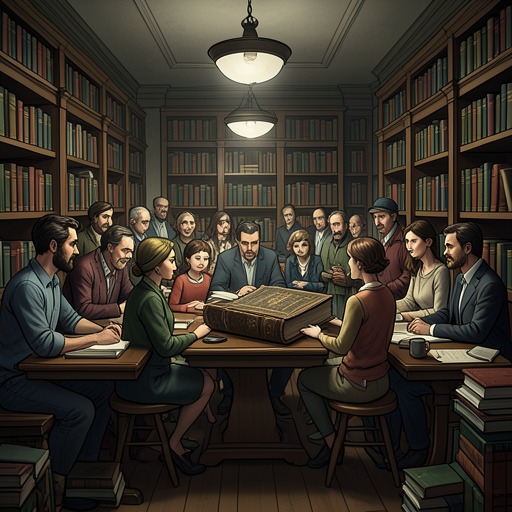
The shop’s neglected books carry an emotional history of their own. Lingering on forgotten shelves, hoping to be chosen, read, and passed on, they experience repeated disappointment that drives them collectively mad. From that madness, frustration, and loneliness comes something that should not exist: a man made entirely of paper. Six encounters this Paperman among the shelves, where layers of yellowed pages and multilingual writing form an origami-like monster that grabs her arms and demands that she read and stay.
Granny is not shown creating the Paperman or controlling the books, and the evidence instead presents him as the proprietor of a space whose objects have acquired agency beyond his authority. His later argument with a thick leather-backed thesaurus makes that loss of control comic and concrete. He insists that nobody’s favorite book is a thesaurus, especially an outdated one, while the book resists being returned to the shelf because it believes someone needs another word for “amazing.” The volume’s conviction turns a routine act of shelving into a struggle between the bookseller’s commercial judgment and the book’s desire to fulfill its own purpose.
The recurring disorder clarifies Granny’s role. He is responsible for a shop, but the shop is not passive property. Its books move, choose, resist, and seek readers. Granny’s frustration comes from trying to restore an arrangement that the books themselves no longer accept. The result is a comic version of haunting: instead of ghosts occupying a building, neglected books refuse to remain objects and force their keeper to confront the needs he has treated as inventory.
Connections to the Wider Magical World
Granny’s shop belongs to the same network of supernatural objects and beings that includes Murphy, the self-driving black SUV animated by Bael and Maharet through a simple animus spell, and the Om-Nom-Nomicon, a sentient grimoire that reaches the mortal world through a weak spot in reality. These examples place Granny’s bookseller within a broader pattern in which things acquire wills, preferences, and the power to redirect events. The shop’s books are not isolated curiosities; they participate in a world where vehicles, cookbooks, and volumes of instruction can become actors.
The later movement of the Om-Nom-Nomicon reinforces the danger implicit in Granny’s experience. The blue-and-white cookbook arrives in the mortal world because reality’s barriers are weakening, and it seeks a new master to corrupt while Six refuses to read it. In contrast, the books in Granny’s store are desperate to be read and attempt to leave through self-created displays. Together, these cases distinguish between books that want readers, books that want influence, and books whose desires become a source of danger. Granny’s shop is the most intimate setting for that conflict because he must handle the consequences at close range.
Narrative Role and Significance
Granny’s episode converts a familiar used-bookshop setting into a comic gothic threshold. The old stove, dusty shelves, hairy werewolf proprietor, paper-bodied monster, and books that resent abandonment combine domestic familiarity with supernatural unease. The space is frightening because its objects have endured neglect long enough to develop collective madness, yet it is also funny because their rebellion takes the form of staff displays and arguments over whether a thesaurus can be anyone’s favorite.
His narrative function is consequently that of a threshold guardian whose authority is real but limited. He presides over the boundary between ordinary reading material and sentient, potentially dangerous literature, but Six crosses that boundary through curiosity rather than force. Her visit exposes what the shop’s quiet order has concealed: the books are lonely, the shelves are unstable, and the proprietor’s task is no longer simply to sell volumes. Granny remains a distinctive figure because he is both the keeper of this impossible collection and one of the people most visibly displaced by its awakening.