Granny’s Books
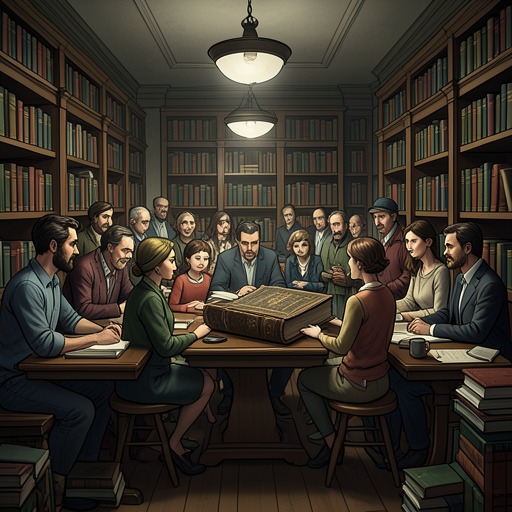
Soul Guardian: A Hellishly Cozy FantasyGranny’s Books is a used bookshop on the far side of town, operated by the werewolf known as Granny. What begins as an apparently ordinary place of secondhand reading becomes one of the book’s most unstable supernatural locations: its neglected volumes feel loneliness, its shelves can rearrange themselves, and its back stacks open into a pocket-dimensional maze. Six’s encounters there transform the shop from a dangerous refuge for abandoned literature into an improvised library, research center, and portal hub in her expanding household.
Setting and Custodian
Granny’s Books is introduced when Six slips away from an outing and follows her muddy feet into a used bookshop. Behind the counter, an incredibly hairy man in a nightgown and blue knit cap reads by the light of an old Franklin stove. He identifies himself as Francis, though everyone calls him Granny, and declines to explain the long story behind the nickname. His shop is therefore marked from the beginning by a comic contradiction: a werewolf presides over books while treating many of them as combustible rubbish.
The stove provides heat, but its fuel is the literature Granny has thrown into the flames. The books left on forgotten shelves suffer through a different kind of torment: they wait to be selected, read, valued, and passed onward, while repeated disappointment drives them toward madness. The shop’s atmosphere is consequently both domestic and hostile. A fire, a chair, and the routines of a bookseller coexist with tortured texts, warning tape, and shelves that no longer reliably obey their owner.
Granny’s apparent authority is also repeatedly undercut. He posts a handwritten sign declaring that no dogs are allowed, only for Titan to point out the hypocrisy of such a rule when the supposed dog is a hellhound capable of speech and judgment. Granny can offer Six shelter by the fire and permission to browse, but he cannot guarantee that the books, the aisles, or the rules will remain under his control.
Six’s First Visit and the Back Stacks
Six’s first visit begins as an unsupervised adventure. Granny warns her that entering the dangerous rear section could make her “history,” but she proceeds into the back stacks, where the abandoned books’ collective frustration and loneliness have produced something that should not exist. She encounters a man made entirely of paper, assembled from yellowed pages, smeared ink, and layers of writing in a dozen languages. The Paperman seizes her arms, leaving paper cuts, and demands that she stay and read.
When Six refuses, the shop itself joins the threat. The shelves shift and rearrange, blocking the route by which she entered and forcing her deeper into darkening aisles. Her chalk circle and incantation fail when the Paperman appears inside the circle with her, demonstrating that ordinary boundaries and escape techniques have little authority in the store’s altered interior. The back stacks are not merely a cluttered part of the shop; they behave as a living architecture that can close around a visitor.
Titan eventually follows Six’s scent into the shop. Granny directs him toward the non-fiction section, where Six has disappeared near shelves marked with warning tape and caution signs. Titan’s search does not solve the problem, and he later admits that wandering aimlessly is ineffective, while his muttering about pocket dimensions confirms that the back stacks have become something more than a physical maze. The location turns a child’s curiosity into a rescue situation and makes the ordinary act of browsing structurally dangerous.
Sentient Books and Six’s Escape
The shop’s books are active participants in Six’s escape. Once she realizes that the Paperman described the books as lonely and eager to be read, she addresses that desire rather than trying to overpower the entire maze. Six calls out that she wishes she had a book capable of helping her find the way out and promises that she would probably take it home. A volume then falls from a shelf by its own accord: Divination for Dummies, which offers methods for telling the future and finding missing objects.
By choosing the book and reading its title aloud, Six converts the books’ need for recognition into cooperation. Following a ball of light she summons, she finds her way out of the maze and reaches a paper woman waiting at the exit. The woman distinguishes her kind from the destroyed Paperman, describing him as mad, twisted, broken, and made from longing, sorrow, and desperation. The encounter clarifies that the shop’s animated literature is not a single species with a single intention. Some books and paper beings are dangerous because their desire has become distorted; others can communicate, negotiate, and help.
The episode gives Granny’s Books a distinctive operating principle: knowledge is not passive property within its walls. Books can fall, move, resist, organize themselves, or attempt to secure a reader. Six escapes not by restoring the shop to normal but by recognizing and manipulating the books’ desire to be chosen. The location therefore rewards a form of practical intelligence based on attention to nonhuman motives.
Research, Restlessness, and a Growing Connection
After Bael’s claims leave Six uncertain, she returns to Granny’s Books to verify the information independently. The effect of her arrival is immediate. A rabid copy of Cujo stops trying to bite Granny’s leg, while heavy grimoires leave the occult shelves and make themselves known when Six asks for reliable books on demonology, specifically material concerning Bael-Sharoth, baron of Hell and lord of torment. The shop becomes a research resource through a reciprocal recognition: Six needs books, and the books want the attention of a reader capable of choosing them.
The connection affects the shop even when Six is absent. Granny’s world falls into disarray after her visit, with books venturing out of the back stacks and creating displays labeled “staff favorites” in an effort to leave. A thesaurus refuses to return to its shelf because it believes someone will need another word for “amazing,” while White Fang bites Granny and Lord of the Flies encourages anarchy. The books’ rebellion is comic, but it also extends the earlier portrait of literary loneliness: once the volumes discover that movement can bring them closer to readers, the static arrangement of the store becomes intolerable.
When Maharet later arrives with a list requesting books, Granny warns that older used books can be unruly. His warning is supported by the shop’s recent behavior, yet he still cannot prevent the books from acting according to their own priorities. Granny’s Books is thus both a business and a contested community, with its owner attempting to preserve order while the books seek purpose, customers, and escape.
Portal, Continuity, and Significance
By the time Six returns from the back stacks, Bael and Maharet have installed a portal between Granny’s Books and Six’s bedroom library. The gateway resembles an antique mirror, uses “Library Card” as its password on the shop side and “cookies” on the bedroom side, and allows Six to step from one mirror into the other without any sensation of travel. The portal changes the location’s role from a place Six must reach physically into an extension of her domestic and intellectual life.
The connection is not perfectly controlled. A small paperback follows Six through the portal without permission, suggesting that the books can exploit the passage as readily as their human companions. Granny’s complaint that some people pay for his books contrasts with Six’s casual borrowing, but the portal has already made the shop part of her routine. She carries away a growing stack for the coming school week and even considers that she should begin paying, while postponing the problem for another day.
Later, Granny’s Books is described as the site of another brewing war. Its books have lost their respect for Granny, redecorated the shop with sale signs and promotional window stickers, and made business boom while depriving him of uninterrupted naps. Six emerges from the back stacks through the bedroom portal as if the shop were now an annex of her own library. The location’s final development is therefore not destruction but institutional transformation: the dangerous, neglected store becomes more successful and more connected precisely because its books refuse to remain inert.
Granny’s Books concentrates the book’s recurring interest in overlooked beings and objects that acquire agency when their ordinary functions fail. A used bookshop becomes a maze, a shelf becomes a barrier, a volume becomes a guide, and a portal becomes a two-way invitation. Its central tension is between ownership and participation: Granny thinks he runs a store, while the books behave as though they belong to themselves. Six learns to work within that conflict, and the shop becomes a durable meeting place where curiosity, danger, family life, and the independent will of literature continually cross paths.