Hell
Soul Guardian: A Hellishly Cozy FantasyHell is not merely a place of punishment but an organized realm with offices, ranks, paperwork, management, and inherited political divisions. Its pits of torment provide the setting for Bael-Sharoth’s professional life, yet the novel repeatedly undercuts the expected image of absolute supernatural evil by showing Hell as a workplace whose inhabitants complain, avoid effort, pursue promotions, and continue its routines long after its founding ideals have lost their force.
Definition and Infernal Structure
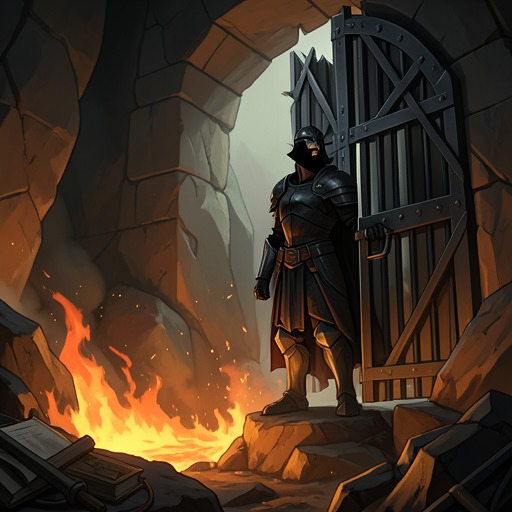
Hell is the realm where souls are received and sorted according to their sins. Supervisory demons oversee the process, answer questions, and listen to complaints, while lower demons in uniforms and clip-on name tags carry out the actual torment. The system is so bureaucratic that its paperwork requires special fire-retardant paper: a stray lick of hellfire could destroy millennia of documents. The material infrastructure makes the infernal realm resemble a dysfunctional public service more than a purely mythic abyss.
Its hierarchy is equally institutional. Bael-Sharoth is a baron of Hell and a member of its upper management, a position he reached by fighting his way upward after beginning as a young demon who pushed a pitchfork. By the time the story opens, he pushes paper instead. His authority therefore combines personal martial history with administrative status, and his career embodies Hell’s capacity to turn violence into procedure.
Bureaucracy, Labor, and Daily Life
Hell’s bureaucracy is described as vital to the realm’s infrastructure, but it is also resistant to change and remarkably inefficient. Many officials spend more time justifying their positions or fighting among themselves than performing useful work. Bael-Sharoth succeeds because he can adapt, uses guile, and has stopped investing emotionally in the institution. His lack of concern at the end of the workday becomes an unexpected professional advantage: he can navigate a broken system without needing to believe in its moral purpose.
The damned themselves participate in this machinery. Complaints accumulated in such numbers that reading them nearly brought the system to a halt, until Bael-Sharoth devised a solution: he outsourced the work to the very souls who had submitted the complaints. The idea earned him a commendation and a black star in his file, neither of which had meaningful power, though both looked useful on a résumé. Hell thus converts even protest into labor and absorbs resistance into its administrative structure.
The lower ranks are no more committed than the managers above them. Demons assigned to torment generally do only enough work to avoid being placed on notice for poor performance, since many are there mainly for the paycheck. The continuity of Hell does not depend on any individual’s dedication. If Bael-Sharoth disappeared, someone else would take his place and the wheels of the realm would continue turning. This institutional replaceability deepens his sense that he does not truly matter within the system.
Bael-Sharoth’s Relation to Hell
Bael-Sharoth’s disillusionment gives Hell its clearest human scale. In his youth, he believed that separating from Heaven served a righteous cause. Later, he rationalized torment as a necessary service for the damned. Eventually he concluded that the work did not matter, or that he himself did not matter. Souls would continue arriving, sorting would continue, and complaints would continue regardless of his presence.
His apartment reflects this emotional exhaustion. It is luxurious by infernal standards but still offers few comforts: a narrow bed with threadbare, secondhand sheets and a scratched, battered headboard. The space is not a dungeon in the conventional sense; it is a worn residence inside an established society. A memory of a younger succubus who once left a mark on more than his furniture briefly interrupts his weariness. He has not spoken to her for centuries and knows that she settled in the seventh circle with a sloth demon and had children, but he still hopes she is happy. Even in Hell, personal attachment survives the institution’s vast indifference.
Hell also contains Bael-Sharoth’s oldest social wound. Before the assault on the gates of Heaven, he spent time with a thousand fellow warriors, drinking stolen Elysian ale and boasting about who would cross the threshold first. They were all identical, formed from the same mold rather than born. The memory explains both his comradeship and its limitation: Hell produced soldiers as interchangeable units, while Bael-Sharoth later discovers that the relationships he chooses can matter more than the collective identity into which he was made.
Conflict with Heaven and the Wider Plot
Hell’s separation from Heaven is not ancient background alone; it remains a live political division. Bael-Sharoth dislikes angels because of the old war and because he sees them as smug creatures who assume moral superiority. He is especially wary of archangels, whom he remembers as terrifying opponents even though ordinary rank-and-file angels could be killed more easily. His distrust makes cooperation with Heaven distasteful, but practical pressures repeatedly force him across the boundary.
When Bael-Sharoth and Maharet Flameheart need help securing a family for Six, he reluctantly considers contacting an angel. The appointment takes place at the Arms of the Angels Adoption Agency, whose conspicuously direct name becomes a joke about angelic lack of subtlety. The scene turns a cosmic division into an administrative encounter: infernal and heavenly representatives confront one another over adoption paperwork, children, and protection rather than armies alone.
Hell’s political silence also becomes suspicious when the apocalypse is being planned. Maharet Flameheart observes that Hell is conducting business as usual, even though the realm would presumably mobilize if it knew Armageddon was approaching. She considers contacting her connections in Heaven to determine whether Gabriel and the other angels are preparing for battle. The possibility that neither side openly understands the coming catastrophe makes Hell’s normal operations ominous: routine may indicate stability, ignorance, or concealment.
The novel’s religious reversals further complicate Hell’s opposition to Heaven. In a church, Bael-Sharoth takes pleasure in the blood, labor, and wealth invested in an ornate building dedicated to a deity he believes does not want such excess. Yet his brother Ganon-Sharoth, possessing the failing body of a holy man, fears that Heaven may reject him because of rules and tradition despite having forsaken Hell. The brothers’ conversation reveals that the boundary between the realms is not simply a division between good and evil. It is also a system of belonging, exclusion, and institutional judgment.
Power, Family, and the Meaning of Home
Hell’s authority follows Bael-Sharoth beyond its borders, especially through Bael’s Black Book. The book contains the worst tortures known to angels or demons and is bound with human skin. It was reportedly used only once, and the victim became permanently insane upon seeing its first page. Even angels know that it is banned, and Bael-Sharoth invokes it to warn that anyone who harms Six or prevents her from finding a good family will face consequences worse than boiling alive.
That threat shows how infernal power has changed meaning for him. The Black Book once represented the machinery of Hell’s torment; in Bael-Sharoth’s hands, it becomes an instrument of guardianship. His capacity for violence remains real, but its purpose has shifted from institutional duty to personal protection. When he later confronts heavenly forces, he declares that he was made for war, fought upward from the front lines and pits, and bears scars from that journey. Nevertheless, the decisive question is no longer which realm has the stronger faith or military claim. He asks whether heavenly faith is stronger than his desire to return to his family, and he is prepared to break Michael as he broke Gabriel if that is what reunion requires.
This confrontation clarifies Hell’s final narrative significance. The infernal realm made Bael-Sharoth, trained him in war, and gave him a career in torment and administration, but it does not finally define what he is willing to defend. Its great institutions continue operating according to inherited rules, while Bael-Sharoth crosses their boundaries for Six and the family he has chosen. Hell remains a realm of punishment and hierarchy, yet the story’s most important rebellion against it is intimate: the refusal to let origin, office, or old allegiance outweigh responsibility to loved ones.