Infernal Infantry
Soul Guardian: A Hellishly Cozy FantasyInfernal Infantry was a front-line military formation of Hell and the wartime identity that most clearly explains Bael-Sharoth’s physical scars, pride, comradeship, and enduring grief. It was not merely a bureaucratic posting: its soldiers fought with polearms against waves of Angels, served as shock troops, and took part in the assault on Heaven’s gates. The unit’s history therefore links military ambition to catastrophic loss, while its survivors’ memories continue to shape Bael-Sharoth’s relationships long after the war has ended.
Nature and Composition
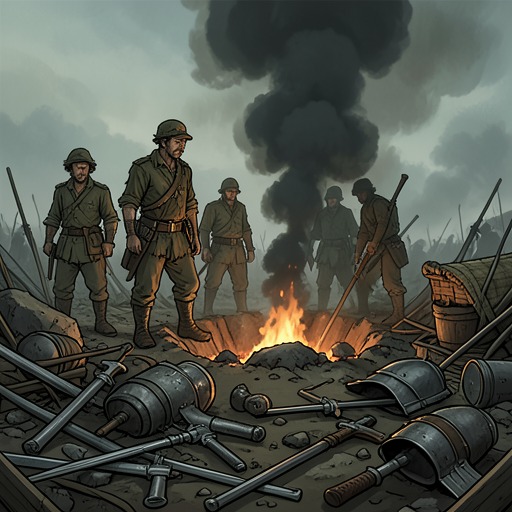
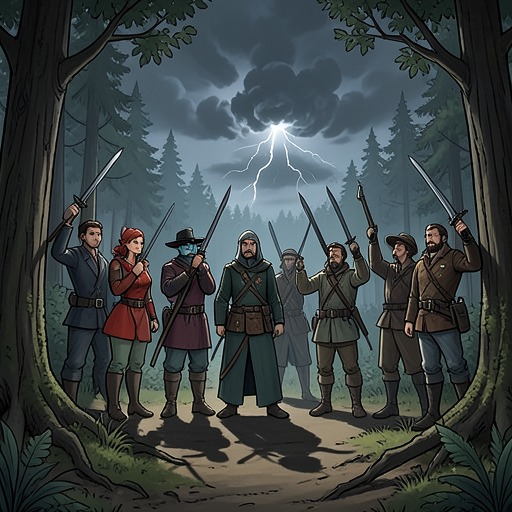
Infernal Infantry consisted of demons built for combat rather than born into ordinary lives. Bael-Sharoth recalls serving alongside a thousand “brothers,” all identical and “formed from the same mold.” Their collective origin was deliberate: Lucifer took a portion of her essence, divided it among them, and used that essence to give them life and create an army. The unit was consequently both a military organization and a manufactured brotherhood, with shared substance substituting for the ordinary structures of family and birth.
The soldiers were designated shock troops. Their purpose was to absorb the first impact of battle, break through resistance, and open a path for larger forces. That role demanded mass formation, aggression, and willingness to face overwhelming opposition. The unit’s identity was therefore inseparable from sacrifice: its members were created to be spent at the most dangerous point of the attack.
Role in the War for Heaven
Bael-Sharoth describes Infernal Infantry as the force that “almost brought down the gates” of Heaven. In the assault, the soldiers fought on the front lines with polearms against waves of Angels, relying on small-unit tactics amid the chaos of the conflict. Their attack was not a symbolic deployment at the edge of the war; it placed them directly against Heaven’s defenses and made them the first bodies through which Hell’s military ambition had to pass.
The unit’s comrades prepared for the assault with stolen Elysian ale, sharing flasks and boasting that each would be the first to cross the threshold. The moment combines bravado with foreknowledge of danger. Their confidence was genuine enough to sustain the charge, yet the memory is tragic because the gathering became one of Bael-Sharoth’s last moments with real friends before the battle destroyed their shared future.
Infernal Infantry nearly succeeded in its initial objective. The assault was part of a broader attempt to overwhelm Heaven, and its soldiers were expected to cut down defenders at the gates so that the rest of Lucifer’s forces could follow. The campaign nevertheless failed to produce the victory they imagined. The survivors were left in Hell to carve out lives after the war, carrying the knowledge that their courage had not altered the final result.
Combat Legacy and Physical Cost
Bael-Sharoth’s later body preserves the organization’s history. Although he eventually became associated with office work and bureaucratic responsibilities, he still carries numerous injuries from his military past. He specifically identifies his knees as damaged and his left shoulder as severely impaired, explaining why he almost never lifts anything heavy with that arm. The contrast between a “paper pusher” and a former infantryman exposes how incomplete his later appearance is as a description of his life.
The unit’s campaigns also explain the scars and injuries remembered by those who knew its veterans. Bael-Sharoth speaks of the formation with pride, but that pride is never detached from bodily damage. Military service survives in posture, limitation, and remembered tactics as much as in titles. The Infernal Infantry thus remains present even when its members have left the battlefield: the organization has become part of their physical identities.
Brotherhood, Loss, and Memory
For Bael-Sharoth, the most lasting consequence of Infernal Infantry is not military honor but the disappearance of his comrades. He admits that he has coworkers, fellow warriors, and former lovers, yet very few genuine friends. The friends he remembers belonged to the period immediately before the charge against Heaven, when a thousand identical soldiers drank together and imagined crossing the gates first. His statement that he misses them, while insisting that he has “gotten over it,” reveals a restrained form of mourning rather than a clean recovery.
That history also changes how Six understands him. She has usually encountered Bael-Sharoth through the circumstances of her own life, but his account reveals an existence thousands of years older than hers, stretching from the war before recorded history to the modern world of cars, fast food, and ordinary conversation. When she coaxes him into describing front-line service, she listens to small-unit tactics and stories about what his fellow demons did when unsupervised. The Infernal Infantry becomes the missing part of his biography: the forgotten military past behind the demon sitting beside her and eating chicken tenders.
Narrative Significance
Infernal Infantry gives the war in Heaven a material and personal scale. The conflict is not represented only through cosmic powers and strategic outcomes; it is also experienced by identical soldiers who share stolen ale, charge with polearms, suffer crippling wounds, and lose nearly everyone they call a friend. Their manufactured origin makes the tragedy sharper, because beings created as instruments of war must later construct private lives from the ruins of the purpose for which they were made.
The organization also establishes a central contrast in Bael-Sharoth’s characterization. His current life can make him appear administrative, domestic, or emotionally isolated, but Infernal Infantry reveals the warrior beneath those surfaces. Its failed assault explains both his pride in what the unit nearly achieved and his refusal to dwell openly on the friends it cost him. In that sense, the unit’s defeat continues beyond the battlefield: its survivors win no historical victory, only the difficult freedom to become something other than the weapons they were designed to be.