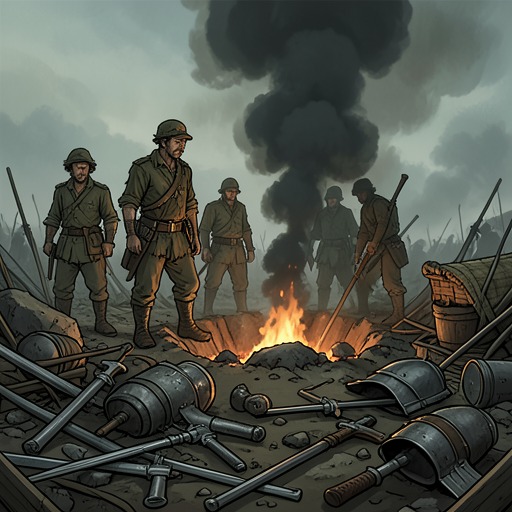
Lucifer’s Rebellion and the War in Heaven
Soul Guardian: A Hellishly Cozy FantasyLucifer’s Rebellion and the War in Heaven is remembered not as a clean contest between good and evil but as a war whose participants dispute its necessity, conduct, and legacy. It involved Lucifer’s rebellion against Heaven, the deployment of demonic and angelic forces, and a defeat that drove the surviving rebels into Hell. The conflict remains active in the present through scars, bitterness, and the distrust between former combatants.
Causes and Competing Claims
Lucifer’s rebellion created the crisis, but the supplied accounts place responsibility for the war’s scale and bloodshed on more than one side. Zephyr argues that the conflict would have been far shorter if Heaven’s loyalists had withdrawn into the inner sanctum and left God to decide what should happen. In his view, God was absolute and omnipotent, so the defense of Heaven did not require armies; Gabriel’s decision to send legions into battle instead reflected Gabriel’s ego and desire to meet the fallen in open combat.
This argument turns the war into a dispute over the meaning of obedience. Heaven’s forces treated resistance as a duty, while Zephyr sees the battle as an avoidable expenditure of lives carried out under the cover of divine authority. His anger is intensified by his history as a soldier who acted on Gabriel’s orders and now doubts whether the violence he committed served any purpose. The rebellion therefore survives as a moral wound rather than a settled historical judgment.
Forces and Battle for Heaven
Bael-Sharoth served in the Infernal Infantry, a demonic unit that nearly brought down Heaven’s gates. Maharet Flameheart fought on the opposite side of the celestial battlefield as part of the First Airborne, a formation composed of Hell’s most powerful and fearless demons. The unit teleported deep into Heaven, overwhelmed its defenses, and destroyed everything in its path. For a time, its advance made victory seem possible.
Maharet Flameheart’s account gives the battle a bodily dimension. She served as air support until a seraph approached from behind and clipped her wings. Her fall was so violent that she did not awaken until the war was almost over, leaving a line of raised scars across her back. Bael-Sharoth, who had not known that she had served, recognizes that his own military past connects him to hers: he fought at the gates while she carried the war into Heaven itself.
The offensive ultimately failed after Gabriel and Azrael entered the fighting. Their intervention broke the First Airborne’s momentum, and the war was lost. The surviving demons were left to carve out lives in Hell, carrying the knowledge that their sacrifices had not changed the outcome. The narrative presents their defeat alongside the bitter belief that, had God played fairly, the airborne assault might have turned the war.
Soldiers, Scars, and the Cost of Victory
The war’s consequences are measured through individual bodies as much as through cosmic geography. Maharet Flameheart’s damaged wings make her service visible long after the fighting has ended. Bael-Sharoth responds to the scars with tenderness, kissing them as part of a brief period of happiness, but the gesture also underscores how intimacy is built around injuries produced by an old political and religious conflict.
Zephyr offers a different record of survival. When Gabriel dismisses his account of peace, Zephyr recalls that peace is purchased by the blood and sacrifice of the previous day, and that the friends lost in war must not have died for nothing. He is not speaking abstractly: he is reckoning with the bad acts he performed on Gabriel’s orders. Gabriel appears to listen but stops paying attention when Zephyr says “peace,” reproducing the same failure of authority and recognition that Zephyr believes characterized the war itself.
A veteran angel’s scar provides a parallel testimony. He displays a massive mark stretching diagonally across his chest, a remnant of the Elysian Fields where he lost a third of his blood and several friends. When another angel asks whether he received a medal, the veteran answers that he did not. The exchange strips away the rhetoric of honored service: neither victory nor loyalty guarantees recognition, compensation, or even a meaningful account of what was lost.
Aftermath and Continuing Tensions
The defeated rebels’ settlement in Hell did not resolve the conflict’s political or emotional consequences. The survivors remain shaped by a war whose official categories—loyalist, fallen, victorious, defeated—do not settle questions of justice. Bael-Sharoth’s service in the Infernal Infantry, Maharet Flameheart’s place in the First Airborne, and Zephyr’s resentment toward Gabriel all show how military allegiance persists as personal history.
The war’s legacy also complicates the book’s religious institutions. The existence of Heaven does not make its rules appear fair to every supernatural being, and the authority of its leaders is repeatedly viewed through the costs imposed on ordinary soldiers. Even later discussions of redemption and divine belonging inherit this tension: the celestial order claims moral legitimacy, yet its combatants remember preventable deaths, unacknowledged sacrifices, and decisions made in the name of a power that did not need defending.
Narrative Significance
Lucifer’s Rebellion and the War in Heaven functions as the book’s buried origin story for mistrust between Heaven, Hell, demons, angels, and former allies. It supplies the characters’ military histories while refusing to reduce them to those histories. Bael-Sharoth can remember his pride as an Infernal Infantry soldier and still seek ordinary happiness; Maharet Flameheart can carry the scars of a failed assault and build intimacy beyond the battlefield; Zephyr can demand that peace mean something to those who fought for it.
The conflict also reverses conventional victory narratives. Heaven wins, but the victory leaves Gabriel associated with arrogance, the soldiers with mutilation and bereavement, and the survivors with unresolved moral debt. Hell loses, yet its defeated combatants retain the ability to interpret, condemn, and remember what happened. In this sense, the war ends militarily but not narratively: its battles are over, while its arguments continue to govern the relationships and choices of the living.