Mike
Soul Guardian: A Hellishly Cozy FantasyMike is the cult leader who brings Six into the summoning ritual as disposable currency and discovers that his bargain has summoned not obedience but catastrophe. His defining significance lies in the collision between grand occult ambition and humiliating incompetence: he plans to sacrifice a vulnerable child for wealth, yet cannot even maintain the magical conditions he relies upon. The failed ritual leaves him alive only to experience the infernal consequences of the scheme he organized.
Identity and Role
Mike leads the cult that summons Bael-Sharoth and presents himself as the person capable of negotiating with a demon. When Bael demands an explanation, Mike’s group offers a child in exchange for wealth. The offer exposes the cult’s governing logic: Six is treated not as a person but as an object of exchange, selected for sacrifice because Mike has taken her in under false pretenses. His authority is therefore founded on coercion, concealment, and the promise that ritual procedure will protect him from the power he has invoked.
That authority is immediately undercut by the group’s poor preparation. The containment circle is made with sugar instead of blessed salt, its runes are barely legible, its shape is closer to an oval than a proper circle, and the chanting is ineffective. Mike nevertheless insists that Bael cannot leave or harm the cult so long as the circle remains intact. The rule would have given him leverage if the ritual had been competently performed; because the material boundary is defective, his confidence becomes the mechanism of his downfall.
The Failed Summoning
The crucial reversal occurs when Bael notices ants following a trail toward the circle and realizes that the supposed sacred boundary is sugar. He quietly tests it, steps outside without suffering the expected magical backlash, and returns before the cultists notice. When Mike accepts Bael’s revised bargain, he does so while still believing that the circle constrains the demon. Bael then steps out openly and asks which of the “geniuses” used sugar instead of blessed salt. A subordinate sheepishly identifies himself as Paul, and Mike responds with shocked disbelief, reducing the cult’s supposedly solemn rite to a furious complaint that Paul had only one job.
Mike’s leadership collapses into panic and exposed negligence. Bael’s question about who will go first makes the danger immediate, and within minutes the chamber is empty except for Six sleeping on an altar, eleven golden statues, and a thousand ants. The statues are the material result of the cult’s bargain, but they also function as a grotesque record of its failure: the group sought wealth and received transformation into treasure, while the intended sacrifice was left behind.
Six and the Ethics of Sacrifice
Mike’s history with Six reveals that the ritual was not an accidental misunderstanding but the endpoint of deliberate exploitation. Six was originally Marleene Quinzel, the sole survivor of a family station-wagon crash at Devil’s Slide. After months recovering in a hospital and two years in foster care, she moved from family to family until Mike took her in. He did not do so out of compassion. From the beginning, he intended to sacrifice her to whatever demon the cult could summon, and he replaced her given name with “Six” because he considered Marleene unsuitable for a victim.
This renaming is part of the violence. Mike strips away the child’s history before placing her on the altar, turning trauma into ritual utility and identity into a label. The fact that the cult had previously failed to summon even an imp makes his plan still more reckless. Their success in bringing Bael into the room is described as luck only in the narrowest sense; because the result is the cult’s destruction, misfortune is the more accurate description. Mike’s objective is wealth, but the ritual instead frees Six from the immediate system that possessed her.
Consequences in Hell
Mike eventually receives the kind of afterlife his conduct has earned. In Hell he works behind a deli counter in an apron that smells like rotten fish, anxiously watching the time because his break is two minutes away and a missed break will lead to a supervisor’s reprimand. A customer repeatedly asks whether the egg salad is organic, and Mike has to tell her for the tenth time that nothing available is organic. The scene reverses his former position: the cult leader who once commanded a sacrificial ceremony is reduced to a resentful employee subject to petty workplace rules.
The punishment is comic in its details but precise in its moral structure. Mike sought power through an institution built on ritual obedience, yet Hell gives him bureaucracy, supervision, and repetitive service. His misery is explicitly part of the point. The consequences do not erase his earlier actions; they translate them into an existence where grand claims of authority have no practical force.
Narrative Function and Significance
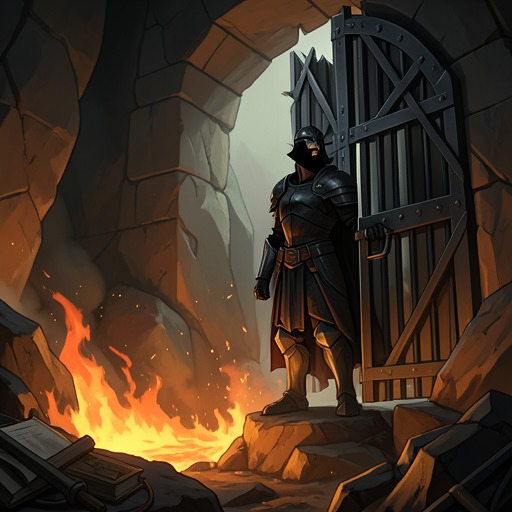
Mike acts as an inverted threshold guardian in the opening movement. He is the human gatekeeper who brings Six to the boundary between ordinary life and the supernatural, but his incompetence breaks that boundary and allows Bael to become an unexpected alternative to sacrifice. The summoning therefore begins as Mike’s attempt to control the occult and ends as the event that removes Six from his control.
His later encounter with Bael also confirms the chain of causation. Bael tells Ganon-Sharoth that he has taken in a human child named Six who was being raised by a cult, then identifies the cult’s mansion as nearby and asks whether Ganon supplied the book designed to summon him. Ganon admits that he did. Mike’s scheme thus belongs to a wider web of demonic manipulation, but he remains responsible for turning that opportunity into an attempted child sacrifice. His defining irony is that he invokes supernatural power to make himself rich, only to become both the author of Six’s danger and the first casualty of his own badly executed ritual.