Titan's Oath of Protection
Soul Guardian: A Hellishly Cozy FantasyTitan's Oath of Protection is the binding vow that places Six under the permanent guardianship of Titan, son of Cerberus. Its decisive significance lies in the fact that protection is not presented as a flexible assignment or a favor that Bael can withdraw. Once Titan has sworn, the oath governs Titan himself: his honor, his life, and his continued presence are all committed to Six's survival.
Origin and Terms
The oath becomes explicit after Six returns from a maze and angrily reproaches Maharet Flameheart and Bael for leaving her in danger. She asks what would have prevented her from starving to death there, and Maharet answers that Titan would never have allowed it. As a pup of Cerberus, Titan would rather die than let harm come to Six. The statement reveals that his guardianship is not merely practical obedience. It is an identity-defining obligation in which Six's safety takes precedence over Titan's own life.
Maharet then explains the oath's consequence directly. Titan swore on his honor to protect Six, so his life hangs in the balance whenever she is endangered. There is nothing he would not do to keep her safe, and Maharet urges Six not to put herself at risk for Titan's sake. The oath therefore creates a reciprocal danger: Six is the person being protected, but her recklessness can force Titan toward self-destruction. Protection is inseparable from sacrifice.
The Oath Tested
Six reacts with horror rather than gratitude when she understands that Titan might die for her. She embraces his neck, buries her face in his fur, and cries that nobody should ever die for her. Her response gives the oath an ethical tension that simple heroic loyalty would otherwise conceal. Titan regards death in her defense as an honorable duty, while Six sees such a sacrifice as morally wrong. The vow is thus experienced differently by guardian and protected child: for Titan, it is dignity and purpose; for Six, it is an unbearable burden.
Titan reassures Six that protecting her is his honor and adds that Maharet Flameheart and Bael share the same honor, although they express it differently. His defense also turns toward Maharet, whose harsh lesson has made Six cry. The oath consequently functions not only as a promise of physical safety but as a standard against which the adults' conduct is judged. Titan's devotion is direct and unmistakable, whereas the others' protection may appear through discipline, manipulation, or calculated tests.
Irrevocable Authority
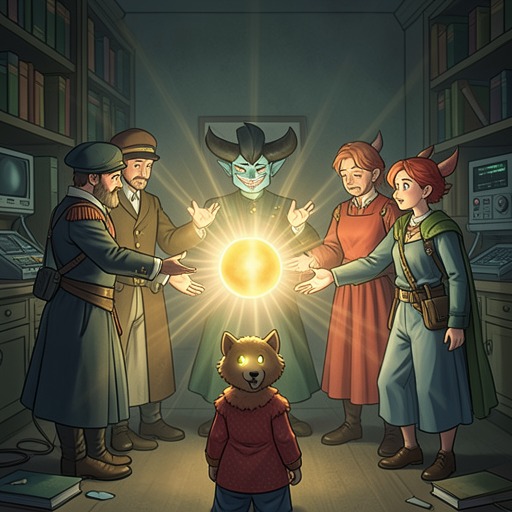
Bael attempts to end the danger by releasing Titan from the oath. He tells Titan that Six has learned her lesson and declares that Titan may leave. Titan rejects the attempted release immediately, insisting that Bael's word cannot break his. The exchange establishes the oath's independent authority: even the person who arranged or supervises the guardianship cannot cancel a vow that Titan has personally made.
Titan's refusal is accompanied by a supernatural display. He roars, sparks shoot between his teeth, and the spots on his body swirl into cursed runes. He declares that he will stay and protect Six for as long as he sees fit, even if doing so requires his own death or Bael's. The oath has become more than a verbal commitment; its force manifests physically and magically when challenged.
Maharet Flameheart warns Titan to remember that he is speaking to a baron, but Titan answers by naming himself Titan, son of Cerberus and second guardian of the Gates of Hell. He refuses to recognize rank as sufficient authority to undo his word. No baron, angel, or even Satan can break it once given. So long as Titan draws breath, Six remains under his protection. The terms are absolute in scope, personal in source, and limited only by Titan's life.
Confirmation and Significance
Bael ultimately approves Titan's defiance and confirms that Titan will remain to guard their daughter. The apparent confrontation was a test: Bael had tried to release Titan, Titan had refused, and the refusal proved that the guardianship was genuine rather than externally imposed. Titan realizes that he has been tricked, while Maharet Flameheart treats the result as something he will eventually learn to accept. The test converts an assumed role into a confirmed bond.
The oath gives the relationship between Six and Titan a clear structure. Six is not simply accompanied by a powerful creature; she is the protected child of a guardian whose honor has been placed ahead of personal survival. Titan's power is therefore defined by restraint and obligation as much as by force. His promise cannot be casually superseded by status, command, or convenience, and its fulfillment depends on his willingness to remain even when protection becomes fatal.
At the same time, the oath complicates the conventional rescue pattern. A guardian's sacrifice would ordinarily be celebrated as proof of love, but Six rejects that logic because she does not want her safety purchased with another's death. The scene makes her maturation begin with recognition of consequence: leaving Titan behind is not only dangerous for her but potentially lethal for him. Titan's vow protects Six from the world while forcing her to understand how her choices affect the person who has pledged himself to her.
In narrative terms, Titan's Oath of Protection establishes a durable rule for future conflict. Six's danger automatically carries stakes for Titan, and attempts to separate them become tests of honor rather than ordinary logistical problems. The oath also distinguishes chosen loyalty from hierarchical obedience. Bael can command, Maharet Flameheart can warn, and supernatural authorities may possess immense power, but Titan's sworn word remains binding because he treats protection as an ethical identity. The final decision that he will stay with Six turns that principle into the foundation of their continuing guardian-child relationship.