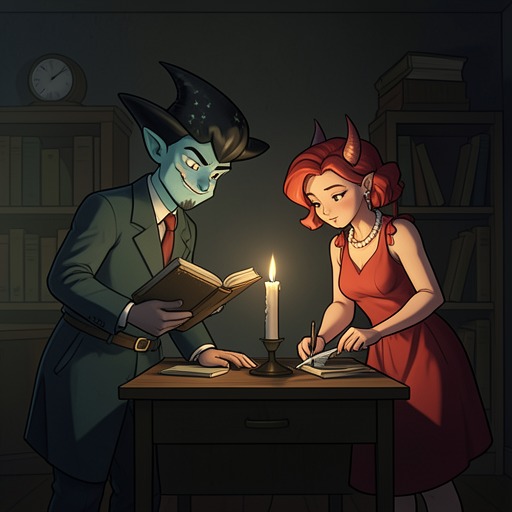
Traveler's Bond
Soul Guardian: A Hellishly Cozy FantasyTraveler’s Bond is the interdimensional connection that forms when Bael-Sharoth and Maharet Flameheart travel through a portal together. In their case, it converts an already volatile partnership into a bodily and emotional entanglement: the longer their journey, the deeper the bond, until each begins to carry traces of the other. What begins as an unpleasant consequence of interdimensional travel becomes a force that alters their identities, their judgment, and the boundary between conflict and desire.
Definition and Conditions
Traveler’s Bond is a known effect of portal travel among demons. Maharet explains that because she and Bael-Sharoth passed through the portal together, “bits of me bonded with bits of you and vice versa.” The result is not a metaphorical alliance but an actual connection between their beings. Bael-Sharoth remembers having heard of the phenomenon and identifies it by name, recognizing that it affects demons who travel through portals together.
The bond is cumulative rather than instantaneous. The longer the journey, the deeper the connection becomes. Its progression moves from shared emotional perception toward the eventual sharing of thoughts, making it especially threatening to Bael-Sharoth, whose life as a schemer depends upon controlling what others know. The bond therefore attacks not merely his comfort but the privacy and strategic independence on which his identity rests.
Formation Through Interdimensional Travel
The bond is created during a journey whose physical consequences are already extreme. When Six rearranges the runes around the summoning circle, Bael-Sharoth and Maharet are hurled from dimension to dimension like ping-pong balls. Bael-Sharoth recognizes a few of the places they pass through, but most are so alien that even he cannot locate them within the cosmic framework. The trip may last hours or minutes from his perspective, and they finally crash back onto Earth in a nauseated heap.
The journey produces more than disorientation. Bael-Sharoth feels as though his bones have been replaced with taffy and his brain is trying to climb out through his eye sockets, while Maharet is even worse off. On another summoning, Maharet becomes seasick and vomits over Bael-Sharoth’s leg, prompting his complaint about removing vomit from fur and his insistence that such sickness is undignified for a major demon. These comic humiliations establish the bond’s material context: cosmic travel strips both demons of dignity before it begins stripping away their separation.
Emotional Contagion and Loss of Boundaries
The first unmistakable sign of the bond is Bael-Sharoth’s sudden experience of Maharet’s emotions. While recalling a ruined mansion from a fading dream, he is filled with overpowering anger and insists that they must leave before Six can become trapped there. Then a cold wash of concern overtakes him. The abrupt change alarms him because the concern does not arise from his own intentions; he realizes that he is feeling Maharet’s emotions and demands to know what she has done to him.
This emotional transfer makes the bond an involuntary channel rather than a chosen act of empathy. Bael-Sharoth does not decide to understand Maharet, and Maharet does not offer him access to her feelings. Their states simply cross the boundary between them. The process resembles contagion more than conversation: affect moves through the joined bodies before either demon can interpret or control it. Anger, concern, desire, and fear become shared pressures, destabilizing the distinction between one demon’s reaction and the other’s.
The bond’s projected development makes the loss of privacy even more severe. As it grows, the demons will begin to feel each other’s emotions and eventually hear each other’s thoughts. For Bael-Sharoth, this possibility is horrifying. As a lifetime schemer, he regards access to the innermost recesses of his mind as an intolerable vulnerability, particularly because the person attached to him is a fire demon who despises him. The bond thus turns intimacy into a threat: knowledge that might ordinarily create trust instead becomes forced exposure between enemies.
From Hostility to Desire
The bond also produces a physical and erotic convergence. When Maharet tackles Bael-Sharoth onto the bed and pins him down, their antagonistic banter gives way to an awareness that the connection has changed what each wants. They began as separate beings, but the bond has made them “two halves of the same demon,” and both halves want to be united. Maharet locks the bedroom door, while the space between them fills with tension and crackling potential.
Bael-Sharoth recognizes the danger of acting on that desire. He approaches Maharet, takes her in his arms, and warns that if they proceed there is no knowing what will happen. The warning captures the bond’s central ambiguity. It is not simply romantic confirmation, because the desire may be generated or intensified by an interdimensional force neither of them controls. Yet it is not merely coercion from outside either: the bond makes their attraction legible through their own bodies and responses. Their closeness is therefore both chosen in the immediate moment and conditioned by a transformation imposed upon them.
Wider Network of Animated Connections
The bond belongs to a broader pattern in which travel, magic, and nonhuman entities reorganize relationships. Interdimensional movement changes Bael-Sharoth and Maharet directly, while an animus spell gives the black SUV a name and autonomous agency. They call the vehicle Murphy, invoking Murphy’s law, and the car develops a knowledge of local streets, confusion about traffic laws, hostility toward electric vehicles, and a damaged but persistent magical spark. These parallel examples show that connection in this world is not limited to human social bonds: portals can bind demons, and magic can animate machines.
The same weakening of reality’s barriers permits the Om-Nom-Nomicon to fall through a weak spot into the mortal world, where it seeks Six as a new master to corrupt. The sentient book’s movement through reality and its active desire to be read reinforce the idea that objects and passages between worlds possess their own agency. Traveler’s Bond is distinctive because its result is relational rather than merely animating, but it participates in the same unstable cosmology, where boundaries between dimensions, bodies, minds, and objects are permeable.
Consequences and Narrative Significance
For Bael-Sharoth and Maharet, Traveler’s Bond changes the value of separation. Before the journey, their antagonism allows each to preserve a distinct position: Maharet can despise Bael-Sharoth, and Bael-Sharoth can scheme without surrendering his interior life. After the journey, hostility itself becomes difficult to keep pure because Maharet’s feelings enter Bael-Sharoth’s awareness and their bodies respond as though they were parts of a single being.
The bond also creates a recurring source of danger and irony. The journey that causes it is treated with comic physicality—unfamiliar dimensions, nausea, vomit, and a humiliating crash landing—but its lasting effect is existential. A prank-like summoning accident can produce a connection deep enough to threaten thought itself. The contrast between slapstick travel and irreversible intimacy makes the bond emblematic of the book’s wider treatment of cosmic forces: the universe can impose profound consequences through absurd, undignified circumstances.
Ultimately, Traveler’s Bond is both a mechanism of plot and a test of identity. It forces Bael-Sharoth to confront an intimacy he cannot manipulate and Maharet to share a connection with an enemy she openly despises. It does not resolve their conflict by erasing difference; instead, it makes difference physically difficult to maintain. Their eventual closeness emerges from a condition that is dangerous, involuntary, and potentially invasive, leaving the bond suspended between curse, transformation, and the possibility of union.