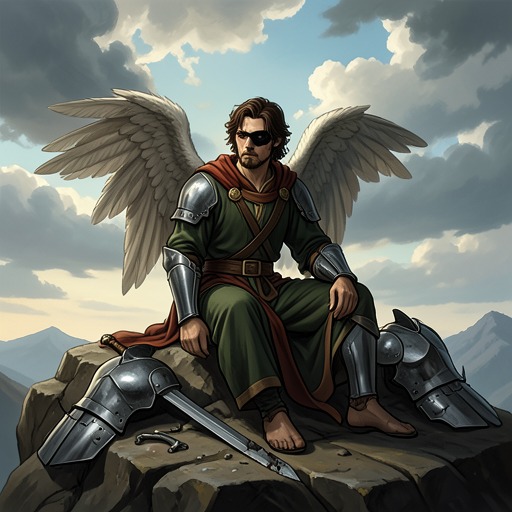
Bael's Defeat and Exile of Gabriel
Soul Guardian: A Hellishly Cozy FantasyBael's Defeat and Exile of Gabriel is both a military victory and a metaphysical judgment. In the showdown, Bael defeats Gabriel not through physical strength but through magic, exposes the archangel's diminished faith, kills him with his own holy weapon, and exercises infernal authority to banish his soul from Hell and its associated territories. Gabriel is thereby denied Heaven, Hell, and even purgatory, transformed from a feared celestial warrior into a soul stranded in the void between dimensions.
Causes and Background
The confrontation grows out of Gabriel's responsibility for the attempt to start the apocalypse and destroy humanity. The apocalypse had been scheduled for Christmas Day, with its timing deliberately arranged so people could open their presents before the end of the world but before discovering that the batteries were missing. That absurdly domestic scheduling detail sits beside the genuinely catastrophic objective: the plot was intended to bring about Armageddon and force a war that nobody else wanted.
Gabriel's history also places him within a broader celestial conflict rather than presenting him as an isolated renegade. Bael explains that Lucy Morningstar's revolution was a civil war in which angels fought on both sides, and that Zephyr was already close to Hell by association. Gabriel nevertheless insists that he is not one of the fallen. Bael rejects that distinction, arguing that Gabriel's attempt to destroy humanity and ignite an unwanted war has already placed him beyond any credible return to Heaven. The event therefore concerns not only combat but the collapse of Gabriel's claim to celestial legitimacy.
Bael approaches the encounter with a complicated awareness of responsibility. He had allowed Lucy Morningstar to remain free because he believed he was being prudent and wanted to keep his options open; he later recognized that the Devil's arrival in the mortal realm was part of the prophecy and that Lucy Morningstar would eventually betray the others. His judgment of Gabriel is consequently sharpened by self-reproach. He sees in Gabriel's pride a version of the same dangerous temptation to believe that a desired ending can justify leaving a threat unattended.
The Confrontation
Gabriel arrives with a flaming sword and immediately declares that sending the witch away was correct because he would have killed her first. Bael answers that his daughter, Six, is remarkably resilient for a mortal. When Gabriel asks whether Bael sent her away merely to prevent her from summoning help, the archangel frames the encounter as a delay before judgment. Bael instead turns the exchange into an interrogation, asking why Gabriel chose to fall when he had everything.
Gabriel denies being fallen, but Bael treats the denial as another form of self-deception. The archangel's stated reasons are exposed as selfish: he chose to end humanity in order to start a war. While Gabriel grows increasingly furious and his sword swings become wilder, Bael remains just outside the weapon's reach and continues speaking. The verbal contest matters because Bael makes Gabriel's pride part of the battle itself; the archangel is not merely being overpowered but is being maneuvered into the very mistake that will cost him the fight.
Gabriel finally abandons the exchange and lunges forward, attempting to run Bael through. Bael catches the blade between both hands in a mockery of prayer. The holy fires along the sword gutter out and are replaced by an otherworldly cold, forcing Gabriel to release it before the chill freezes his fingers. Bael's control over heat as another form of kinetic energy, an ability he normally uses to keep ice cream from melting, becomes a weapon capable of neutralizing celestial fire.
After taking the sword, Bael flips it into the air and catches it by the hilt. His physical weakness is explicitly linked to centuries spent behind a desk, but his magical abilities compensate for the lost strength and endurance. Golden tendrils bind Gabriel and pin him to the ground within seconds, while the stolen blade rests at the archangel's throat. The scene reverses the expected hierarchy: an archangel who should be beyond the reach of a demon is rendered helpless by the baron he intended to judge.
Faith, Power, and Judgment
Bael makes the reversal intelligible by identifying the principle behind it. Angels are only as powerful as their faith, and Gabriel's faith is lacking; Bael's own power is not subject to the same limitation. The contest thus treats celestial authority as conditional rather than automatic. Gabriel possesses the appearance, weapon, and history of sacred power, but his actions have hollowed out the belief that sustains it. Bael, though openly demonic, retains the stronger operative power in the moment because his authority does not depend on Gabriel's claim to righteousness.
Gabriel recognizes that Bael's question about why he fell was a trap. He can already feel his body becoming heavier, which signals his fall from grace, yet he still imagines an eternity in which revenge might be possible. His threat to see Bael and Six in Hell reveals that even at the edge of defeat he remains oriented toward retaliation rather than repentance or responsibility. Bael answers that there will be no tomorrow for Gabriel. The judgment is not postponed for another battle; it is made final in the present.
Bael's decision to send Six away adds a personal limit to the violence. He did not remove her only because he feared for her safety. He also did not want her to see him as he truly was, killing Gabriel. His resentment and pity toward the archangel coexist with the execution, making the act more than a triumphant display of cruelty. Bael claims the right to judge as a baron of Hell, but his tiredness and his concern about Six show that exercising that right costs him something emotionally.
Death and Exile
Bael invokes his status as a baron of Hell to banish Gabriel from the infernal realm and all associated territories. He then plunges Gabriel's stolen holy sword through the archangel's heart, killing him instantly. The weapon's significance is doubled: it first marks Gabriel's failed celestial power, then becomes the instrument through which Bael carries out an infernal sentence.
Death does not deliver Gabriel to a recognized destination. His soul is dragged toward the pit where it belongs, but it stops at the threshold. Gabriel cannot return to Heaven, yet Bael's banishment also prevents him from entering Hell. Purgatory is unavailable as well because it lies on the outer fringes of the infernal realm. Gabriel is therefore trapped in the space between dimensions, excluded from every available afterlife rather than assigned to one.
The exile is not stable. Unprotected contact with the void causes Gabriel's soul to begin unraveling, and he realizes that this is not merely imprisonment but an existential dissolution. His final condition converts Bael's battlefield victory into a complete metaphysical defeat: Gabriel loses his body, his weapon, his celestial belonging, his infernal destination, and finally the integrity of his soul.
Narrative Significance
The event reverses the familiar religious arrangement in which Heaven possesses unquestioned moral and military supremacy. The book repeatedly treats sacred institutions with irony: Bael delights in opulent churches whose blood, sweat, and tears are wasted on a deity he believes wants none of the excess, while an atheist looking at such a church cannot understand how anyone could believe in it. Against that background, Gabriel's defeat makes faith a measurable source of power rather than a guarantee attached to holy appearance.
The confrontation also turns the book's end-times material into a judgment on motives. The planned apocalypse is not presented as an inevitable sacred destiny but as a result of actors choosing destruction for personal or political gain. Gabriel's fall becomes the consequence of trying to force history toward an outcome that serves him, while Bael's victory depends on refusing to let Gabriel's title conceal what his actions have made him. The result is an inversion of the expected apocalypse narrative: the celestial warrior becomes the condemned transgressor, and the demon becomes the agent who enforces the final sentence.