Bael-Sharoth and Gabriel
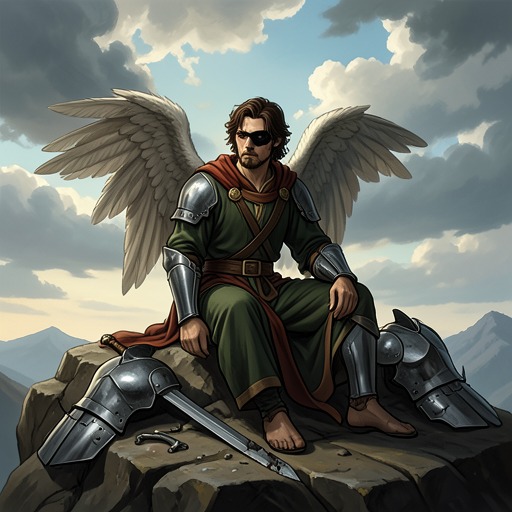
Soul Guardian: A Hellishly Cozy FantasyBael-Sharoth and Gabriel embody the central military and ideological opposition between Hell and Heaven. Gabriel treats Bael-Sharoth as a demonic contaminant and a strategic threat, while Bael-Sharoth sees Gabriel as an enemy whose certainty about divine order conceals the same lack of freedom that governs everyone else. Their relationship therefore develops beyond a simple battle between good and evil: it is a contest over who has the authority to define purity, allegiance, and destiny, culminating in Gabriel’s death and metaphysical exclusion.
Suspicion and Opposing Institutions
Gabriel’s hostility is rooted in his position as commander of Heaven’s armies and in his determination to prevent Bael-Sharoth from entering Heaven. When Metatron disappears and Heaven’s intelligence network reports no clear information about Hell’s preparations for war, Gabriel suspects Bael-Sharoth of abducting or killing the missing angel. The possibility that Bael-Sharoth has discovered the surveillance gives Gabriel a motive for retaliation, turning uncertainty into a military calculation: Heaven may need to strike first if it believes Hell has already taken one of its own.
Gabriel’s institutional anxiety is intensified by pressure from Heaven’s bureaucracy. His forces are only at half strength, and he needs a decisive victory before Heaven transfers him to clerical work such as putting faces on potato chips or arranging minor miracles. Zephyr is considered compromised, further reducing Gabriel’s available forces. Waiting for reinforcements might produce a stronger attack, but it also risks Heaven approving Bael-Sharoth’s job application before Gabriel can act. The conflict is thus driven by both strategic fear and Gabriel’s dread of losing his military authority.
Their opposition also appears in smaller encounters that reveal the hierarchy Gabriel expects to impose. When he catches Zephyr playing an acoustic guitar, Gabriel takes the instrument, inspects its worn fretboard and fraying sling, and rebukes Zephyr for failing to maintain his equipment. He invokes the principle that an unclean sword signals corruption, even though Zephyr points out that the object is a guitar rather than a sword. This moment does not involve Bael-Sharoth directly, but it clarifies Gabriel’s mindset: discipline, martial symbolism, and moral judgment are inseparable for him, preparing the ground for his later insistence that a demon cannot be admitted into Heaven.
The Angelic Assault
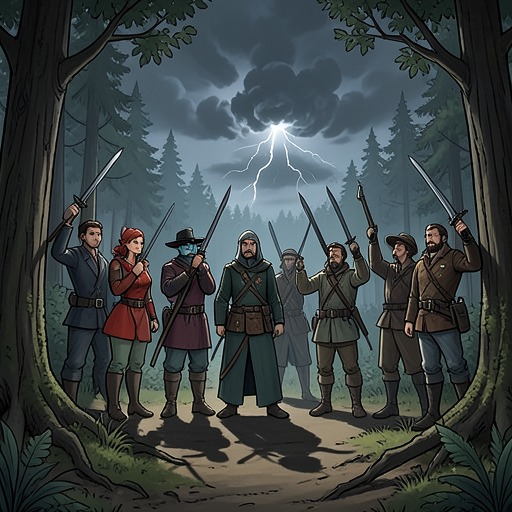
Gabriel eventually moves against Bael-Sharoth with an airborne force. The attack is not a fair confrontation but an attempted surprise assault: angels rapture away the humans around Bael-Sharoth and descend from above, assuming that concealment and overwhelming numbers will prevent him from responding. Bael-Sharoth notices the pressure in the air and recognizes the arrogance of the maneuver. The angels have mistaken the absence of visible resistance for ignorance, underestimating both his awareness and his willingness to turn an ordinary activity into a weapon.
Bael-Sharoth is fishing when the attack begins, but the line on his hook no longer carries a worm. It has acquired a distinctive golden sheen. As the angels flutter into motion, he steps back and yanks the rod as though setting a hook. The result is a supersonic crack: the golden line lashes outward like a whip, sweeps around him, cuts through the surrounding space, topples trees, and sends bloody feathers through the air. In a single attack, Bael-Sharoth kills half of Gabriel’s forces and wounds the rest. The battlefield shifts instantly from an angelic ambush to a demonstration of infernal superiority, with Gabriel the only attacker left untouched.
Bael-Sharoth then sets down the fishing rod and approaches the surviving archangel. His taunt treats the assault as an unnecessarily elaborate response to a rejected application, reducing Gabriel’s grand military operation to a bureaucratic refusal that could have been delivered by letter. Gabriel answers that he will not allow Bael-Sharoth to pollute Heaven and would rather die than watch a demon pass through its gates. His language makes the stakes explicit: for Gabriel, Bael-Sharoth’s possible admission is not merely a personnel decision but a violation of Heaven’s identity.
Freedom, Fall, and the Moral Argument
The confrontation becomes philosophical when Bael-Sharoth rejects Gabriel’s belief that either of them possesses meaningful control. Bael-Sharoth argues that if God wants him in Heaven, he will be there, and if God wants Gabriel to fall, Gabriel will fall. He frames both characters as puppets while claiming that some beings can at least see the strings. This argument directly attacks Gabriel’s confidence in his own moral agency and transforms their combat into an argument about predestination, obedience, and responsibility.
Bael-Sharoth’s practical answer to Gabriel’s resistance is equally decisive. With a pulling motion, he tightens dozens of golden threads around the remaining angels. The lines ensnare them one after another until Gabriel stands alone. The image converts the earlier statement about puppets into a physical reality: the angels are literally controlled and immobilized by the threads, while Gabriel is forced to confront the fact that his army’s authority has collapsed in front of him.
Bael-Sharoth then presses Gabriel on the contradiction between his actions and his self-description. He asks why Gabriel, who had everything, chose to fall, and Gabriel rejects the label, insisting that he is not one of the fallen. Bael-Sharoth answers that Gabriel’s attempt to kick-start the apocalypse and destroy humanity has already placed him outside the welcome of Heaven. In Bael-Sharoth’s judgment, Gabriel’s campaign was an act of destructive ambition: he tried to begin a war that no one else wanted, yet continues to speak as though his institutional affiliation guarantees his righteousness.
Execution and Exile
The personal dimension of the conflict is revealed when Bael-Sharoth explains why he sent Six away. He says that he did not send her away solely from fear for her safety; he also wanted to prevent her from seeing him as he truly was, including the act of killing Gabriel. This admission places the execution within Bael-Sharoth’s relationship with Six. Gabriel is not only an enemy to be defeated but also a death Bael-Sharoth expects his daughter to judge, making the final act a burden he deliberately keeps from her.
Gabriel struggles against the metal tendrils while still thinking about revenge and how to overcome Bael-Sharoth later. Bael-Sharoth denies him that future. Exercising what he identifies as his right as a baron of Hell, he banishes Gabriel from the infernal realm and all associated territories, then drives a sword through his heart. Gabriel dies instantly. The killing is therefore both a battlefield victory and a formal legal act: Bael-Sharoth does not merely defeat Gabriel but declares him outside the jurisdiction and refuge of Hell before carrying out the execution.
Death does not restore Gabriel to Heaven. His soul is dragged toward the pit, but it stops at the threshold because he cannot return to Heaven and has been barred from Hell. Even purgatory is unavailable because it lies on the outer fringes of the infernal realm. Gabriel is trapped between dimensions, and unprotected contact with the void begins to unravel his soul. The outcome gives Bael-Sharoth’s victory an especially severe consequence: Gabriel is not granted the consolations of either side of the cosmic order he defended.
Narrative Significance
The relationship’s decisive pattern is reversal. Gabriel begins as the commander with an army, surveillance network, institutional legitimacy, and confidence in Heaven’s boundaries. Bael-Sharoth appears to be the isolated demon under observation, yet he detects the assault, turns a fishing rod and golden line into instruments of mass destruction, binds the surviving angels, exposes Gabriel’s compromised status, and determines the terms of his final punishment. Military hierarchy is repeatedly undone by superior perception and control.
Their conflict also exposes the instability of the categories Gabriel invokes. Gabriel calls Bael-Sharoth a pollutant because he is a demon, but Bael-Sharoth argues that Gabriel’s attempted apocalypse has already made him fallen in substance, whatever title he retains. The distinction between angel and demon consequently becomes less secure than Gabriel believes. The final image of Gabriel suspended between Heaven, Hell, purgatory, and the void completes that destabilization: the supposed guardian of a sacred boundary becomes the figure who belongs nowhere, while the demon he rejects possesses the power to decide his fate.