Earth
Soul Guardian: A Hellishly Cozy FantasyEarth is the living world into which supernatural powers are repeatedly drawn, and its decisive significance lies in its instability as a boundary. It appears at once as a cold physical realm reached through dimensional gateways, a place governed by institutions such as the Arms of the Angels Adoption Agency, and a reality whose seams can be damaged by interdimensional travel. The plot treats Earth not as a passive backdrop but as the meeting ground where infernal customs, angelic authority, human vulnerability, and cosmic maintenance become entangled.
Definition and Setting
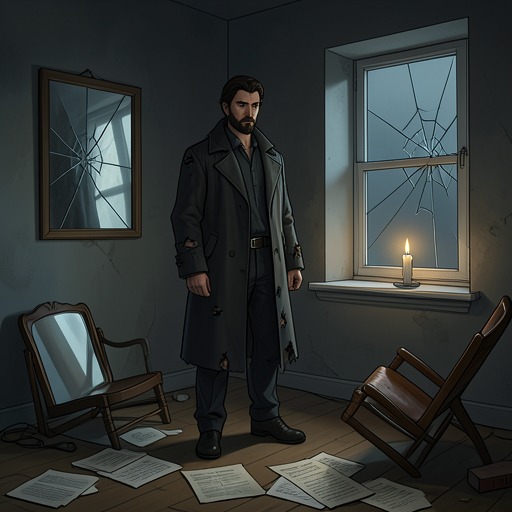
Earth is identified with the World of the Living, contrasted with Hell and the other dimensions connected by portals. Bael-Sharoth experiences that contrast immediately when a cult’s summoning tears him away from the warmth of Hell and thrusts him into a frigid terrestrial setting. He arrives wearing or retrieving a thick winter parka, an oddly domestic detail that emphasizes the physical difference between his interrupted infernal routine and Earth’s cold environment.
The mortal realm is also a place where supernatural ceremony is given material form. Bael-Sharoth first encounters Six on an altar surrounded by flickering candles, while a later summoning places him in a familiar stone room flanked by eleven golden statues. The room’s carefully drawn circle is not merely decorative: its replicated runes and protective geometry imprison him, and stepping beyond it subjects him to an arcane blast powerful enough to leave his hair smoking and his body convulsing. Earth therefore contains spaces capable of restraining beings from Hell, but those protections are constructed rather than inherent; the realm’s safety depends on knowledge, ritual, and precise physical arrangements.
Cross-Dimensional Access
Earth functions as an interface between worlds. When Bael-Sharoth and Maharet Flameheart are summoned together, the rules of interdimensional travel require both objects to return together. Bael-Sharoth exploits that condition to prevent Maharet Flameheart from leaving Six behind, turning the portal’s technical limitation into a means of forcing their shared responsibility for the child. The result makes Earth the setting where a supernatural law becomes a practical instrument of family formation.
The same passage between worlds produces the Traveler’s Bond. Because Bael-Sharoth and Maharet Flameheart crossed a portal together, parts of each became bonded to the other; their emotions begin to pass between them, and the longer the journey, the deeper the connection. The bond is described as a transformation with a human analogue: couples who travel together may become unusually close without recognizing that travel itself has helped cause the attachment. Earth thus mediates not only movement but altered relationships, making physical passage a source of emotional consequence.
Institutions and Conflicts
Earth is also where supernatural authority adopts bureaucratic and social forms. Bael-Sharoth and Maharet Flameheart visit the Arms of the Angels Adoption Agency while seeking a new family for Six. Its conspicuously direct name reflects the angels’ lack of subtlety and their preference for imposing their way rather than negotiating delicately. The agency places the adoption plot inside a terrestrial framework, but the surrounding power struggle remains anything but ordinary: angels may be manageable at ordinary rank, while archangels are described as terrifying battlefield opponents.
The adoption conflict leaves visible consequences on Earth’s inhabitants and visitors. After Six and Maharet Flameheart leave with their family photograph, Zephyr remains behind with Bael-Sharoth to settle the final details. Zephyr is blistered, flinching, and wary that Maharet Flameheart may return to attack him, evidence that the terrestrial negotiation has already become a physical confrontation. Earth’s institutions do not neutralize infernal or celestial violence; they provide a social stage on which that violence can be redirected, disguised, or temporarily contained.
Pocket Dimensions and Damaged Boundaries
Earth’s connected spaces include pocket dimensions that defeat ordinary assumptions about geography. When Six and Titan become trapped inside one, Titan explains that there are no walls to break through and that the only exit is the point of entry. The pocket dimension is therefore not simply a hidden room within Earth. It is a closed spatial system whose rules replace terrestrial architecture, leaving escape dependent on understanding the mode of arrival rather than overpowering a physical barrier.
The boundary between Earth and other dimensions can also be physically damaged. After Bael-Sharoth tears a hole in reality, Six drifts through the dark space between dimensions and encounters Lou, a massive repair creature with octopus-like tentacles and bat wings. Lou treats the rupture as faulty infrastructure: the seam must be redone and reinforced or it will fail again after several millennia. This image recasts cosmic catastrophe as maintenance work and reveals that reality has an engineered, vulnerable structure rather than an untouchable permanence.
Cosmic Order and Narrative Significance
Earth’s ultimate protection depends on domain and jurisdiction. When Lucy Morningstar attempts to unleash Hell’s power against Bael-Sharoth, her intended halo of hellfire sputters out. Bael-Sharoth invokes the principle that every master is supreme in his own domain and calls on Lou, an old ally, after which the repair creature appears above Lucy Morningstar. The scene establishes that Earth’s reality is not governed solely by the strongest combatant; authority depends on which power controls the relevant domain and on the alliances supporting that control.
Taken together, these episodes make Earth a layered threshold rather than a stable neutral world. Its altars and stone chambers can summon and imprison demons, its agencies can convert supernatural conflict into questions of adoption, its portals can create lasting bonds, and its pocket dimensions can trap travelers outside ordinary geography. Yet the same realm can be punctured, requiring a cosmic repairer to restore its seams. Earth’s narrative role is consequently double: it is the place where Six can be brought into a chosen family, and the fragile structure whose permeability continually threatens that family and every other being living within it.