Fallen angel
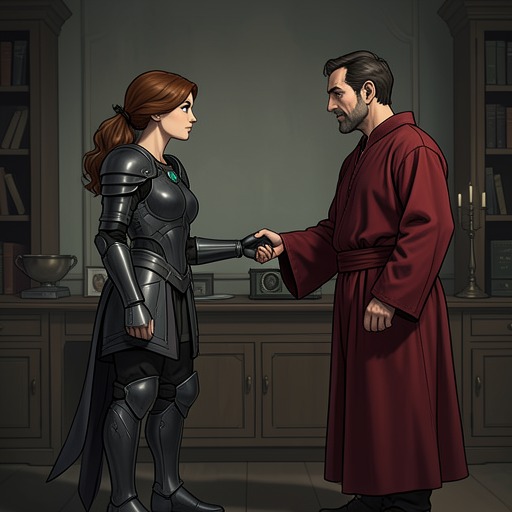
Soul Guardian: A Hellishly Cozy FantasyFallen angel is a state of celestial exile whose consequences are physical, political, and spiritual. The condition is associated with lost or damaged signs of angelic belonging, exclusion from Heaven, and an unstable position within Hell. Maharet Flameheart’s history makes the state especially concrete: she once possessed wings and a halo, lost them while fighting in Lucy Morningstar’s rebellion, and was subsequently placed in an inferior bureaucratic role among the very creations whose authority replaced her former standing.
Definition and Physical Signs
The condition is recognized through bodily evidence as much as through official history. Maharet Flameheart tells Bael-Sharoth that she is not a fire demon but an angel, a truth she has concealed because she fears his rejection. Later, she identifies herself more specifically as a fallen angel. Her clipped wings are part of the explanation: she had told Bael-Sharoth that they were lost during the battle for Heaven. Bael-Sharoth also infers her angelic heritage from the contrast between her body and that of a fire demon. She lacks the hooves he associates with demons, and she possesses physical wings, which fire demons generally do not. These details turn the body into a contested record of origin, even when the character attempts to live under another classification.
The physical signs also carry a social danger. Maharet Flameheart worries that, if her wings grow back, they might return white rather than black like Lucy Morningstar’s. White wings would reveal her as fallen, and fallen angels have no easy existence in Hell. Her anxiety is therefore not merely about appearance or personal shame. A restored body could expose her to the same institutional hostility that followed her original fall, making concealment a practical form of protection.
Origins in Rebellion and Exile
Maharet Flameheart’s fallen status originates in her participation in Lucy Morningstar’s rebellion. Lucy promised her the world if she joined the revolt, but the defeat produced a radically different result. Maharet Flameheart lost both her wings and her halo in the fighting, while the promised reward became a humiliating desk job in which Lucy’s creations exercised authority over her. The fall thus combines military defeat with a broken political promise: Maharet Flameheart paid the bodily and professional cost, while Lucy Morningstar retained a privileged relationship with God.
When Maharet Flameheart confronts Lucy Morningstar, her anger is directed at this unequal distribution of consequences. Lucy had the plan, but Maharet Flameheart was the one who lost her wings and halo and was forced into diminished service. The grievance is sharpened by the belief that Lucy Morningstar is protected by divine favoritism: even after rebellion, she remains loved by God, whereas those who fought for her endure the practical punishment. The fallen angel state therefore exposes a hierarchy within rebellion itself. Defiance does not affect all rebels equally; the leader can remain exceptional while the followers become permanently marked.
Exclusion from Heaven and Hell
The state becomes most severe when it is treated as a problem of jurisdiction. Ganon-Sharoth, possessing the body of a holy man, declares that he has forsaken Hell. He regards eternal residence there as damnation for crimes the demons did not commit, yet his rejection of Hell does not guarantee acceptance by Heaven. His existence occupies an uncertain space between inherited infernal identity and desired celestial belonging.
Ganon-Sharoth explains the danger directly: he knows that Heaven exists, but fears that he may not be allowed to enter it when the human body he possesses dies. The obstacle is not simply his own conduct. He believes that rules and tradition may exclude him even though he has abandoned Hell, leaving him judged by an order whose standards he cannot satisfy. His case makes fallen or displaced angelic identity resemble a legal exception: the subject remains governed by supernatural authority while being denied the full protection or recognition of any side.
This logic reaches its starkest form in Gabriel’s fate. After Bael-Sharoth kills and banishes Gabriel, Gabriel’s soul cannot return to Heaven, but it is also forbidden from entering Hell. Purgatory is unavailable because it lies on the outer fringes of the infernal realm. The fallen angel is thus trapped between dimensions, and the absence of a recognized destination becomes an immediate physical threat: unprotected contact with the void begins to unravel Gabriel’s soul. Banishment is not merely removal from a community. It is an active sentence imposed at the boundaries of existence.
Relationships and Political Consequences
The fallen angel condition shapes Maharet Flameheart’s relationship with Bael-Sharoth because disclosure risks changing the terms of their intimacy. She considers telling him the truth before their shared future is built on a lie, but she anticipates rejection. When she finally says that she is a fallen angel, Bael-Sharoth reveals that he had already suspected it. He points to her missing demonic features, her physical wings, and her account of the battle for Heaven. His response transforms the revelation from a potential rupture into an acknowledgment that her identity was visible even when unspoken.
Her history also complicates her relationship with Lucy Morningstar. Maharet Flameheart does not regard Lucy as a simple comrade or former leader. Lucy is the person who recruited her, promised her a future, and left her to bear the consequences of defeat. The old rebellion remains present in the language of wings, halos, office rank, and power. Maharet Flameheart’s anger shows that falling is not only a theological event completed in the past; it continues through institutional humiliation and through the memory of who benefited from the rebellion.
The condition also informs the larger conflict between Heaven and Hell. Fallen angels are evidence that the boundary between the realms is neither morally transparent nor administratively humane. A demon may reject Hell, an angel may be physically marked by exile, and a defeated celestial being may be denied every available afterlife. The supernatural orders preserve their classifications even when individuals no longer fit them, turning identity into an instrument of discipline.
Thematic Significance
Fallen angel functions as a model of exclusion through which the narrative questions whether moral identity can be reduced to origin, allegiance, or official destination. Maharet Flameheart’s conduct after the rebellion cannot erase the fact that Heaven and Hell continue to read her through the history of her fall. Ganon-Sharoth’s refusal of Hell shows the opposite pressure: personal repudiation does not necessarily change the institution’s judgment. In both cases, the individual’s chosen position is weaker than the categories imposed by the cosmic order.
The state also gives bodily transformation a political meaning. Wings and halos are not decorative symbols; their loss records military defeat, while their possible return threatens renewed exposure. The body carries the evidence of a prior war into ordinary relationships and employment. Even concealment cannot fully undo the past, because physical difference allows Bael-Sharoth to reconstruct Maharet Flameheart’s history from clues.
Finally, the condition connects rebellion with unequal sacrifice. Maharet Flameheart’s fallen status is the price of joining Lucy Morningstar, but Lucy Morningstar’s continued divine favor prevents the fall from functioning as an evenly shared punishment. Gabriel’s final banishment extends that asymmetry into a cosmic ordeal, where exclusion from both Heaven and Hell leaves a soul to unravel in the void. Fallen angel is therefore less a single fall than an enduring condition of being claimed by a system that refuses to offer a secure place within it.